There is a peculiar sort of success in the buildings business: a day when nobody has anything to say. The lights work. The floor is clean. The meeting starts on time. People reserve their admiration for the architecture and their complaints for everything that makes the architecture usable. Scott Salmirs has built his career in that second category, where a well-executed job can disappear into the background.
His move to ABM in 2003 required some explaining. He had held facilities leadership roles at Goldman Sachs, Lehman Brothers and CBRE. These were organizations with recognizable names and extensive real estate to manage. Then he went to a company whose janitorial work offered fewer opportunities for cocktail-party glamour. The change looked stranger to other people than it did to him.
“Everyone thought I was crazy to move to a janitorial services company,” he recalled. He saw room to solve problems. The distinction matters because his career is often described as a departure from investment banking, including in his own shorthand. His actual responsibilities at the banks involved facilities. He was moving across the table in a business he already understood.
A bank’s address can confer prestige. Its air conditioning still requires attention. Salmirs had experience with the practical side of expensive real estate, and ABM offered a chance to apply it across customers. In this telling, the career change becomes less mysterious. He followed the work that interested him, even when the name on the business card became harder to explain.
Twelve years before the corner office
Salmirs graduated from SUNY Oneonta in 1984 with a business-economics degree, then earned an MBA in finance at SUNY Binghamton. His education sits comfortably beside both halves of his working life: understanding the numbers and understanding the places where people produce them. Before ABM, he had already learned that a property portfolio comes with a long list of daily obligations.
At Lehman Brothers, he was a senior vice president responsible for the North American Facilities Group. At ABM, his remit grew through the Northeast operation and into aviation and international activities. By the time the board selected him to succeed Henrik Slipsager, effective March 31, 2015, he had spent roughly twelve years inside the company. The appointment made him its seventh chief executive.
That sequence gave him something a newly arrived turnaround specialist would have had to acquire: familiarity. He knew the organization before he became responsible for changing it. His predecessor had overseen substantial expansion, so Salmirs inherited a business with scale and an established customer base. His task was to decide how that scale could translate into the next period of growth.
A phone call on day one
One account of his arrival in the top job begins with a telephone. Josh Feinberg, then at Boston Consulting Group, was sitting in a mutual friend’s office, helping that friend develop a strategy. Salmirs called on his first day as CEO. The friend passed Feinberg the phone with a compact introduction: “Scott needs a strategy.”
Feinberg later joined ABM in 2019. The episode is amusing partly because it strips the succession ceremony down to the immediate problem. There is the new title; there is the company; now someone has to decide what to do. A friend with a consultant in the room is a useful first-day coincidence.
The relationship also gives a more concrete picture of how Salmirs assembles help. Feinberg described an introduction that became years of working with the team before he moved inside the business. The eventual hire followed sustained contact. For a CEO whose public language returns repeatedly to relationships, the route from an unexpected call to a senior appointment is a revealing example.
The client who stays
During Salmirs’s Northeast tenure, revenue tripled and client retention reached 96 percent. They describe different parts of the same managerial challenge. Winning work makes a company larger. Persuading existing customers to keep buying it makes that growth less dependent on a constant supply of replacements.
The regional retention figure offers a clue to the kind of business he believes ABM is running. Facilities contracts put the company’s promises to a recurring test. A customer can compare what was offered with what happens in the building. Growth has to survive that comparison across different properties, different teams and different working days. The relationship depends on the service continuing to justify it.
“We’re in a relationship business,” he has said. In his description, the same principle applies to suppliers and technology partners. The people providing goods and systems deserve the consideration the company expects from its own customers. This is fairly ordinary advice, which is part of its appeal. It becomes demanding when it must survive purchasing negotiations, operational pressure and the temptation to treat size as permission to stop listening.
“We’re a low-margin business, so collecting cash is paramount.”
Scott Salmirs
Back on campus, with résumés
The less ceremonial details of Salmirs’s visits to Oneonta are especially telling. In April 2017, he returned for a talk about his route to the chief executive’s job. Before the presentation, he held a résumé workshop. A student could leave with an idea about leadership and, more usefully that afternoon, a better document to send to an employer.
He urged students to develop their own core values, arguing that careers could change direction while those values provided continuity. That advice fits the move he made in 2003. It also gives young people a test they can apply before they have an impressive title: whether the work allows them to take pride in what they do.
His involvement extended to opportunities inside ABM. With support from Salmirs and fellow alumnus Larry Pestana, four students secured summer internships at ABM in 2017. He has served on the business school’s advisory council, maintaining a connection to the institution well beyond the moment when it awarded his degree.
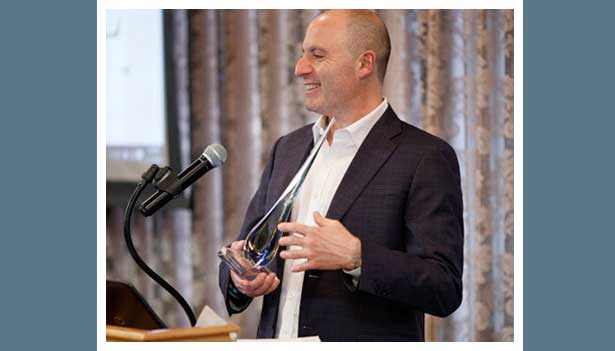
In 2019, Beta Gamma Sigma recognized him with its Business Achievement Award after a nomination from Oneonta’s chapter. He returned to campus to accept it and speak with students about workplace skills and social contribution. The award supplies the photograph; the workshop and internships supply the more interesting evidence. There are several ways to show gratitude to a university. Making yourself useful is a good one.
The ambition inside the organization chart
Salmirs has described a specific ambition for ABM’s management ranks: that their diversity should reflect the people doing the work in the field. He has framed that as something he wants to define his legacy. It is a more demanding aspiration than pointing to the composition of the workforce as a whole. It asks who gets promoted and who gets authority.
His view of employee giving follows a related logic. Discussing ABM Cares, he emphasized matching contributions to causes chosen by employees. The choice belonged to them. Giving people a say over where support goes is a modest but tangible way to make a large organization feel less remote.
His outside commitments include joining ICF’s board in May 2021. The consulting and digital services company recruited him for experience managing a large, varied services business. Alongside his university work, the appointment places him in another setting where the managerial questions concern people, projects and the difficulty of delivering consistent results across many different assignments.
The buildings behind the digital economy
As ABM has expanded, Salmirs’s business has moved further into the infrastructure behind other companies’ ambitions. An office needs daily services. A semiconductor fabrication facility brings a different set of technical requirements. A growing digital economy still occupies physical space, and that space needs people who understand its equipment and operating demands.
In December 2025, ABM announced an agreement to acquire WGNSTAR for approximately $275 million. The company brought managed workforce and equipment-support services for semiconductor and high-technology customers, with operations in the United States and Ireland. The proposed addition connected ABM more closely to the technical work inside chipmaking facilities.
By its September 2026 results, ABM was reporting contributions from the acquisition. The strategic direction also reaches beyond semiconductors. Its 2025 annual report identified energy resilience, microgrids and data centers as areas of opportunity. These markets make the old facilities question newly conspicuous: what has to keep working for the customer’s business to function?
For Salmirs, that question connects an established service company to newer demands without requiring it to abandon the practical work. Electricity, cooling, maintenance and trained staff remain consequential even when the customer’s product is discussed in more abstract terms. The cloud has an address, and somebody has to look after it.
Growth still has a daily schedule
The September 8, 2026 update brought both progress and complications. ABM reported $2.3 billion in revenue for the fiscal quarter ended July 31, up 4.2 percent from a year earlier. Manufacturing & Distribution and Aviation grew, while Business & Industry revenue declined. Certain Technical Solutions projects had been deferred. The business was expanding unevenly, as large service businesses tend to do.
Salmirs’s response emphasized execution, cash generation and cost discipline. The company raised its full-year free-cash-flow expectation to approximately $210 million. Those are useful details to set beside the aspirations about new markets. A plan for semiconductor services still has to coexist with billing, project timing, interest expense and the customers already on the books.
That is the continuity in his story, from managing financial firms’ buildings to leading the company that services so many other workplaces. The prestige attached to an address changes. The need to make it function persists. Salmirs chose a business where the evidence of success is often another ordinary working day. After more than two decades at ABM, he is still attending to what makes that day possible.
Continue the conversation
Interviews, campus visits and the latest company update.
- ABM / Executive biography
- LinkedIn / Scott Salmirs
- Watch / NYSE Floor Talk
- Listen / Leadership & digital transformation
- Read / The career move to ABM
- Read / The first-day phone call
- Oneonta / Mentoring & internships
- Oneonta / 2019 award
- Read / Culture, clients & legacy
- ICF / Board appointment
- ABM / Semiconductor services
- ABM / September 2026 results