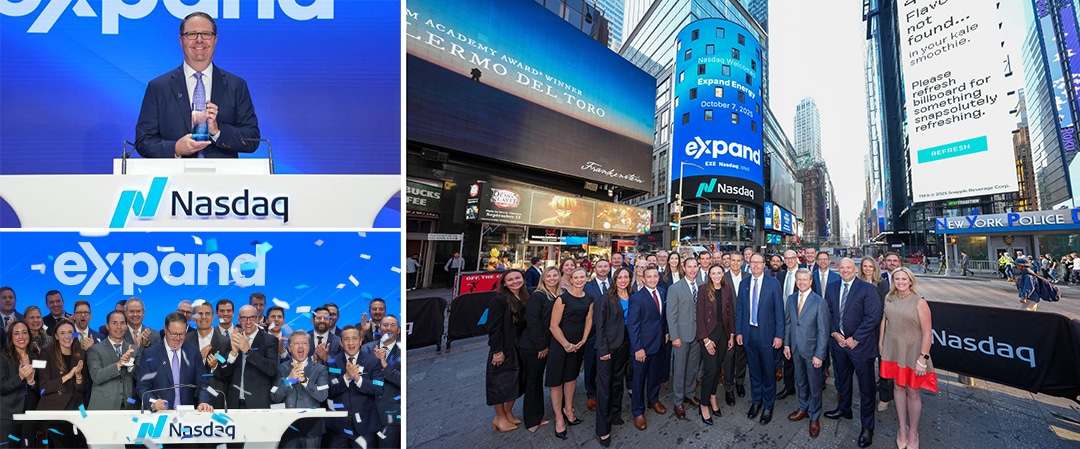
On October 7, 2025, Nick Dell’Osso stood at the Nasdaq MarketSite with employees from Expand Energy. The company was celebrating its first anniversary. There were photographs, a Times Square screen and the opening bell, that agreeable Wall Street ritual in which years of work receive a few seconds of noise.
Four months later, his tenure as chief executive was over. Expand announced a change in leadership and plans to move its headquarters from Oklahoma City to the Houston area. By late May, Dell’Osso had another chief executive’s job, this time at Gulfport Energy. His second act required a new company name, though his professional address remained Oklahoma City.
The sequence makes an unusually compact business story: a merger, a celebration, a departure, another appointment. The longer story is more revealing. Dell’Osso had spent years working on the financial machinery behind energy production before he became the person expected to explain where an entire company should go. His career runs through both sides of a deceptively simple question: what is a gas field worth, and how do you actually collect?
An education in what money costs
His formal name is Domenic J. Dell’Osso, Jr. The Nick is the name used in introductions, interviews and company announcements. He earned an economics degree at Boston College in 1998 and an MBA in finance at the University of Texas at Austin in 2003. Before the operating-company titles came investment banking: Banc of America Securities from 2004 to 2006, then Jefferies from 2006 to 2008.
In August 2008, he joined Chesapeake as vice president of finance and chief financial officer of its midstream subsidiary, Chesapeake Midstream Development. By November 2010, he was Chesapeake’s executive vice president and CFO. He held that position until 2021. Eleven years in the finance chair is a substantial apprenticeship in the distance between an attractive asset and an affordable business.
Those dates matter because they place him inside Chesapeake through its financial restructuring. The company emerged from Chapter 11 in February 2021, while he was still CFO. Approximately $7.8 billion of debt had been converted to equity, and the previous common and preferred equity interests were cancelled. A corporate fresh start had very different meanings depending on which security someone owned.
Dell’Osso became CEO in October 2021, following a board search and a period with Mike Wichterich as interim chief executive. He therefore took charge after the restructuring, with its consequences already written into the balance sheet. The order is important. His CEO assignment was to run the reorganized enterprise, carrying forward the emphasis on cash generation and financial restraint.
- 2008Joins Chesapeake
Finance & midstream - 2010Becomes CFO
Eleven years in the role - 2021Becomes CEO
October appointment - 2026Joins Gulfport
Effective May 28
A larger company, with a smaller cost per unit
The transaction that defined his tenure arrived in January 2024. Chesapeake and Southwestern announced an all-stock merger valued at $7.4 billion at announcement. Dell’Osso would lead the combined business. Together, their acreage in Appalachia and the Haynesville offered the prospect of a larger natural-gas portfolio near important consuming markets.
The announced rationale went well beyond combining production totals. The companies initially identified approximately $400 million in annual operational and overhead savings. Longer horizontal wells, shared infrastructure and lower drilling and completion costs were part of the argument. The financial attraction depended on what combining the businesses would let them do differently, rather than simply how large the resulting organization would look.
The merger closed on October 1, 2024, and Chesapeake became Expand Energy. The accounting value of shares issued at closing was approximately $7.9 billion, reflecting a different measurement date from the announcement valuation. It is a small distinction with a useful lesson: even the headline number on a stock transaction has a calendar attached.
Later that October, Expand raised its expected annual merger savings to $500 million. Those were expectations, rather than a bag of cash already on the table. Dell’Osso’s early presentation of the combined business paired the new scale with a familiar concern: lower the cost at which the company could operate and reach customers more efficiently.
The operating plan also included restraint. Expand described deferred well completions and wells waiting to enter production, with activation dependent on market conditions. For a producer, having the ability to supply more gas does not settle the question of when to supply it. A well can be ready before the market is ready to pay a satisfactory price.
The customer is at the other end of the pipe
Dell’Osso had been making a related argument before Expand existed. In a 2022 Energy Council interview, he discussed the gap between America’s capacity to produce natural gas and its capacity to deliver that gas to markets that needed it. Resources alone could not finish the job. Infrastructure had to connect production with consumption.
That theme became commercially specific in 2023, when he discussed Chesapeake’s proposed arrangements with commodities trader Gunvor and talks about liquefaction capacity. Liquefaction allows natural gas to travel by ship. It also introduces another set of contracts, costs and construction decisions between a domestic well and an overseas buyer. The overseas price is only the beginning of the calculation.
His public appearances provide a running record of these concerns. A February 2025 Oklahoma City Rotary presentation addressed growing gas demand and Expand’s response. In April, he discussed boards’ responsibilities in mergers and acquisitions with the National Association of Corporate Directors’ Heartland chapter. Energy supply and corporate governance may attract different lunch audiences, but both sit squarely inside the job he had come to hold.
At Nasdaq that October, employees joined him to mark the first year of the merged company. In his own LinkedIn account of the occasion, he credited their work and collaboration. The ceremony offered a highly visible finish to the anniversary. Integrating the businesses, controlling spending and selling the product were continuing assignments, with considerably less confetti.
February closes one chapter. May opens another.
Expand’s February 2026 announcement brought an abrupt change. Wichterich would again serve as interim chief executive. The company planned to relocate its headquarters to the Houston area, emphasizing relationships with commercial and industry partners. Dell’Osso also left the board and was to serve as an external adviser during the transition.
The board acted on February 6; the public announcement followed on February 9. His termination was classified as without cause. His departure coincided with a change in the geography of the executive team, as Expand emphasized Houston’s role in connecting the business to commercial partners and the global natural-gas market.
Wichterich’s farewell credited growth from a $5 billion business to a $26 billion investment-grade enterprise during Dell’Osso’s CEO tenure. Those company valuations describe the enterprise, rather than his personal wealth. They also describe an outcome built by many people, through a major merger. Dell’Osso’s record belongs within that wider corporate history.
Gulfport announced his appointment on May 5, effective May 28. It gave him the president and chief executive titles and a place on its board. He moved into another natural-gas-focused producer, with principal properties in eastern Ohio and central Oklahoma. The Ohio business targets the Utica and Marcellus formations; the Oklahoma assets include the SCOOP Woodford and Springer formations.
His introduction to Gulfport employees, shared on LinkedIn, emphasized participation and collective goals. He wanted a workplace where people contributed to decisions and shared in the results. For an executive arriving from outside the organization, that emphasis gives employees a particular promise to measure: that they will help shape the work ahead.
“everyone has a seat at the table”
Nick Dell’Osso, on his approach to the Gulfport team
The next calculation is already on the desk
Gulfport gives that approach a concrete assignment. In its August 3 second-quarter update, the company outlined a discretionary acreage acquisition program targeting $140 million in 2026, with $40.3 million already deployed in the second quarter. Alongside an Ohio state land acquisition, the investments were expected to lengthen the development runway. The distinction between an expected future inventory and current production remains essential.
Dell’Osso’s stated priorities included reducing breakeven costs, adding inventory selectively, preserving the balance sheet and returning excess cash to shareholders. Acreage purchases and share repurchases would compete for capital. The question behind both is recognizable from his finance years: which use of the next dollar offers the better return under the circumstances? A lease purchase puts money toward future drilling opportunities. A share repurchase spends it on ownership in the existing business. Both can be described as investment; they commit the company to different things. Comparing them forces a chief executive to bring the geology, the operating plan and the price of the shares into the same conversation.
His Oklahoma connections extend beyond corporate offices. A 2025 Rotary biography listed nonprofit board service with United Way of Central Oklahoma, Bishop McGuinness Catholic High School and Cristo Rey OKC. He also serves as a Transocean director, a position he has held since 2023. His professional life spans an onshore producer, an offshore drilling boardroom and local institutions concerned with education and community life. The Rotary introduction also placed a family alongside the résumé: his wife, Nicole, and their two sons and a daughter. That public introduction connects the executive’s Oklahoma City life with the city in which he has worked since joining Chesapeake in 2008.
The Nasdaq photographs now belong to an earlier job. Gulfport’s acreage, operating costs and capital decisions belong to the present one. The continuity is the work itself: understanding what an asset can produce, what it costs to reach a buyer, and how much the company should spend before it receives the proceeds. For Dell’Osso, the second act begins with a very familiar piece of arithmetic.
Which use of the next dollar offers the better return?