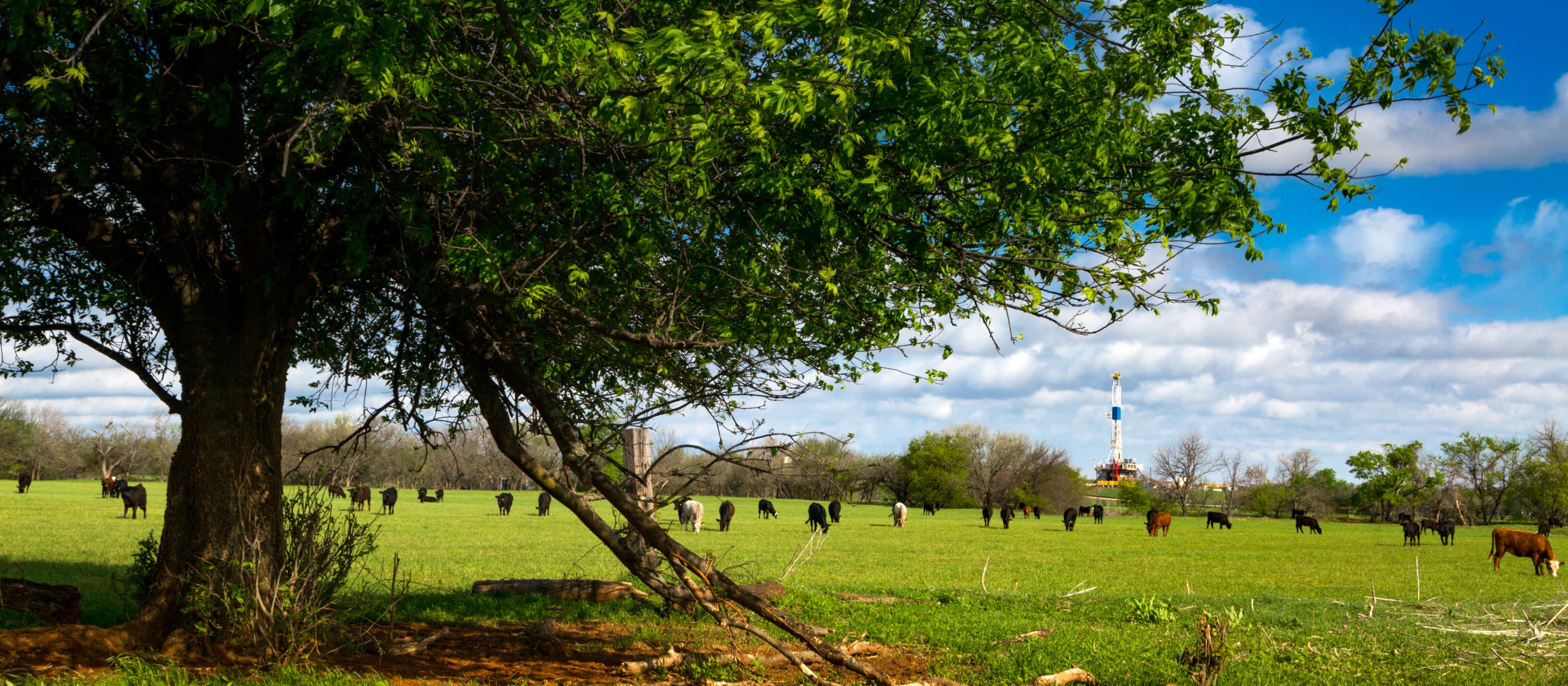
In one of Gulfport Energy’s field photographs, cattle graze beneath a broad tree while a drilling rig rises in the distance. The cows have secured the foreground. The machinery looks almost incidental. It is a useful picture of a business whose most consequential work is easy to overlook: deciding how much money should go underground, and how much should come back.
- Gulfport sells natural gas, oil and liquids produced in Ohio and Oklahoma.
- Its 2021 bankruptcy exit removed more than $1.2 billion of debt.
- Today’s test is allocating cash among wells, acreage and shareholder returns.
Consider an apparent anticlimax. In 2025, Gulfport’s production averaged about 1.04 billion cubic feet equivalent per day, broadly level with 2024. Yet it reported $324.7 million of adjusted free cash flow. Higher gas prices also helped its 2025 results. The distinction is the heart of this company’s story. More production is a physical accomplishment. Making the investment worthwhile requires another calculation.
The balance sheet needed a new life
Gulfport was formed in July 1997 from existing assets, including those of WRT Energy and an interest in Louisiana’s West Cote Blanche Bay field. Its history includes Canadian oil sands, Thailand and the Permian Basin. Eventually, the operating focus settled on Appalachian gas and Oklahoma’s SCOOP. There is a whole oil-industry education in that itinerary: acquire, explore, sell, concentrate.
The immediate squeeze was liquidity. In October 2020, lenders cut Gulfport’s borrowing base from $700 million to $580 million. The company deferred interest payments as pandemic demand losses and lower commodity prices strained its ability to handle $2.1 billion of long-term debt. By November, Gulfport had filed for Chapter 11. Its restructuring agreement proposed converting debt into equity and rejecting or renegotiating contracts, including costly midstream obligations. The business could keep operating while the claims on its future cash were rewritten. The announced financing included $105 million of new money within a $262.5 million debtor-in-possession facility.
It emerged on May 17, 2021, with $853 million of debt, more than $1.2 billion of deleveraging and a new board. Existing common shares were canceled. That last fact belongs beside every cheerful turnaround account: the corporation’s second chance did not preserve the old shareholders’ investment.
“continuing to reduce costs and generating sustainable free cash flow”
Timothy J. Cutt · May 2021
The reset made the governing question explicit. How much cash could the assets generate after the spending needed to develop them? Bankruptcy had forced changes to both financing and contracts. A better drilling program alone could not have accomplished that balance-sheet repair.
The customer is at the other end of a pipe
Gulfport’s products are natural gas, crude oil and condensate, and natural gas liquids. It is an upstream producer: it develops reservoirs and sells production into wholesale markets through spot and term transactions. Buyers receive energy commodities. Gulfport receives prices shaped by market conditions, location and contractual terms. One unnamed purchaser accounted for 14% of its 2025 product sales before hedging.
Think of Gulfport as an early link in the energy supply chain. Its output enters markets serving electricity generation, industry and other uses. A household does not sign up for a Gulfport subscription. Commercial counterparties buy production; landowners and suppliers deal with a different side of the business. Its owner-relations and supplier channels give those groups practical routes into the company.
The sale price has to carry the whole journey.
The geography matters. Eastern Ohio supplies Gulfport’s Utica and Marcellus opportunities; central Oklahoma supplies its Woodford and Springer targets. In its Ohio development area, the Marcellus lies roughly 3,500 to 4,500 feet above the Utica. A leasehold can therefore offer another development horizon without requiring a completely new geographic footprint.
This is where expertise earns its keep: geology, reservoir engineering, horizontal drilling, completions and the scheduling of production into infrastructure. Gulfport occupies the same broad gas-producing market as Antero, CNX and EQT. Its competitive argument rests on acreage economics and execution. The molecule offers little room for brand loyalty.
The land next door costs $83 million
In June 2026, Gulfport announced an approximately $83 million purchase of 4,700 net undeveloped acres in Belmont County, Ohio. The acreage adjoins existing operations. Management identified about 16 net drilling locations, normalized to 15,000-foot laterals, and expected development to begin in 2027.
4,700net undeveloped acres
~16net drilling locations*
Adjacency is the interesting word. Nearby infrastructure and available midstream capacity can make a neighboring tract more useful than an isolated one. Gulfport described the purchase as an opportunity to improve development efficiency and use existing infrastructure. The price secured access to future opportunities. Wells still have to be paid for.
Another boundary matters: cash flow definitions. Gulfport’s adjusted free cash flow is a non-GAAP measure, with a reconciliation in its financial materials. Investors need to read those adjustments before treating it as the amount available for every purpose. Acreage purchases, drilling commitments and repurchases compete for financing even when each comes with an appealing rationale.
A second chance needs a scorecard

Nick Dell’Osso
President and CEO since May 28, 2026.
The next allocation decisions land here.
Nick Dell’Osso, formerly chief executive of Expand Energy, took over in May 2026. In August, Gulfport outlined a $140 million discretionary acreage program, including spending already made in the second quarter. For that quarter, it reported $149.9 million of operating cash flow and $6.4 million of adjusted free cash flow. Those figures measure different stages of the cash calculation.
Operational discipline also reaches the well site. Gulfport says it is replacing gas-driven pneumatic equipment with compressed-air or other non-venting alternatives and independently recertifying Appalachian gas annually. Its published mission links operational measurement, safety, environmental stewardship and community work. These commitments require ongoing execution; a statement of intent cannot do the maintenance.
The transferable lesson is practical: compare uses of capital after accounting for their full costs. It depends on productive acreage, workable infrastructure and prices that support development. Falling gas prices, minimum-volume commitments or transport constraints can undermine the calculation. Gulfport’s reset changed its obligations. Every new investment still has to justify the next dollar.
Follow the next dollar
Explore Gulfport’s operations, announcements and earnings conversations.