On September 27, 2026, oil began flowing from a field called Golden Camel off Vietnam. For Murphy Oil Corporation, this was the arrival of a new business in a familiar region. But the more revealing detail came nearby: another well, White Camel North, had encountered oil. Suddenly, the pipes and processing equipment built for one field had a possible second assignment.
- Murphy produces oil and gas, selling to commercial buyers.
- Its Vietnam hub could give nearby discoveries a cheaper development route.
- Dry wells and a rising capital budget keep the arithmetic honest.
An offshore discovery presents two questions. Is there enough oil to produce? And can you afford to get it out? The distance between those answers is where Murphy’s story becomes interesting. A reservoir can look promising on a map and still need an expensive collection of machinery before it earns a dollar.
The customer never visits the platform
Murphy works upstream: finding hydrocarbons, drilling wells and producing crude oil, natural gas and natural gas liquids. Buyers operate farther along the chain. Its 2025 financial disclosures identify Chevron and ExxonMobil as customers representing 19 percent and 12 percent of sales revenue, respectively. A familiar industry name can be a competitor in one setting and a buyer in another.
The company’s practical contribution is supply. Refineries and energy purchasers need physical volumes delivered into a system that can process and move them. Murphy’s expertise joins subsurface interpretation to drilling, production engineering and operations. The product is a commodity; the work required to deliver it is particular to each field.
There is also a name trap. Murphy USA, the fuel retailer, separated from Murphy Oil in 2013. Today’s Murphy Oil is an independent exploration and production business. Its portfolio combines North American onshore production with offshore assets and international exploration. Think Eagle Ford in Texas, Tupper Montney and Kaybob Duvernay in Canada, and offshore production beyond them.
Give the next field somewhere to go
Golden Camel, formally Lac Da Vang, sits in Vietnam’s Cuu Long Basin. Murphy operates the block with a 40 percent working interest; PetroVietnam Exploration Production holds 35 percent and SK Earthon 25 percent. Those percentages divide the venture. They also remind us that an offshore operator works inside a partnership.
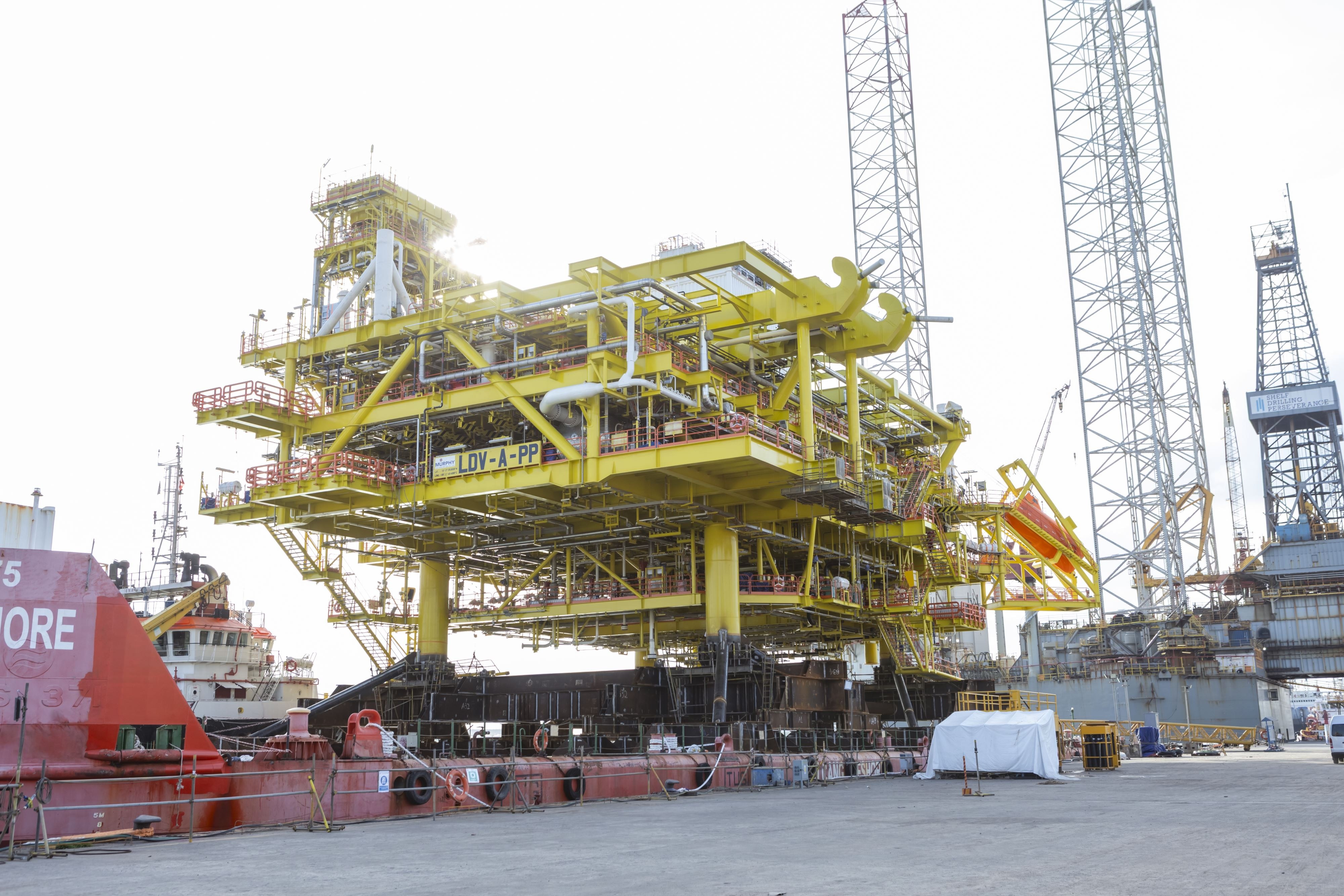
The central platform processes crude to export quality, then transfers it to a floating storage and offloading vessel. PTSC M&C handled engineering through construction and installation for the platform. At its July loadout milestone, the contractor reported nearly 4.5 million work hours without a lost-time injury. The industrial choreography behind “first oil” involves rather more than opening a valve.
The company’s October announcement supplied the strategic detail: the now-producing field offers nearby infrastructure for a potential connection from White Camel North. That connection, known as a tieback, could shorten development time and reduce capital requirements. It remains an option under evaluation, rather than a completed project or a guaranteed saving.
Golden Camel
+ storage
Nearby discoveries
This is Murphy’s competitive argument in miniature. An established route to market can make the next opportunity more attractive. Against larger integrated companies and other independents, the relevant question becomes whether Murphy can develop its particular barrels at an acceptable cost. Owning a useful location and understanding the surrounding geology matter together.
A discovery can move the budget
Infrastructure requires money before it creates flexibility. In 2025 Murphy bought the Pioneer floating production, storage and offloading vessel for a net $104 million. Management described the purchase as extending field life and improving the economics of the Chinook development well. Buying the equipment changed the economics of using it.
In 2026, the spending plan moved too. Murphy’s September presentation showed a capital midpoint of $1.55 billion, up from $1.25 billion. The $300 million increase covered additional Bubale exploration spending, a Bubale West appraisal well, accelerated Eagle Ford activity and Chinook development spending. The plan was being rewritten around both opportunity and execution needs.
The rock gets a vote
The awkward result arrived in the second quarter. Hai Su Vang-4X, an appraisal well at another Vietnam discovery, was expensed as a dry hole. An appraisal well is supposed to improve the understanding of a discovery’s size and shape. Sometimes that understanding improves by revealing where the reservoir disappoints.
That result belongs beside the successes. Murphy subsequently described a post-appraisal recoverable resource range of 200 million to 300 million barrels of oil equivalent at Hai Su Vang. These are estimated resources, distinct from booked proved reserves and actual production. The distinction matters when a story about oil underground starts sounding like cash already in the bank.
“These achievements highlight Murphy’s ability to create value across exploration, appraisal and development.”Eric M. Hambly · President and CEO · October 2026
The evidence changed the allocation of money and narrowed the geological picture. Readers can copy that decision habit: separate discovery from validation, then separate validation from delivery. Spend according to what the next stage actually establishes. A promising result earns another examination; it does not settle every question that follows.
The patience has conditions
Murphy’s family enterprise incorporated in 1950, after a history rooted in Arkansas land interests. Its longer institutional memory includes backing the pioneering drilling barge Mr. Charlie. Today, the company says it supports employees through mentoring, training and tuition assistance. Its stated purpose is providing energy that empowers people.
The transferable lesson is practical: build shared capacity around a viable first project, then evaluate what can reuse it. That logic needs suitable nearby resources, available processing capacity, workable partnerships and prices that justify investment. A distant discovery, poor reservoir performance, delays or prolonged weak prices can erase the expected advantage. Golden Camel is producing. What connects next will decide how much more that first investment can do.