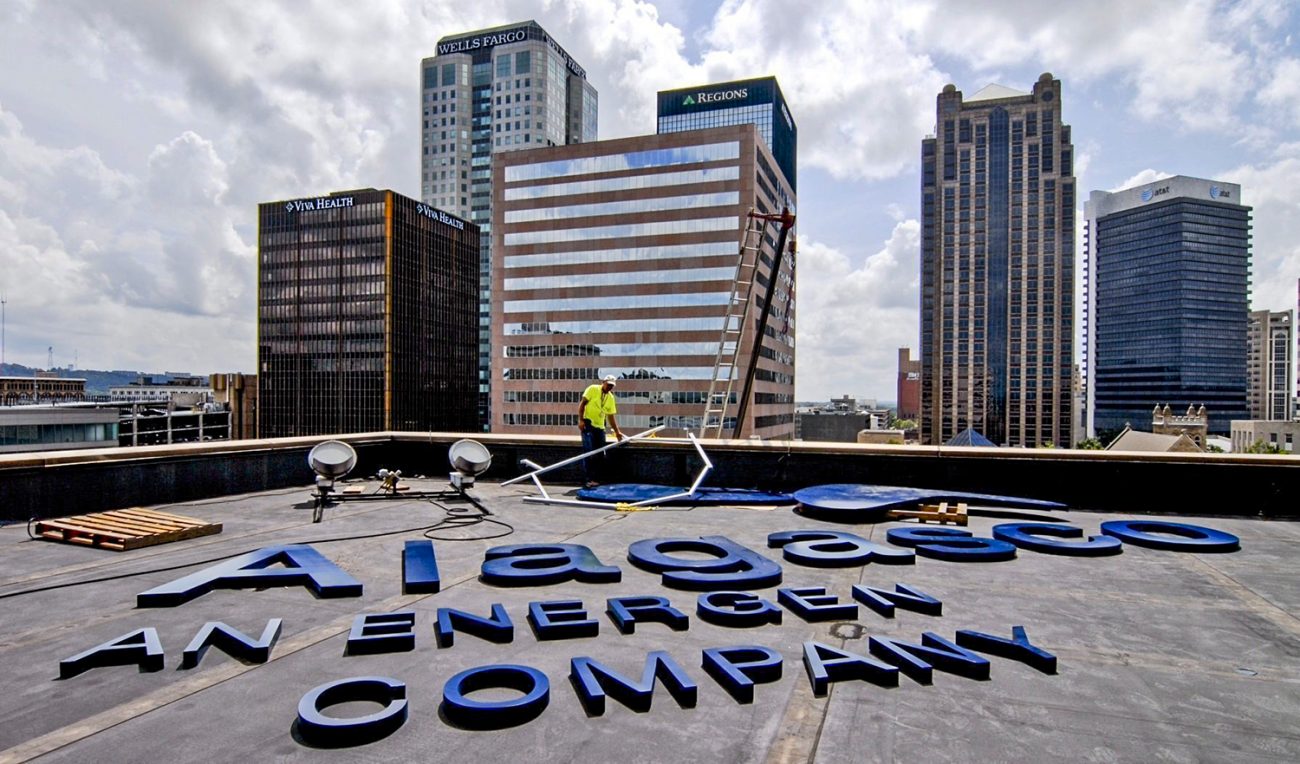
In March 2016, a worker removed the Alagasco sign from Energen’s Birmingham headquarters. There is something wonderfully literal about that photograph. A company had decided what it wanted to become, and somebody had to take the old letters down. The utility had already been sold. Energen’s attention was moving west, toward the oil-bearing rock of the Permian Basin.
- Sell the utility and concentrate on oil and gas production.
- Improve the wells, while paying the considerable bill for drilling them.
- Join Diamondback when the ownership argument shifts toward scale.
Two years later, Energen agreed to become part of Diamondback Energy. The announced transaction value was approximately $9.2 billion, including net debt. This was a company improving its operations while reconsidering its independence. That combination makes the story useful well beyond the oil patch.
Selling the dependable part
Energen’s corporate family contained two different businesses. Alagasco distributed natural gas to Alabama households and businesses. The exploration subsidiary, originally Taurus and later Energen Resources, looked for hydrocarbons and brought them out of the ground. One delivered energy through a utility network; the other invested in the uncertain productivity of rock.
In September 2014, Energen completed the sale of Alagasco to Laclede for $1.6 billion, including assumed debt. At the announcement, the utility served more than 422,000 customers. Energen used sale proceeds to reduce indebtedness. A familiar, regulated business had helped finance a very different future.
The retreat from diversification continued. In June 2016, Energen announced closed or agreed non-core asset sales totaling $551.7 million in gross proceeds. Exiting its remaining San Juan properties completed the transition to a Permian specialist. Concentration meant fewer geological neighborhoods to understand, but also fewer places to hide when conditions deteriorated.
A well is an expensive experiment
What remained was an upstream producer: lease acreage, drill wells, complete them, sell the output, repeat. Oil, natural gas liquids and natural gas went to wholesale buyers. Plains Marketing and Shell Trading accounted for approximately 56 percent and 13 percent of 2017 commodity-sales revenue. Energen supplied the energy chain before the filling station or the household bill.
Its expertise lay in the details that make neighboring producers perform differently: which formations to target, how far to drill horizontally, how to space wells, and how aggressively to fracture the rock. Its Generation 3 completion designs used more intensive fracturing. The product was a commodity; the method of producing it was where operating judgment mattered.
Ten thousand feet. Millions upfront.
Those costs make “growth” a rather muscular word. In February 2018, Energen planned $1.1 billion to $1.3 billion of drilling and development investment for the year. The plan included disposal wells and facilities as well as producing wells. Underground promise still needed an expensive surface operation.
The price assumptions cracked
The earlier downturn shows what can go wrong before an operating strategy has time to prove itself. Energen reported a $945.7 million net loss in 2015. Its accounts included substantial noncash impairments: lower commodity-price assumptions had reduced the carrying value of properties. The rock had not vanished. The financial expectations attached to it had shrunk.
The response involved assets, people and shareholders. Energen reduced its workforce in early 2016, sold properties and raised approximately $381 million through an equity offering. Share issuance brought fresh capital but diluted existing ownership. Selling peripheral acreage produced cash while surrendering future output from those properties. Neither choice was free.
By the third quarter of 2018, production reached 103,100 barrels of oil equivalent a day, roughly 4 percent above the guidance midpoint. Reported lease operating expense was $5.80 per equivalent barrel. Those were encouraging operating numbers. They did not, by themselves, answer whether Energen should remain independent.
Sixteen calls and a different answer
The merger record describes a board changing its assessment. In June 2017, directors favored continuing the standalone business plan. Corvex, the activist investor, kept pressing for alternatives. In March 2018, Energen agreed to add two Corvex nominees and undertake another review. Carl Icahn subsequently joined the shareholder pressure.
By June, the board authorized outreach. Advisers contacted 16 potential counterparties; three entered confidentiality agreements. That sequence matters. There was no single disclosed revelation that suddenly made selling obvious. Shareholder input, operating prospects, market conditions and the relative attractions of a combination were being reconsidered together.
What the next owner could do
Diamondback’s argument rested partly on combining acreage and applying its operating approach. It projected Midland drilling, completion and equipment savings of up to $200 per lateral foot, alongside annual administrative savings of $30 million to $40 million. These were merger forecasts. They should be read as a proposed route to value, rather than money already earned.
“what is now truly becoming a manufacturing business”
Travis Stice, Diamondback CEO, on the combination · August 2018
That description captures the shift from finding a promising location to developing many locations economically. Energen brought acreage and operating knowledge. Diamondback proposed extracting more value through scale and cost control. The acquisition was also a judgment about which organization should run the next round of work.
Keep the method. Question the owner.
The merger closed on November 29, 2018. Eligible Energen shares converted into Diamondback shares, keeping investors exposed to the combined company. Energen’s separate stock-market listing ended. Its assets entered a larger operating system.
The transferable idea is to examine capital allocation and ownership separately from production growth. Selling peripheral assets can fund a focused operation; testing completion methods can improve its economics. But the approach needs financeable wells, workable infrastructure and buyers for the output. Low commodity prices, disappointing reservoirs or expensive services can overwhelm an elegant plan. Energen’s useful question survives its ticker: who can make the next dollar invested work hardest?