In March 2011, Brian Lipke sent his board a letter that made his compensation package smaller. He gave up rights to 52,686 shares of Gibraltar Industries stock. The language was unusually firm: the award was surrendered permanently, and the compensation committee was instructed against replacing it later. In a document built for lawyers, he had left very little room for a sequel.
Gibraltar had endured a punishing stretch. Its markets had contracted, costs had been cut, and the company had finished 2010 short of profitability. Lipke remained optimistic about the business. He also believed his own pay should reflect what shareholders had experienced. The letter puts an interesting wrinkle in a career usually described through expansion: sometimes the revealing number is the one an executive subtracts.
By then he had spent nearly four decades at Gibraltar, working through the transformation of a Buffalo steel processor into a public manufacturing company. He had learned its operations before leading them, watched the family business acquire a much larger collection of businesses, and taken his financial experience into Buffalo's civic institutions. His story moves between those scales: a production floor, a public company, a city budget, a school fundraising campaign.
A family business, with machinery attached
Lipke joined Gibraltar in 1972, the year his father, Kenneth Lipke, acquired the business. It was a single steel processing facility in Buffalo with annual sales of about $9 million. That starting point matters. The family name came with an operating business, customers and equipment. Growth would require finding more uses for what the company knew how to do.
Brian worked in production, purchasing and divisional management during the following fifteen years. Those jobs sit well below the ceremonial altitude of a chairman's title. Production asks whether something can be made; purchasing asks what it costs to make it; divisional management asks whether the whole arrangement pays. His early career put him in each part of that conversation.
He attended Alfred State and the University of Akron. His brother Neil also built a career inside Gibraltar, working in production, sales and marketing before becoming an executive vice president. The enterprise grew around a family and an operating team, rather than a lone figure with a taste for acquisitions.
By the late 1980s, Brian was leading the business. One problem facing the team was concentration: too much depended on automobile manufacturing. Buying businesses serving other customers offered a way to spread that exposure. A steel processor could understand another metals operation while gaining access to a different market. Familiar machinery could lead to unfamiliar customers.
The stock symbol was ROCK. The plan required movement.
Gibraltar went public in 1993. A second share offering followed in 1996, providing more capital for expansion and diversification. Lipke's stated growth plan called for annual sales of at least $1 billion by 2003, with average annual growth of 20 percent. It gave the business a destination that could be written on a single line, even if getting there required rather more paperwork.
By 1997, sales were approximately $450 million. The company had expanded to 39 locations across 17 states and Mexico by the time the University at Buffalo recognized Lipke as Niagara Frontier Executive of the Year in 1998. The geographical change was as telling as the revenue change: Buffalo remained the base, while the business had become a network.
Acquisitions brought construction products, heat treating and consumer products into the portfolio. Mailboxes joined the industrial mix. That is a pleasingly ordinary object to encounter in an expansion story: a business can diversify by acquiring something people pass on the way to collect their electricity bill.
The strategy also required continuing investment in existing plants. In 2006, Lipke described annual spending of roughly $20 million to $25 million on operations, technology, quality, service and productivity. Buying companies supplied new territory. Keeping equipment useful and employees trained helped defend the territory already held.
“If you're not finding ways to get better at what you do, your competition is.”
Brian Lipke, 2006
His accompanying warning had more personality than the usual corporate appeal to continuous improvement. An executive could hardly put his feet on the desk, read hunting and fishing magazines, and expect the business to last. The magazines were his example of complacency, rather than a disclosed reading list. The joke worked because the underlying obligation was so relentless.
Then the arithmetic became less cheerful
The downturn changed the questions. Expansion had made Gibraltar larger; weak demand tested how much cost that larger business could carry. In his 2011 letter, Lipke described estimated annual cost reductions of $100 million. He also pointed to improved working capital management, the elimination of bank debt and more than $60 million in cash at the end of 2010.
Those improvements had still failed to return the company to profitability that year. Keeping both facts in view gives the episode its weight. Liquidity had improved. Shareholders had endured difficult results. Lipke chose to surrender the remaining restricted units from a January 2010 award, and tied that decision explicitly to their interests.
The subsequent compensation disclosure recorded the surrendered portion at $885,124 of previously reported compensation, representing 75 percent of that grant. That accounting figure describes the award; it is not a measure of his wealth. It does, however, give scale to the otherwise rather dry phrase “voluntary surrender.”
A single pay decision cannot settle every question about a chief executive's record. It does make this one concrete. Lipke put the reduction in writing, specified the shares and closed off replacement through a future compensation decision. Readers can judge the action without being asked to accept a slogan about leadership.
Growth, with a pencil behind its ear
By February 2014, Lipke was discussing Gibraltar's ability to invest and pursue acquisitions more actively. He paired that ambition with detailed conditions: fit with existing operations, financial performance, an immediate contribution to earnings per share, longer growth prospects and operating benefits that could begin after a purchase closed. The shopping list came with a calculator.
His operational explanations were similarly specific. During a May 2014 earnings discussion, he described combining production in fewer facilities to reduce overhead and improve shipping. Sending products to the same customer from two locations created costs that a consolidated operation could avoid. Lean manufacturing had freed space to accommodate incoming work.
He also described how Gibraltar tested industry forecasts against conversations with customers and information from salespeople. Housing demand, a difficult winter and the timing of orders complicated projections. His account of forecasting allowed for those complications. A range could express what management thought achievable without pretending the weather had signed an agreement.
Buffalo had a different balance sheet
While leading Gibraltar, Lipke took on responsibilities outside the company. Governor George Pataki appointed him chairman of the Buffalo Fiscal Stability Authority in January 2005, succeeding Thomas Baker. The assignment involved a city's spending and financial plans, with the public consequences and arguments that accompany them.
During his chairmanship, the authority adopted three financial plans. Its 2007 resolution honoring his service connected those plans with the improvement that enabled the city's wage freeze to be lifted effective July 1 that year. Lipke stepped down after nearly two and a half years to devote more attention to Gibraltar. It was a substantial civic commitment with a defined end.
He also served on the Erie County Fiscal Stability Authority. At his introduction to that board in August 2011, chairman Daniel Oliverio emphasized his experience with the city's authority. Lipke's reply was brief: “Thank you, very happy to be here.” After years of corporate presentations, there are still occasions when one sentence will do.
His regional work extended to the Peace Bridge Authority, the YMCA, education and the arts. At Elmwood Franklin School, he and Betsy Constantine Janowski co-chaired the 2017-2018 annual fund campaign. It brought together 472 donors and raised $284,949, exceeding its $250,000 goal with help from a Lipke family matching challenge. The proceeds supported everyday educational work, including technology, field trips and classroom needs.
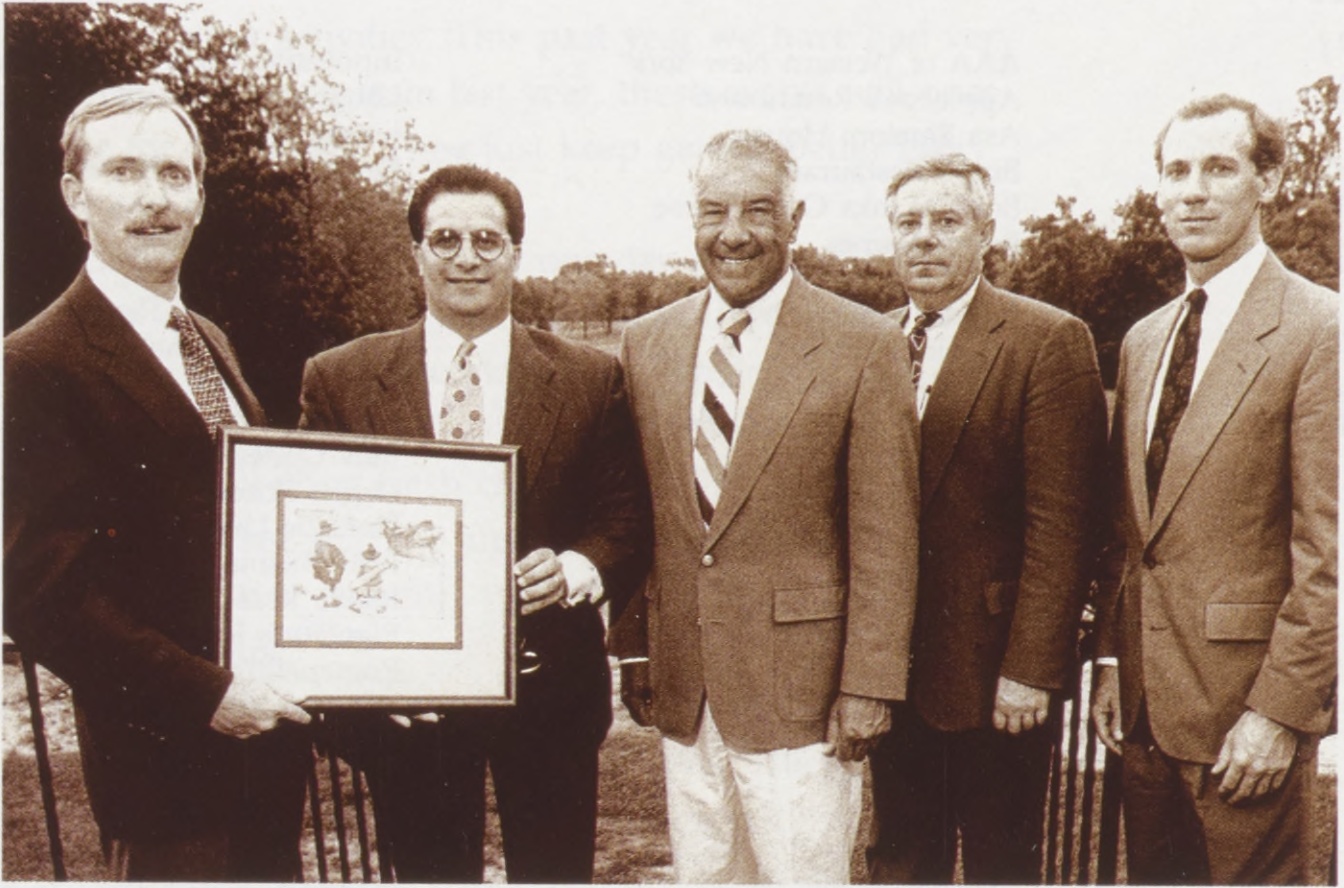
The connection with education reaches back further. Lipke chaired the June 1993 Daemen Golf Classic at Park Country Club, which raised more than $23,000. A photograph from the event shows him accepting a print alongside fellow committee members - a public thank-you for the kind of organizing work that rarely enters an executive biography.
The handover was part of the work
Lipke retired as Gibraltar's CEO at the end of 2014. Frank Heard took over on January 1, 2015, after serving as president and chief operating officer. Lipke remained executive chairman for the transition, then retired from employment and the board effective May 31. William Montague succeeded him as chairman.
The succession process had occupied the board over two years. It also separated the chairman and CEO positions. For a company so closely associated with the Lipke family, changing the structure alongside the personnel was meaningful. The organization would carry on through a different arrangement of authority.
Retirement from Gibraltar left other work in place. Lipke had joined Moog's board in 2003 and continued serving until immediately before its 2025 annual meeting. His experience as an operating executive became experience available to another company's directors. Merchants Insurance Group also lists him among its board members.
In 2015 he joined Scott Friedman, Jerry Jacobs Jr., Mark Hamister and Ted Pierce in Buffalo Capital Partners. It was another setting for evaluating businesses and the people building them. The steel processing career had opened onto investing, governance and institutions close to home.
In September 2026, Lipke appeared in Buffalo’s entrepreneurship community again, joining an ecosystem panel alongside actor William Fichtner and Golisano Institute Buffalo region director Jim Dentinger. A career that began inside a steel processor was still finding room in conversations about the region’s next businesses. The setting had changed; Buffalo remained in the picture.
There is no need to make all these assignments resemble one another. A factory, an insurer and a school ask different things of their leaders. What connects Lipke's public record is the repeated willingness to take responsibility for an institution's finances and its next stage. Sometimes that meant buying. Sometimes it meant consolidating. Eventually it meant handing over the keys. And, on one unusually specific day in March, it meant giving something back.