Consider the wooden pallet. It has no screen, no subscription and no obvious claim on your attention. Its job is to disappear beneath something more valuable. For UFP Industries, that unglamorous object belongs to a much larger idea: everyday materials become better businesses when somebody understands precisely what a customer needs them to do.
- Three markets: retail building products, construction and industrial packaging.
- A 2020 reorganization put customer markets ahead of geography.
- Engineering adds value. Freight and weak housing demand can take it away.
UFP manufactures through a family of businesses that includes ProWood treated lumber, Deckorators decking, PalletOne pallets and construction-component operations. Its 2025 sales were $6.32 billion. The interesting question is how a company working with such familiar objects persuades customers to pay for something beyond the material itself.
01 / A board has several careers
A homeowner wants a deck that looks good and holds up outdoors. A builder wants framing components that arrive ready for assembly. A manufacturer wants its equipment to survive a truck journey. All three may buy from UFP businesses. They are buying different kinds of certainty.
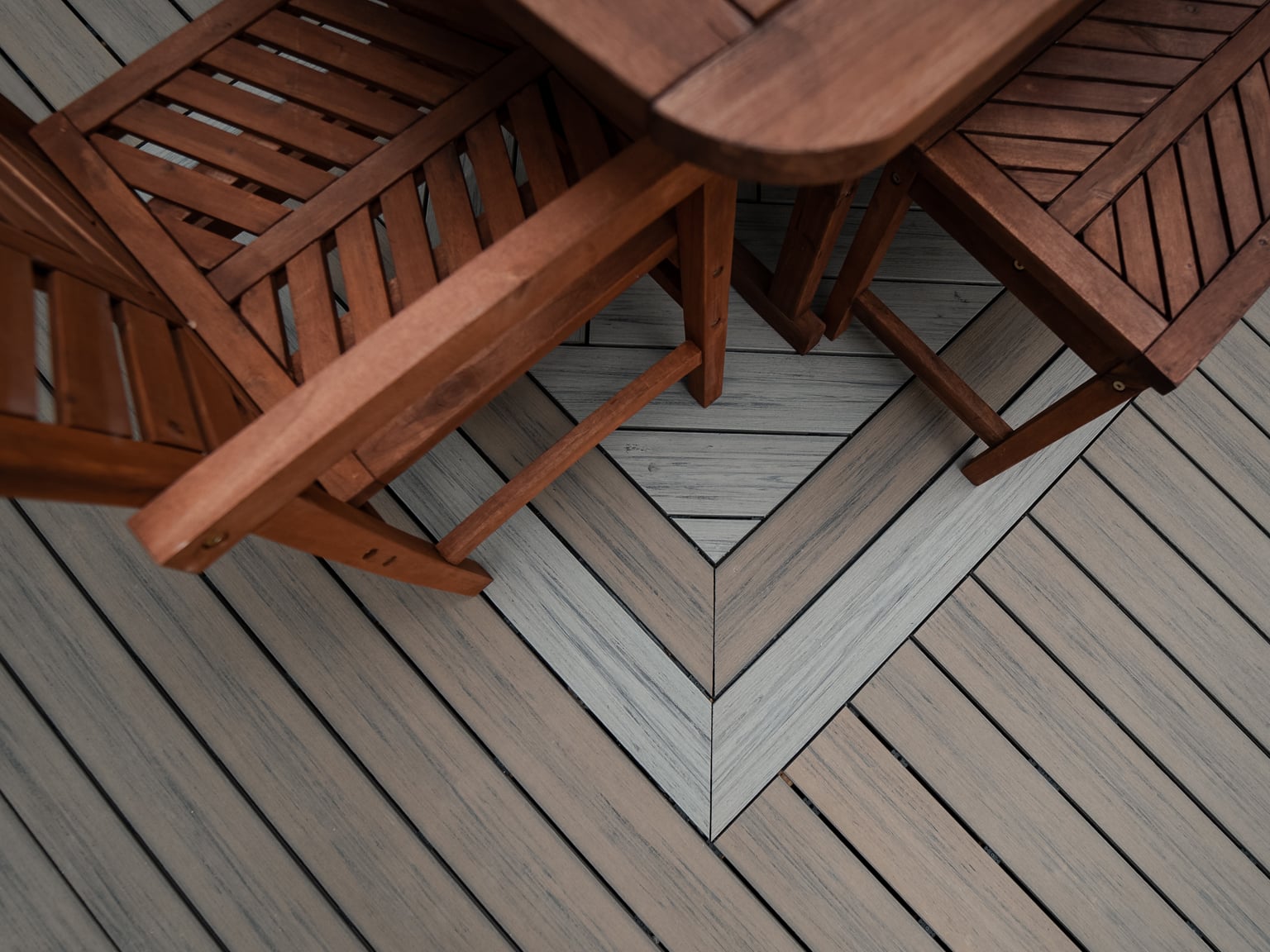
ProWood pressure-treats lumber to protect against decay and insects, with treatments matched to applications. Deckorators makes both wood-plastic and mineral-based composite decking. Its Surestone technology gives contractors another material choice, with different moisture and movement characteristics. The proposition is practical: specify a material for the conditions it will face.
Construction customers can order prefabricated trusses and framing systems rather than ask every jobsite to reproduce the same fabrication work. UFP Site Built describes a network of more than 30 manufacturing facilities. Factory-built customers include manufactured-housing, recreational-vehicle and cargo-trailer producers. The expertise extends beyond cutting lumber to designing components around assembly.
For homeowners, the route in is a dealer, lumberyard or home center. Industrial buyers can bring a packaging specification; builders can discuss components for a project. UFP earns money selling physical products and related services, with all the scheduling, inventory and delivery work that implies. There is no single catalog item that explains the whole company.
Packaging follows the same logic. UFP supplies pallets, crates, skids, foam, corrugated materials and steel packaging. A crate for an awkward industrial product is a design problem involving weight, handling and damage risk. For a buyer, the attraction is fewer things to coordinate and a supplier that can work across multiple locations.
+ fabricationCustomer’s
specific job
02 / The map was the wrong manager
In 2020, UFP changed the way it organized itself. Previously, geography shaped management. The new structure centered on retail, construction and industrial customers. The company also adopted the UFP Industries name, reflecting a business that had expanded beyond forest products.
The reasoning matters more than the rebranding. A regional manager has a territory to cover. A packaging leader has packaging problems to solve. UFP said the change would sharpen its sales approach, improve resource allocation and bring products to market faster. An organization chart, in this case, was an argument about specialization.
The roots were narrower. William Grant began the business in 1955, supplying factory-built housing. UFP produced its first treated lumber in 1978; a year later, it shipped treated lumber to a new retailer called Home Depot. By 2025, Home Depot accounted for 17% of UFP sales and Lowe’s another 11%.
Those relationships bring volume and bargaining pressure together. UFP’s competitors vary by aisle: Trex in decking, Builders FirstSource in construction components, regional producers in pallets and crates. Its distinguishing combination is purchasing scale, local production and several specialized businesses. Customers still have alternatives when price, service or product performance disappoints.
03 / Buying the next move
Expansion has a price tag. In December 2020, UFP closed its PalletOne purchase. The annual filing described approximately $232 million in base consideration, plus $21 million for specified investments and a $6 million working-capital adjustment. That bought an operating network, experienced people and a larger position in pallets and treated lumber.
In 2025, UFP spent $269 million on capital expenditures, including capacity, automation and facility improvements. Spending did not make execution effortless. The annual report described decking-capacity inefficiencies and disruption associated with closing Edge facilities in Bonner, Montana. More equipment can introduce its own problems before it produces the intended savings.
Then came a revealing change of plan. In April 2026, UFP acquired MoistureShield decking operating assets for approximately $56 million in cash, as initially reported. Its next quarterly filing said a planned new wood-plastic composite decking location was no longer necessary. Buying existing capacity had changed the build decision.
“Our teams are not simply selling boxes or crates.”Scott Worthington · President, UFP Packaging · August 2026
04 / The truck gets a vote
The limits appear in the results. Second-quarter 2026 sales rose about 3% to $1.88 billion, while adjusted EBITDA fell to $154.5 million from $174.1 million. Freight costs increased $27 million, after surcharges and price adjustments. Residential construction remained weak. Better products did not exempt the company from transportation economics or customers delaying projects.
For another operator, the copyable part is specific: organize around a customer’s recurring problem, share the purchasing muscle, and compare an acquisition with the real cost of new capacity. That approach needs enough volume to support engineering and plants. It struggles when freight overwhelms the margin or buyers mainly want the cheapest interchangeable item.
05 / A factory for future managers
UFP’s people strategy has an unusually tangible expression: a two-year business school offering a full scholarship and paid work opportunities. Students prepare for jobs in operations, sales, logistics and other functions. Internal promotion becomes easier to believe when a company builds a place to teach the next group.

The next physical investment points back to the customer. In August 2026, UFP announced a planned $5.31 million structural-packaging facility in South Carolina, expected to create 136 jobs over five years, subject to approvals and final agreements. More capacity for difficult shipping problems. Somewhere, a product needs to arrive intact. Somebody has to think seriously about the box.