In 2016, the problem at Ghana’s Jubilee oil field was a bearing. The floating production vessel’s turret could no longer rotate as designed. Oil remained beneath the seabed. Wells still existed. Yet a mechanical fault above them forced the partners to rethink how a ship held its position and transferred its cargo.
Tugboats helped control the vessel’s heading. Revised offloading arrangements involved a shuttle tanker and a storage tanker. It was an awkwardly concrete reminder of what an oil discovery actually buys you: the opportunity to solve a much longer series of problems.
- The product: offshore crude oil and natural gas, sold to wholesale buyers.
- The advantage: geological judgment, experienced partners and access to existing infrastructure.
- The test: turn discoveries into cash before development costs and debt consume the reward.
01 / Twenty people, one overlooked idea
Kosmos began in 2003 with industry veterans including Jim Musselman, Brian Maxted, Greg Dunlevy, Paul Dailly and Kenny Goh. They brought experience from earlier oil companies, including Triton. This was a new enterprise built around people who already knew the work, and often knew one another.
In a 2008 account, Dunlevy put the team behind the 2007 Jubilee discovery at 20 people. Their opening was an overlooked geological interpretation along Africa’s Transform Margin. Kosmos identified an Upper Cretaceous structural-stratigraphic play offshore Ghana. The technical language matters less than the wager: the rocks could contain something other explorers had missed.
The capital was substantial from the beginning. A February 2004 announcement described provisional commitments of up to $300 million from management, Warburg Pincus and Blackstone Capital Partners. Another $500 million in equity followed in 2008. Small team, large chequebook. Deepwater exploration does not offer much room for the garage-startup version of thrift.
Those sums need careful labels. An equity commitment finances a company; an acquisition price buys a business; development spending builds a project. Adding them together produces an impressive number while explaining very little about whether a particular field will pay its way.
Jubilee reached first production in late 2010, roughly three and a half years after discovery. Kosmos served as technical operator for development; Tullow operates the field. Development proceeded in phases, allowing early production and operating lessons to inform subsequent work. The attraction was practical: start generating revenue before completing every part of the eventual field.

02 / A discovery needs a customer
Kosmos is an upstream producer. It owns interests in resources, shares development spending and sells its share of output. There is no consumer subscription, petrol-station network or exploration package to order. Its commercial audience consists of oil and gas buyers. Governments and national oil companies also matter as license authorities, partners and recipients of economic benefits.
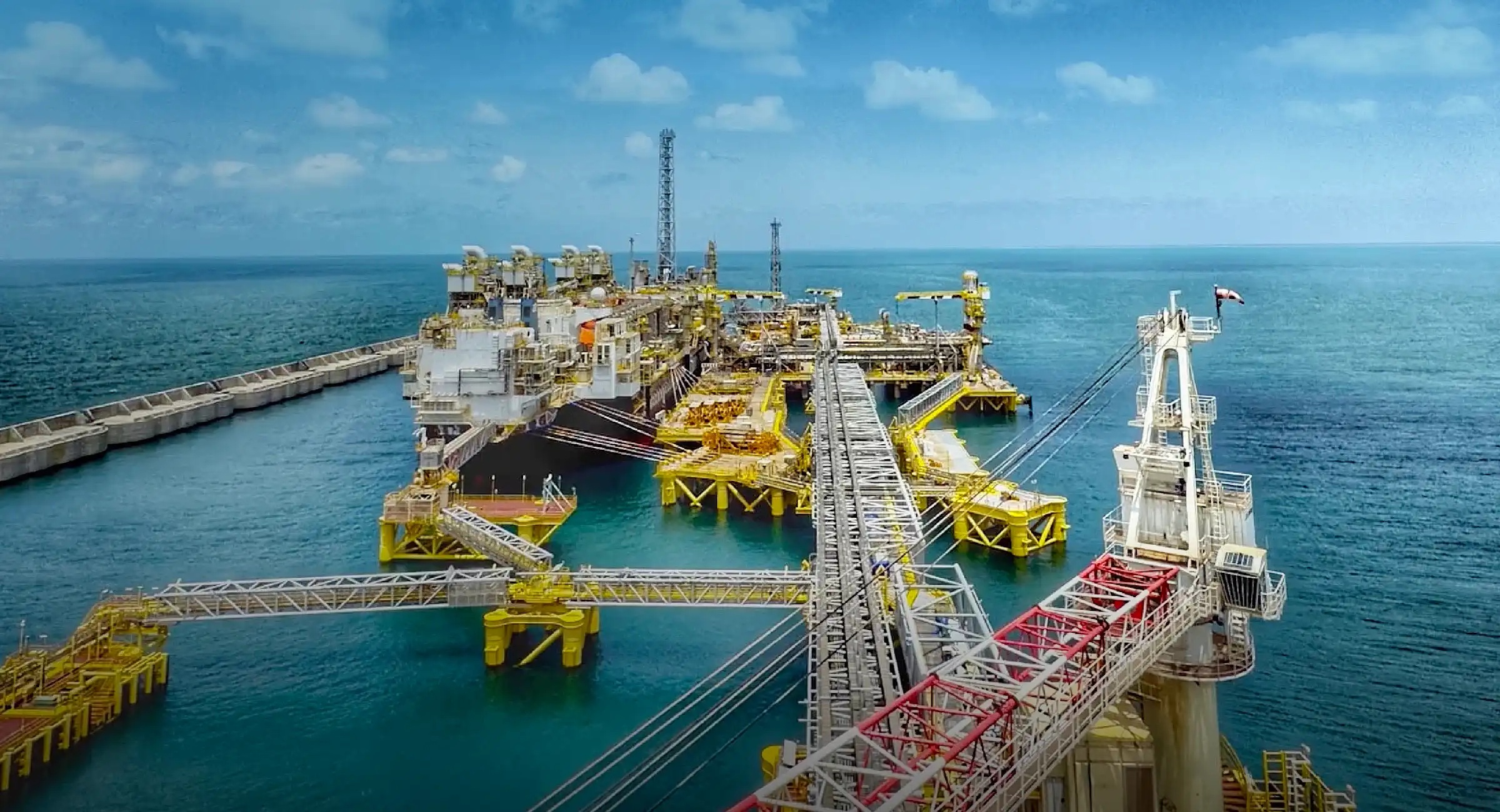
Greater Tortue Ahmeyim, or GTA, makes those relationships visible. Kosmos discovered gas offshore Mauritania in 2015. The development straddles the maritime boundary with Senegal. BP operates it, alongside Kosmos and the two countries’ national oil companies, SMH and PETROSEN. BP Gas Marketing is the contracted buyer for Phase 1 LNG.
Getting that gas to market requires a sequence of machines. Subsea wells feed a floating production, storage and offloading vessel, which processes the gas. A pipeline carries it to a floating liquefaction facility sheltered by a nearshore hub. Liquefaction makes shipment possible. Every link has to function before a geological success becomes a cargo.
- 01ExtractSubsea wells
- 02ProcessFloating production vessel
- 03LiquefyPipeline to floating LNG
- 04ShipLNG export cargo
The partnership with BP, announced in 2016, joined different capabilities. Kosmos brought exploration expertise; BP brought deepwater development and LNG experience. The $916 million fixed consideration comprised cash and commitments to cover specified exploration and development spending. It was not simply a cheque for the entire amount.
First gas arrived at the end of 2024. First LNG followed in February 2025; the first export cargo loaded that April. About ten years separated discovery and shipment. A discovery announcement can fit in a morning’s news cycle. Its commercial consequences may take a decade to arrive.
03 / The $1.225 billion change of direction
The founders’ original emphasis was growth through discoveries. In 2018, Kosmos agreed to acquire Deep Gulf Energy for $1.225 billion, comprising $925 million cash and $300 million in shares. The transaction added a producing U.S. Gulf business and a team experienced in finding resources near existing facilities.
Management’s stated reasoning was revealing. Competitors were leaving the Gulf to pursue onshore shale; Kosmos saw an opening. Production and shorter development cycles could complement its longer projects. Today, the company emphasizes infrastructure-led exploration: a discovery near usable facilities can reach production with less new construction.
“those who move fast, win big”
Andy Inglis, in Kosmos’s 2025 African Energy Week recap
That approach depends on what is already there. Nearby facilities need capacity, suitable connections and reliable operations. Projects need workable economics, funding and government alignment. Jubilee’s bearing problem demonstrated the equipment risk. Kosmos’s December 2025 statement on Yakaar-Teranga illustrated another constraint: without a suitable partner and viable development concept, it contemplated returning the block to Senegal.
04 / Less acreage. More cash.
By June 2026, Kosmos had completed the sale of its Equatorial Guinea production interests to Panoro. Completion cash consideration was approximately $127 million after adjustments, with contingent payments possible. Proceeds were earmarked for borrowing repayments. Second-quarter net production averaged about 71,400 barrels of oil equivalent daily; net debt stood near $2.56 billion.
For a wholesale buyer, Kosmos supplies physical energy. For a host country, the promise extends to export income and domestic gas. Those interests overlap, but the demands can differ. An export contract, a power project and an investor’s debt schedule each impose their own timetable on the same resource.
The everyday work is less cinematic than discovery: water injection, well re-completions, infill drilling and changes to production facilities. Kosmos lists these among its methods for extracting more value from existing assets. In a market selling commodities, the distinction between companies often rests on where they find supply and what delivering it costs.
There is an unexpected parallel onshore. Kosmos launched Ghana’s Kosmos Innovation Center in 2016 to support agricultural entrepreneurs. It later became independent and announced a four-year, $16 million Mastercard Foundation program in 2022. Here, too, another organization supplied a capability and resources the original sponsor could not provide alone.
The transferable lesson is an editorial one: identify the next bottleneck before celebrating the breakthrough. Find the partner, customer and operating system that can carry an idea further. Kosmos’s experience gives that advice a physical form. Sometimes the bottleneck is a financing agreement. Sometimes it is a bearing on a ship.