At 7:43 on a Friday evening, a pizza kitchen can resemble an air-traffic tower designed by people who have never met. The till has one queue. Deliveroo has another. Uber Eats chirps from a tablet. A phone order is balanced on a paper spike. The website uses a different printer, and three drivers want to know what leaves next. The food may be excellent. The information architecture is a small fire.
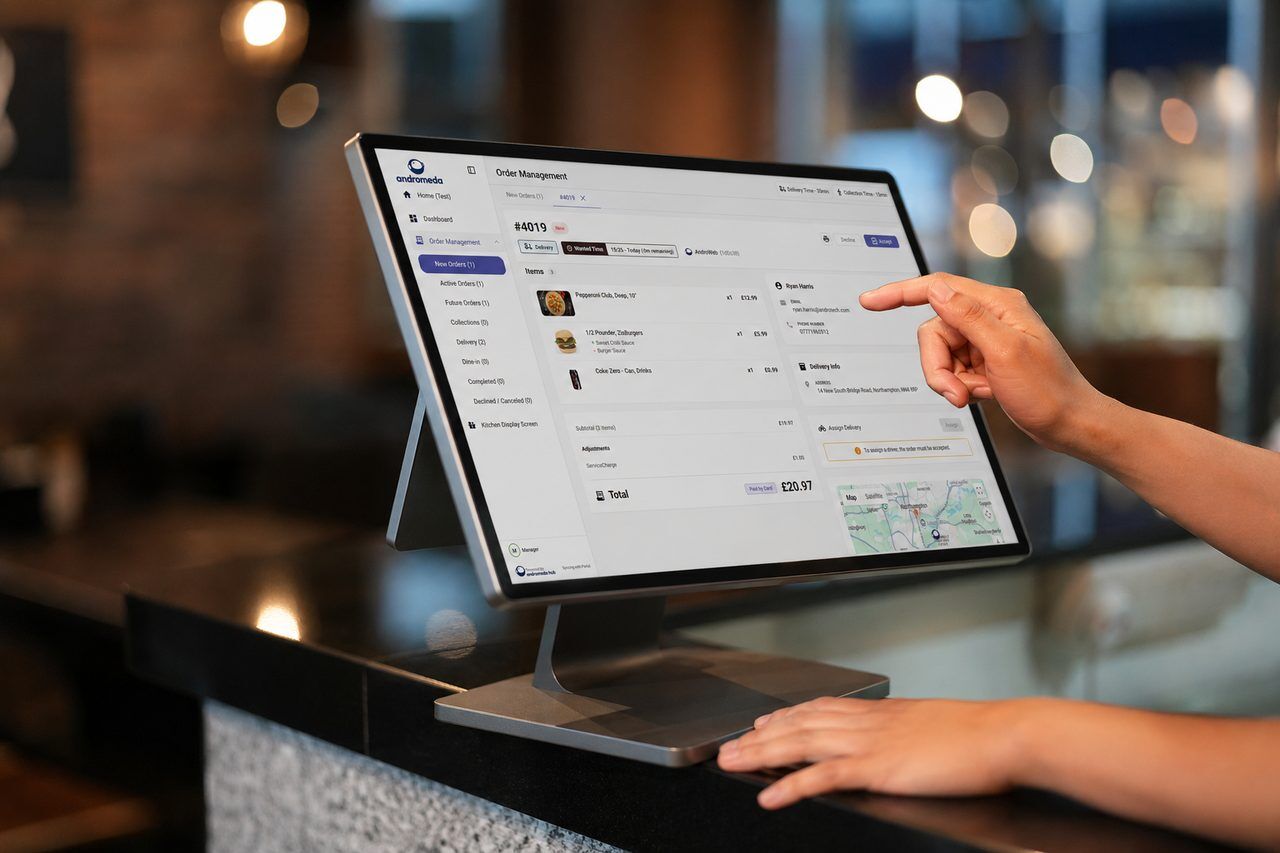
Andromeda POS has built its business around putting out that fire. The London company makes electronic point-of-sale and ordering software for takeaways, quick-service restaurants, fast-casual operators and chains. Its platform covers the obvious things - tills, websites, apps and payments - then follows the order into the parts customers never see: kitchen screens, make times, packing, driver assignment, proof of delivery, cash reconciliation and the owner's live sales view.
That breadth can sound like the usual software-suite brochure. The more useful way to understand Andromeda is as a clock. Website, app, kiosk, counter, phone, Uber Eats, Deliveroo and Just Eat orders are meant to enter one stream. Every state - created, accepted, preparing, ready, dispatched, delivered, cancelled or refunded - carries a timestamp. Instead of asking why Friday was bad, an operator can see whether dinner sat too long on the rack, the oven fell behind or the drivers did.
The first thing to fail is the handoff
Andromeda says it was founded by former restaurant managers Ben Portsmouth and Ben Cole. Portsmouth, now chief executive, started on the floor at Wimpy and later managed Pizza Hut delivery units. That biography matters because the company's most distinctive vocabulary is not technical. It talks about the pass, rack time, modifier mistakes and the point on a wet Friday when the driver rota stops matching demand.
Its published Pronta Pizza case study gives the cleanest account of what failed first. The restaurant had four tabs, multiple printers and separate marketplace tablets. Staff wasted time “finding the next order.” Tickets were dropped, duplicated or given to the wrong driver. Andromeda replaced the patchwork with one kitchen display, connected marketplace feeds, a branded app, a kiosk and automatic overflow delivery. The company reports Friday-night volume rose 32 percent in the six months after go-live, with no extra kitchen staff or second dispatcher. That is a vendor-reported result, not a controlled trial, but the diagnosis is painfully credible.
“Our old setup had four tabs, two printers and a lot of arguing. Andromeda put it all on one screen and the shouting stopped.”Luca Romano, owner, Pronta Pizza
The drawing is deliberately simple. The work is making menu changes, order status and timing survive every arrow.
The change of mind here is operational: stop treating each sales channel as a separate miniature business. One master menu controls products, prices, modifiers and allergens. Marketplace orders print where staff already look. A sold-out item can be changed once. Head office gets a common report rather than a spreadsheet séance. For a chain, role-based access lets headquarters see the estate, area managers see their patch and franchisees see their own stores.
A direct order is only useful if the kitchen can absorb it
Restaurant technology now has two competing promises. Marketplaces offer discovery and delivery capacity, while direct ordering offers better margins, customer data and a brand relationship. Andromeda refuses the neat either-or. It connects Uber Eats, Deliveroo and Just Eat to the same workflow while selling restaurants their own SEO-oriented website, iOS and Android app, loyalty scheme and marketing tools.
That difference is important. Commission avoidance alone does not create a direct business. The restaurant still needs a site customers can find, a checkout they will finish, a reason to return and an operation that does not punish the kitchen for receiving more orders. Andromeda links the direct channel to customer profiles, points, reward tiers, product rewards, email, SMS and push notifications. The restaurant keeps the customer data; marketplace orders deliberately do not earn its direct-channel loyalty points.
At the counter, self-service kiosks use the same menu and send orders into the same production line. Four formats run from compact 15-inch countertop units to 21-inch floor-standing models. Andromeda publishes a starting price of £79 a month and says kiosks typically lift average order value, although any operator should test that claim against footfall, menu complexity and card fees. A kiosk in a busy chicken shop can split a queue. A kiosk in a quiet dining room may become expensive furniture.
Three clocks, not one excuse
The company's restaurant-operator DNA is clearest in its timing model. “Late delivery” is divided into make time, rack time and drive time. Make time exposes the kitchen station that is behind. Rack time shows prepared food waiting for collection. Drive time reveals routing or capacity trouble. Ready-time updates can flow back to marketplaces, while Mission Control lets owners watch sales, order count, channel mix, feedback and service times on a phone.
Then there is the driver problem. Employing enough riders for the Friday peak leaves idle capacity on Tuesday; relying entirely on couriers can be costly and patchy. In February 2026, Andromeda integrated Uber Direct into a service it calls Deliver Plus. In March it added Stuart. The dispatch engine can use a restaurant's own driver when available, compare courier coverage and quotes, and fall back to the second network if the first has no rider. The kitchen keeps one screen and the diner keeps one ETA.
This hybrid is a sharper competitive position than “all-in-one.” Toast, Lightspeed, TouchBistro and Square cover broad restaurant operations; Owner.com and ChowNow press the direct-ordering case; middleware providers connect aggregators. Andromeda is most legible where delivery itself is the operating system - pizza, curry, chicken, kebab and other kitchens in which dispatch is not an add-on after payment.
The bill is public. The migration cost is not.
Andromeda's published pricing begins at £49 per site per month for Essentials, including a touchscreen and printer, branded ordering website and app, Order Manager, basic menu and loyalty tools, Uber Direct access, and its Go and Mission Control apps. Growth costs £99 and adds aggregator connections and advanced reporting. Pro is £149 and brings counter, collection, delivery and dine-in POS functions. One-time setup fees are £295, £395 and £495 respectively.
The front door
£49per site / month + £295 setupWebsite, app and order manager for a direct-ordering start.
The tablet cleanup
£99per site / month + £395 setupAdds marketplace connectors, menu sync and deeper reporting.
The whole counter
£149per site / month + £495 setupAdds the full POS for counter, phone, delivery and dine-in.
Online-order economics require another choice. The restaurant can pay 6 percent per web or app order, or pay a stated 2.95 percent processing fee while the customer pays a 60p service charge. Courier trips are usage-based. Enterprise and volume discounts are quoted. The sticker price is therefore only the beginning: card mix, direct-order volume, kiosk rental, hardware, data migration, training and marketplace contracts determine the real bill.
There is also an old-versus-new tension. Public company material describes a hybrid SaaS and on-premise heritage, useful for chains with existing hardware and integration constraints. The current product pitch includes provisioned touchscreens and a connected cloud stack. That flexibility can make Andromeda easier to fit into a complicated estate, but it also means buyers should map every terminal, printer, payment provider, menu and custom integration before treating the monthly plan as a total cost.
What an operator can steal without buying anything
The one-queue test
- Draw every place an order can enter. If staff must swivel to find one, the architecture is charging rent.
- Measure make, rack and drive time separately. “Late” is a symptom; one of those clocks is the cause.
- Keep one canonical menu. Prices, allergens, modifiers and sold-out items should change once.
- Use employed drivers for predictable volume and overflow capacity for spikes, but compare the full per-order cost.
- Treat direct ordering as a retention system, not merely a cheaper checkout page.
The model is not universal. A tiny café with one till and no delivery may not benefit from a delivery-first control room. A fine-dining operation may care more about reservations, tables, courses and hospitality workflows. Restaurants without enough repeat demand may struggle to move diners from marketplace discovery to a branded app. And no platform can rescue bad food, weak staffing or an unrealistic delivery radius.
But for the delivery-heavy restaurant, Andromeda's long view is persuasive because it is gloriously unromantic. The company does not need to predict how people will order next. It needs to make the next channel enter the same queue, obey the same menu and leave a timestamp behind. The restaurant still has to survive Friday night. At least the screens can agree on what happened.