A pizza is an awkward thing to describe to a computer. Put pepperoni on one half, mushrooms on the other, extra cheese everywhere, then apply a coupon that changes the price. Now send it to the kitchen, remember the customer’s address, and find a driver. Dinner has become a coordination problem. This is the territory HungerRush chose.
- Connected POS, ordering, payments, delivery and marketing.
- A particular appetite for pizza, carryout and independent operators.
- The buying lesson: test one real store before switching the chain.
The Houston company began in 2003 as Revention. Founder Jeff Doyle was already discussing restaurant hardware reliability in a Samsung case study a decade later. Today, the name is HungerRush, and the pitch extends from the terminal to the customer’s next visit. Its expertise lives in the fussy details: modifiers, delivery zones, repeat orders, coupons and the people who must make them work.
01 / The coupon that multiplied
Consider Flyers Pizza, a ten-location Ohio chain. In HungerRush’s account, an earlier software migration created menu bugs and online orders that failed to connect properly to the register. There was also a remarkably ordinary problem: staff entered menu revisions and coupons separately at each store. Flyers changed its coupons weekly. Every new offer brought another round of clerical work.
What changed the decision was a pilot. Flyers tried HungerRush in one restaurant, then moved all ten locations within eight weeks. The company’s case study says centralized updates eliminated three days of manual work per week. Treat that as a customer result reported by its vendor, rather than a promise for your restaurant. The useful detail is the sequence: prove the workflow locally, then repeat it.
02 / Follow the order, not the app
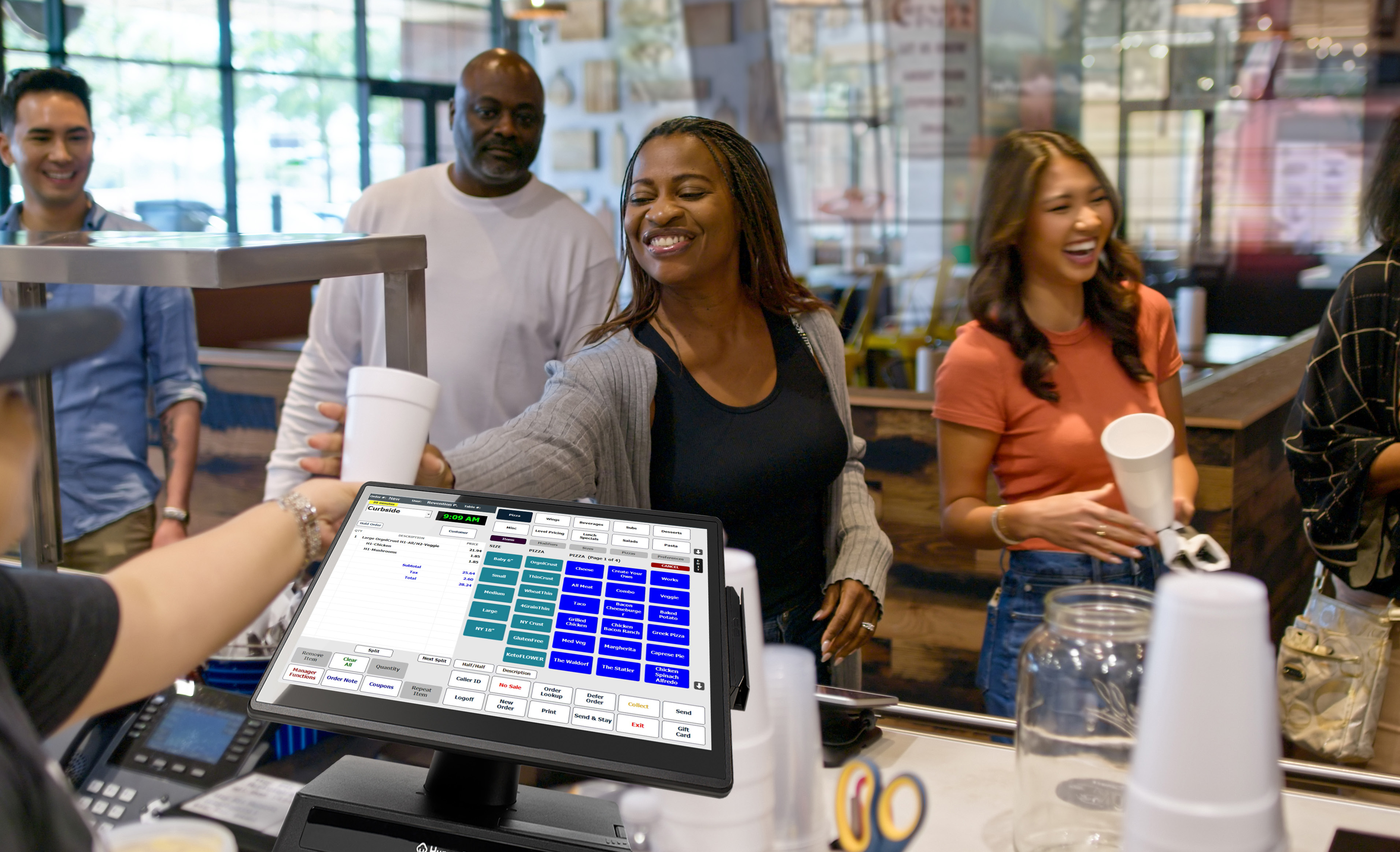
HungerRush sells a connected operating system for restaurants. A direct online order, a delivery-app order and a counter order can reach the same POS workflow. Menu changes, kitchen displays, payments and dispatch belong to the same operational conversation. Managers can inspect sales and labor reporting remotely; marketing and loyalty tools can use the customer history left behind.
This matters because restaurants rarely experience software as a list of features. They experience it as handoffs. Does the coupon survive checkout? Does the kitchen receive the modifier? Does someone have to type an order again? HungerRush’s argument is that fewer disconnected handoffs give staff fewer opportunities to lose the plot.
Phone · Web · Apps02
POS + payment03
Kitchen + dispatch04
Loyalty + follow-up
The market includes broad restaurant platforms such as Toast, Square and Lightspeed. HungerRush makes its case through pizza and delivery specialization, while serving other quick-service and fast-casual concepts too. An owner with drivers, complex toppings and several stores has different purchasing questions from a café selling mostly coffee. The fit starts with those questions. Ask how the system behaves when an order changes after payment, a driver returns late, or a guest wants the same combination they bought last Friday.
03 / The people behind the screen
For Creno’s Pizza, the problem also involved trust. HungerRush’s case study describes inaccurate reporting, weak delivery integrations and features its previous supplier had promised but never delivered. The 24-location Ohio chain became a customer in 2024. Owner Eric Mitchell’s explanation was unusually direct:
“What sold us on HungerRush was the people”Eric Mitchell · Creno’s Pizza
That preference has practical consequences. Implementation needs calendars, training and someone who answers when a store hits trouble. HungerRush advertises US-based support around the clock. Its careers page emphasizes small teams and direct communication. Those are company descriptions; Creno’s story supplies a concrete reason an operator might care about them.
The same case study reports about $219,000 in associated revenue from a two-week text campaign. Associated revenue deserves careful reading. It does not establish how many purchases would have happened anyway, or how much profit remained after discounts and costs. The repeatable idea is to connect customer outreach to actual transactions, then ask tougher questions about the result.
04 / A text that remembers dinner
HungerRush assembled part of this capability through acquisitions: OrdrAI in 2020, then digital marketing business 9Fold and online-ordering platform Menufy in 2021. Corsair bought a majority stake in HungerRush in June 2022; CapStreet retained a minority investment. The acquisition price was undisclosed. This is a software, hardware and payments business built partly by joining neighboring tools.
OrderAI adds text and phone ordering. At Jet’s Pizza, customers can repeat a previous order by texting “re-pizza.” In December 2025, Jet’s announced more than ten million AI orders representing over $250 million in sales. Its announcement covered programs involving HungerRush and ConverseNow, so the entire milestone cannot be assigned to HungerRush alone. The appealing behavior is simpler than the technology: dinner remembered.
05 / Read the bill. Test the rush.
The current base offer starts at $149 monthly, with hardware leased at zero down under a 36-month agreement. Core POS, online ordering and delivery dispatch are included. Payment processing and optional modules belong in the budget conversation. Marketing, loyalty and AI phone ordering can change the package. Across the full term, the advertised monthly base adds up to $5,364. That arithmetic gives buyers a starting point for comparison, but the more revealing calculation includes their order volume, processing arrangement, extra equipment and the time staff spend learning a new system. A low monthly number cannot answer all of those questions.
Monthly base charges over the agreement. Processing and optional modules need separate consideration.
Connection also creates responsibility. In March 2026, HungerRush said compromised third-party vendor credentials allowed access to its email marketing service and customer contact information. The company said passwords and payment-card data were not exposed, and it disabled affected access. A restaurant buying connected customer tools is also choosing who helps safeguard those relationships.
For an operator evaluating the platform, the practical move is to bring a troublesome order to the demo, then test it in a store. Check modifiers, discounts, kitchen routing, dispatch and refunds. A simpler operation may gain less from the breadth; a reluctant team or an unproven migration can erase the convenience. Software can move an order through a restaurant. The kitchen still has to keep up.