In Paris, Brendan Sweeney encountered a peculiar failure of hospitality. The food had a reputation. The menus had text. Choosing where to eat meant comparing three pieces of paper, as though dinner were a procurement exercise. He later recalled the absurdity to Restaurant Business: “Greatest food city in the world, and I’ve got three pieces of paper with text on them to compare.”
- Popmenu turns restaurant menus into dish pages with photos, reviews and a path to purchase.
- It bundles websites, ordering and follow-up marketing for independent restaurants and groups.
- Its useful trick is connecting those jobs. The AI helps with the repetitive parts.
- Subscriptions start at a $159 monthly equivalent in the US, prepaid annually; extras change the bill.
Three pieces of paper in Paris
The complaint sounds cosmetic until you think about the decision a menu must support. A guest wants to know whether the dumplings look good, whether anyone else likes them, what they cost and how to get them. A PDF can supply some answers. It usually leaves the guest to assemble the rest elsewhere. The restaurant has introduced its product, then sent its prospective customer on a research expedition.
Popmenu began in 2016 with that gap. Sweeney, Tony Roy, Mike Gullo and Justis Blasco built a company around giving restaurants a more useful digital presence. Sweeney brought product and marketing experience, including earlier work building small-business websites. Today, Popmenu sells a subscription platform that connects the restaurant’s site to its menus, ordering, guest communications and performance reporting. The company says more than 12,000 restaurants use it.
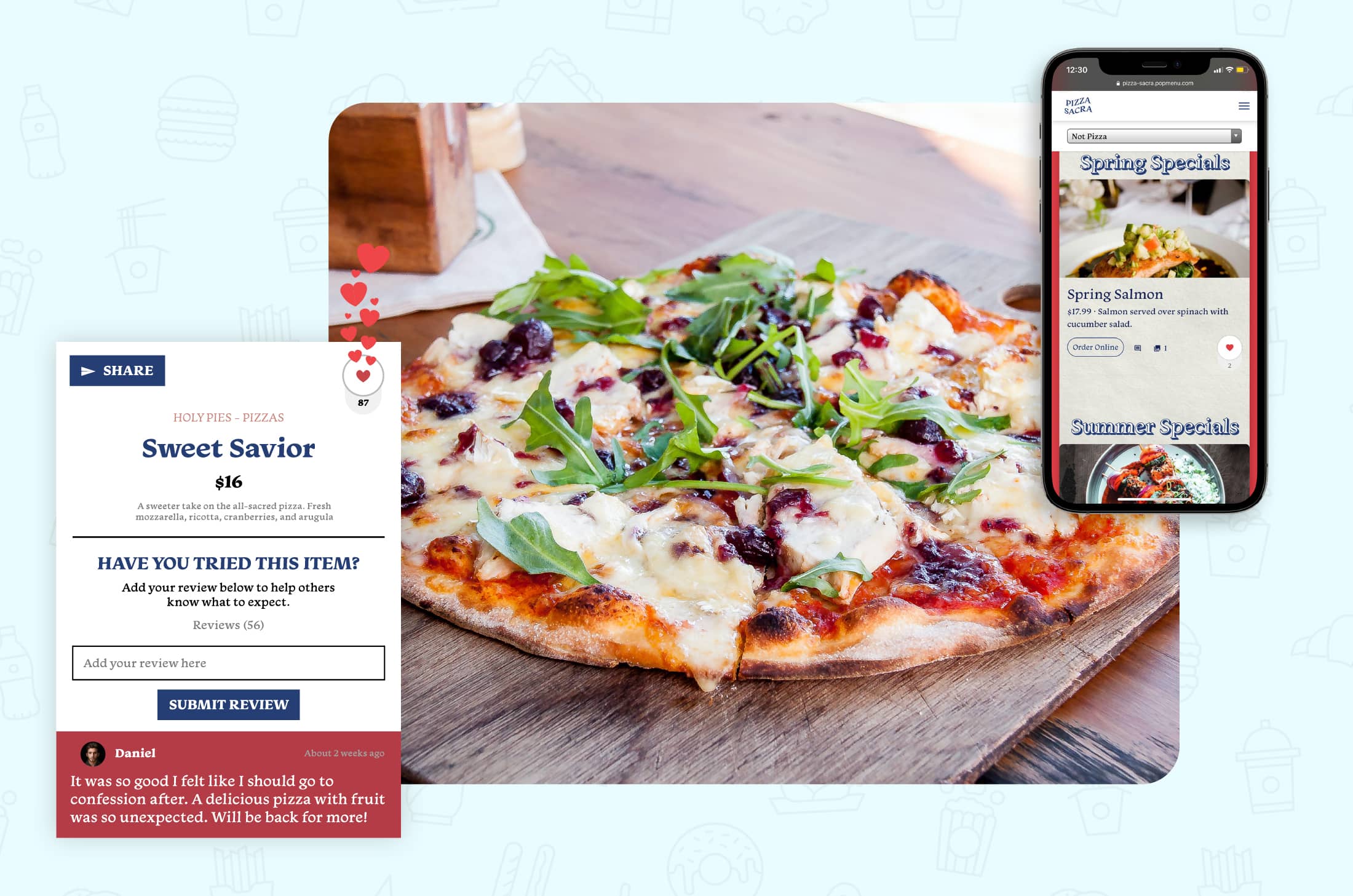
A dish gets its own address
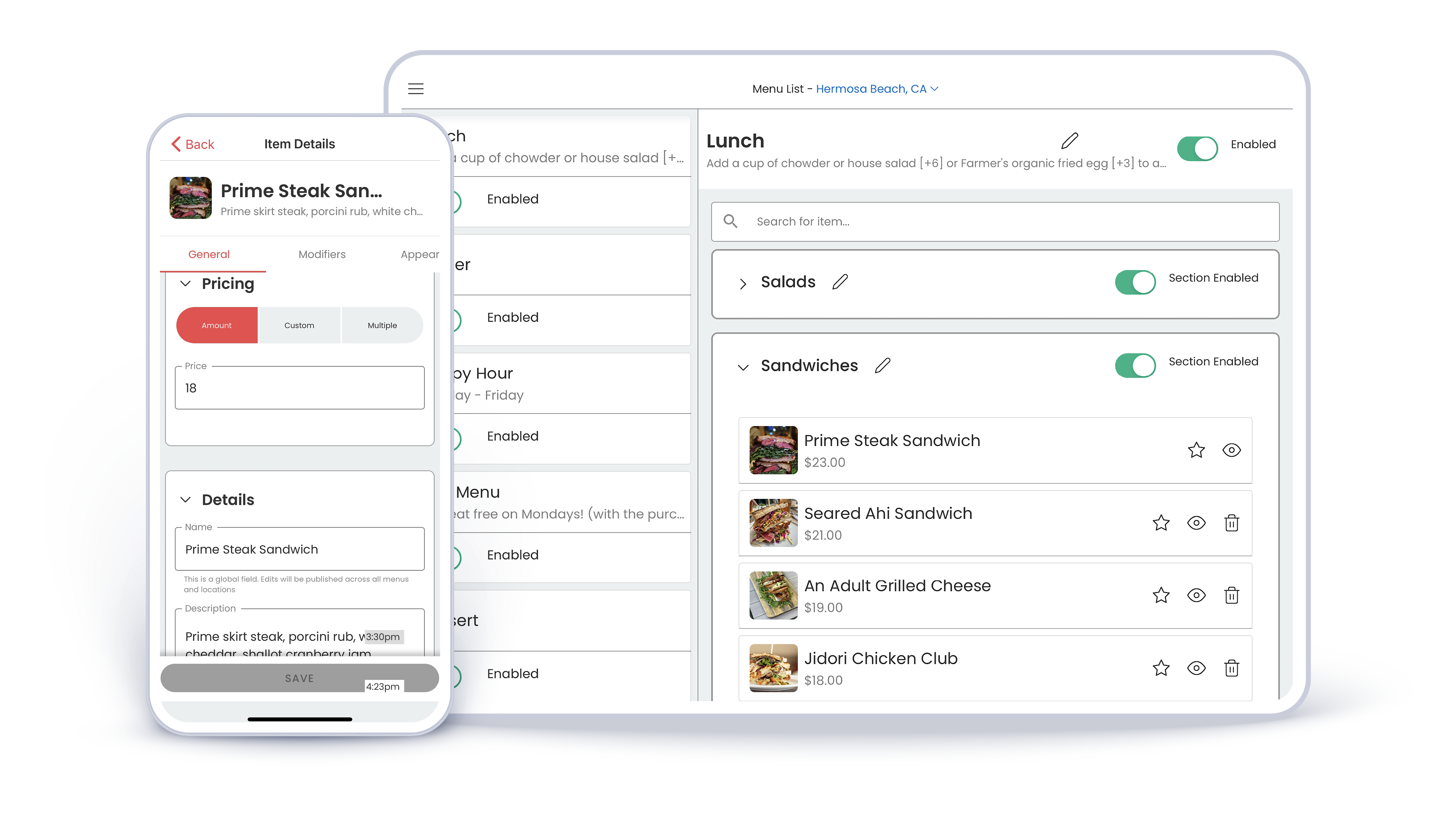
The menu remains the most interesting part. Popmenu gives individual dishes their own indexed pages, with structured information intended to help search engines understand them. Photographs, videos, reviews and dietary details can sit beside the description. Owners can update the menu through the web or mobile app. A sold-out dish need not enjoy an extended afterlife on an abandoned attachment.
This changes the unit of attention. Someone can arrive looking for a particular dish rather than knowing the restaurant’s name. Once there, they can examine it, react to it and order. Those interactions also give the operator clues about what interests guests. A menu becomes a place to learn as well as a place to announce. The business can use what it learns to make its next message more relevant.
- 01Get foundSearchable dishes
- 02Help decidePhotos + reviews
- 03Take the orderOn the restaurant site
- 04Invite a returnUseful follow-up
The copyable idea is straightforward: put the evidence beside the decision. Show the food where people are choosing food. Give a guest a direct next step. For any small business, shortening the journey between curiosity and purchase is a more sensible starting point than buying another dashboard.
Eight restaurants, too many passwords
Steam Boys, a Tennessee group serving Chinese comfort food, supplies a more grounded explanation of the bundle. In Popmenu’s account, its eight locations had accumulated tools for website changes, ordering and email that did not work together. The problem was keeping up with them and seeing what customers actually did.
The group adopted a Popmenu website, photo-rich menus with reviews, and ordering hosted directly on the site. It collected guest contacts through transactions, then used automated messages and custom offers to encourage another visit. The case study reports more than $1.5 million in online sales, over 28,000 followers and more than $430,000 in sales associated with email marketing.
“It saves so much time and effort on my end.”Tunji Junard, CMO & Co-founder, Steam Boys
These are Popmenu-published customer results. They describe sales and attribution, not an independent experiment proving how much additional profit the software created. Their practical value is the sequence: bring ordering onto the site, build a contact list, follow up and compare performance across locations. That is an operating habit a restaurant can copy.
The phone rings while brunch burns
Breakfast Brothers offers another route into the product. In its published customer story, co-owner Rickey Booker describes expansion followed by hurried hiring. He shifted attention toward recruiting, training and leadership, then used technology to take routine work off the team’s plate. What changed his mind about the software was its integration: he wanted the reports together.
Popmenu supplied AI marketing, phone answering and online ordering. Its case study says AI Answering handled more than 9,300 calls, resolved 49% automatically and saved over 119 staff hours. Thirty percent of calls arrived on Sundays. That last detail is more revealing than a slogan about efficiency: the interruption was arriving during a lucrative brunch rush.
Breakfast Brothers, in Popmenu’s case study. Useful coverage; a substantial share still needed another route.
The current phone product answers common questions and texts links for orders and reservations. It starts at $149 a month. Operators should test those exact jobs. A link to checkout is different from a completed spoken order, and an unusual question still needs a human path. Accurate hours, menus and responses remain someone’s responsibility.
For marketing, Popmenu can prepare a restaurant-specific calendar of emails, texts and social posts for approval. Its 2023 GPT announcement added content creation and previewed campaign recommendations based on guest behavior and past results. The appeal is less literary than logistical. Someone running a dining room can review a month’s messages without beginning each one with an empty screen.
The bill arrives monthly
Popmenu’s business model is software sold per location, with optional products and managed services. Its current US annual-prepaid plans have monthly equivalents of $159, $269 and $449. Online ordering is an add-on; the platform charges $1 per order rather than a percentage commission. The restaurant can absorb that dollar or pass it to the guest.
“Commission-free” therefore needs careful reading. There is still a transaction fee and a subscription. Take an illustrative restaurant earning $8 in contribution from an extra order after food, packaging and other variable costs. Absorbing the $1 fee leaves $7. A $269 base subscription would require roughly 39 additional orders a month to cover itself, before ordering add-ons or other expenses. Those are assumptions, not Popmenu results.
This is how an operator should judge the purchase: contribution from genuinely additional business, plus a realistic value for time saved, against the entire bill. Orders moved from another channel can improve margins without being new orders. A marketing report should not be permitted to confuse the two.
The unglamorous art of agreeing on a price
Behind the guest experience sits a harder problem: getting systems to agree. Popmenu integrates with platforms including Square and Oracle Simphony, connecting menu information and online orders to the point of sale. A price on the website must mean the same thing to the system receiving the order. The photograph can be charming; the wrong modifier cannot.
Engineering partner ShakaCode describes an engagement lasting from August 2020 to March 2026. Early attempts at two-way menu synchronization introduced consistency and conflict-resolution problems. Different POS systems had different architectures and data structures. The team rebuilt the Toast sync engine and developed a repeatable method for further integrations. Its account reports more than 1,000 pull requests over the engagement.
That is a documented difficulty, and it explains some of the expertise the company needs: restaurant marketing, user experience and reliable integrations. It also gives buyers a useful test. Confirm the precise POS version, menu ownership and order flow before switching. More tools in one contract help only if the connections work in the restaurant’s actual setup.
A bigger menu, a tougher market
The product expanded with the company. Popmenu announced a $4.5 million Series A in 2019, a $17 million Series B in 2020 and a $65 million Series C led by Tiger Global in June 2021. That October it acquired OrderNerd, which consolidated incoming third-party orders. The move addressed another restaurant irritation: several delivery services could mean several tablets and printers.
Popmenu now occupies a crowded stretch of restaurant technology. Owner.com also combines websites, ordering and repeat-customer tools. Clover’s BentoBox offers marketing and commerce; its current site limits new BentoBox services to Clover POS customers. Popmenu’s menu-first approach is distinctive, but the feature lists overlap. Existing systems, migration effort and the operator’s ability to use the tools matter more than a contest of adjectives.
The company’s careers page says every employee receives equity and lists values including Act Like an Owner and Make Others Shine. Its customer-facing mission is to make profitable restaurant growth easier. In November 2025, it announced a fourth consecutive Deloitte Technology Fast 500 appearance, reporting 323% revenue growth from 2021 to 2024. In 2026, its research has continued into US and UK dining behavior.
There are limits to the proposition. A restaurant with little direct traffic, few usable guest contacts or no capacity to review campaigns may gain less from the bundle. Poor food and unreliable service will also survive a website upgrade. Breakfast Brothers’ changes to hiring are a useful reminder: automation works inside an operating business. The website can invite someone back. The kitchen still has to make that invitation worthwhile.