Andrew Mason has a reliable way of announcing that he is no longer the chief executive: he makes a joke. In February 2013, after Groupon dismissed him, the punchline was blunt. “Just kidding - I was fired today.” In August 2025, introducing his new position as Descript’s executive chairman, he teased the familiar spectacle of a founder hanging around to interfere with a successor. Then he explained that Laura Burkhauser would actually be in charge.
Those announcements sit twelve years apart. One followed a board’s decision. The other described a decision Mason had helped arrange. The humor remained; his relationship to the chair had changed. A career usually filed under Groupon’s rise and fall had acquired a quieter development: the founder could see a future for his company with somebody else running it.
By autumn 2026, he was also involved in a business with an unusually tangible interface. Tabletop Library, a membership board game club in Berkeley, had opened its doors. After years of helping people manipulate digital recordings, Mason was helping them find a table. The box you opened might contain cardboard.
The music major and the pizza downstairs
Mason grew up in Mount Lebanon, outside Pittsburgh. At fifteen, he started Bagel Express, a Saturday-morning delivery service. It is a modest beginning for an internet entrepreneur, though it has the advantage of an easily understood customer need. People wanted breakfast. Someone had to bring it.
At Northwestern, he initially studied materials science engineering before switching to music, graduating in 2003. Computers and music were both already part of his life. Recalling high school, he described seeing another student sell a website to a dentist for $400 and briefly concluding that the market for websites had been cornered. The future Groupon founder had underestimated the number of dentists.
His route through Chicago included web development and graduate study in public policy at the University of Chicago. Eric Lefkofsky, for whom he had worked, supplied seed backing for The Point. The idea was collective action with a threshold: people would commit to something if enough others joined to make it worthwhile. Its ambitions were broader than shopping.
The smaller proposition proved easier to explain. Groupon offered a local deal, with the company doing the negotiating. An early offer was two-for-one pizza at Motel Bar, downstairs from the office. Mason could code enough to assemble a WordPress version. The original machinery was makeshift; customers were less concerned with architectural elegance than with getting their pizza.
By July 2010, Groupon had attracted twelve million members worldwide. It went public in November 2011. A simple daily offer had become a large organization with competitors, international operations, and public shareholders. The distance between making something people want and managing everything required to deliver it had become difficult to ignore.
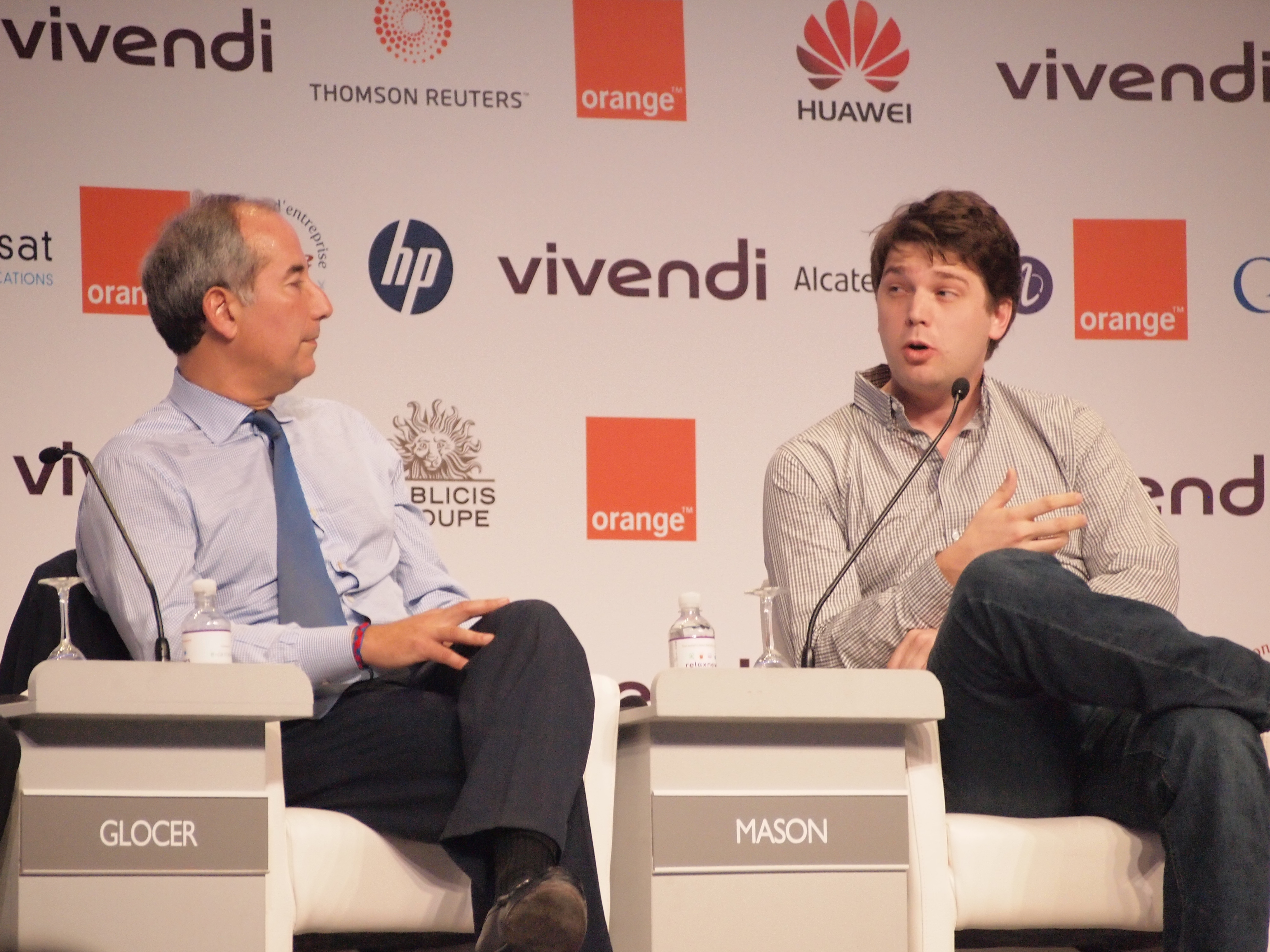

Seven tracks, no quarterly guidance
Groupon’s disappointing results and falling share price preceded Mason’s dismissal on February 28, 2013. His farewell acknowledged responsibility. Its opening joke traveled widely, partly because executive departure notices generally work so hard to avoid the verb he used. Mason had given the event a recognizable human voice.
Then he released a record. Hardly Workin’, issued that July, contained seven tracks of motivational business music. Titles included The Way to Work, My Door Is Always Open, and Stretch. Don Gehman, whose credits included R.E.M. and John Mellencamp, produced it. Corporate advice had found a studio booking.
The album makes more sense if the music degree stays in the picture. Mason had returned to something he could make, combining a real interest with an elaborate joke. Business lessons could apparently be sung. Whether anyone wanted a manager’s wisdom in their headphones was another question, but the experiment was certainly specific.
His humor had also been part of Groupon’s product. The company employed humor writers for its deal descriptions. An otherwise ordinary offer acquired a voice. That instinct runs through Mason’s work: even a routine transaction can bear the marks of someone who enjoyed making it.
The tour that contained another company
Detour began with a frustration Mason remembered from traveling with his wife. They wanted context for the places they visited, without joining a group on somebody else’s schedule. A smartphone could carry the guide. The city could supply the scenery.
Released in 2015, Detour offered location-aware audio walks. Its narrators had a connection to the places they described. Cleve Jones guided listeners through the Castro. A KQED collaboration brought Peter Coyote to the Haight-Ashbury. Mason particularly liked a Tenderloin walk narrated by people who lived there. He wanted visitors to reconsider a neighborhood they might otherwise pass judgment on.
There was considerable production work behind that apparently simple walk. Interviews needed recording, passages needed choosing, and spoken material needed arranging. Editing waveforms imposed a technical layer between the producer and the sentence. Detour’s team built an internal editor that connected a transcript to the recording.
The idea was immediately legible: remove words from the text and remove the corresponding audio. Move a passage and the recording follows. People already knew how to edit a document. The transcript gave them a handle on a medium that had previously required a different vocabulary of controls.
Detour struggled to reach a broad audience. Producers shown its editing tool were interested. In 2017, Descript became a separate company with $5 million in seed funding from Andreessen Horowitz. Bose acquired Detour in 2018. The venture had produced something valuable along the way, although it was rather different from the thing Mason had set out to sell.
Keeping the editorial ear
Mason’s recording background helped him recognize the friction. In a 2024 interview, he described a Detour team that brought technologists and former public-radio producers together. The software grew around people making narrative audio, with practical opinions about how an edit should sound.
That last point matters. A sentence can look clean on a page and sound peculiar when spoken. A pause may carry hesitation, emphasis, or a little humanity. Removing every filler word can make a person sound as though they have been assembled. Mason has discussed that problem too: easier editing still benefits from an experienced ear.
“Culture is like another product we want to build at the company.”
Andrew Mason, on building Descript
Descript expanded into video and AI-assisted production. In 2022, it raised a $50 million Series C led by OpenAI Startup Fund. The attraction went beyond faster transcription: the editor could become a place where someone shaped an idea without having to master every technical operation first.
That ambition leaves a useful tension. Tools can shorten the distance between an intention and a finished piece. They cannot decide whether the intention is interesting. Mason’s own projects illustrate the distinction rather well. A walking tour needs a reason to take the walk. A business record needs a joke worth hearing. An editor needs something worth editing.
A successor, chosen in advance
After Groupon, Mason spoke more explicitly about the mechanics of company culture. At South Park Commons in 2018, he discussed the cost of expanding with operating partners whose commitment to customers differed from his own. Values, he argued, needed to describe behavior clearly enough to guide decisions when people were no longer in the same room.
At Descript, that attention took concrete forms. Employee pages in Notion preserved onboarding details and ongoing conversations. Meeting templates captured feedback. Mason resisted adding unnecessary database fields, recognizing how a small administrative burden multiplies across an organization. The person associated with conspicuous jokes was also thinking about the accumulated nuisance of an extra box to fill in.
By August 2025, he was ready to change his own place in that organization. He named Burkhauser, previously the head of product, as CEO. His announcement reported $55 million in annual recurring revenue and 75 percent year-over-year growth. Those were his figures for that moment, a subscription run rate rather than a statement of annual booked revenue.
Mason’s reported Descript figures at the August 2025 leadership transition.
He praised Burkhauser’s product judgment, business sense, and leadership. He also credited her with naming Underlord, the AI editing assistant. Cultural continuity apparently included a willingness to sound slightly sinister. His new role would provide context and a sounding board; operating decisions would belong to her.
The next meeting has a game board
With Nabeel Hyatt and David Chen, Mason pursued Tabletop Library in Berkeley. He and Hyatt demonstrated experiments with AI for business planning, organizing games, and a text-based concierge to help people find fellow players. The technology addressed a familiar social complication: wanting to play something and needing a group before it can happen.
The physical club developed its own scale. Its September 2026 grand-opening announcement described twenty-four tables, more than 1,100 games, and five hundred vinyl records. The celebration was scheduled for October 3 and 4. The old interests had found new furniture: music, systems, local discovery, and people doing things together.
Mason added another experiment. In September, he pledged to publish quarterly financials, with the aim of discovering a model other board game clubs could repeat. He laid out projected capital requirements and a path toward profitability. These were targets, with actual results still to come. The aspiration was a business from which an owner could make a living.
That is a revealing place to leave him: having handed over one company’s operating decisions, and helping work out whether another kind of gathering place can support itself. He still has ideas that require other people to show up. He still finds the administrative details worth tinkering with. And he still seems to regard a business announcement as an opportunity to let a joke escape.