Northwestern University began like a startup with a pitch deck nobody sensible would fund. Nine Chicago men met above a hardware store in 1850 to build a university for the old Northwest Territory. They had no campus, no faculty, no students and, on the institution’s founding date, a reported $9.92 in the treasury. Only one of the nine had attended college. John Evans called the early persuasion campaign “wind work.” In modern language: pre-product community building, regulatory strategy and an heroic amount of networking.
The pitch eventually became a private nonprofit research institution with 12 schools, campuses in Evanston, Chicago and Doha, roughly 23,000 students and $3.459 billion in fiscal 2025 operating revenue. It sells no single thing. Degrees are the obvious product, but Northwestern also provides research infrastructure, clinical training, executive education, industry collaboration, intellectual-property licensing, startup incubation, cultural programming and a talent network that keeps renewing itself.
The first product was a promise
What did it cost to get moving? Evans and fellow founder Orrington Lunt each put in $5,000. Northwestern’s first building cost just under $6,000. The trustees wanted to raise $200,000, with half expected from “perpetual scholarships.” From 1853 to 1867, buyers paid $100 in four installments. In return, the buyer and one heir per generation could attend tuition-free. Clark Hinman, Northwestern’s first president, sold $63,000 worth before dying in 1854, a year before any student enrolled.
It was clever because the same contract supplied immediate cash and future customers. It was also a liability with a very long tail. Northwestern has continued to honor qualifying contracts. The mechanism is worth studying, not copying literally: sell access early, make the promise concrete and let early believers recruit the next cohort. The catch is brutal. A perpetual benefit only works if the institution survives in perpetuity.
What failed first became an asset
The original campus idea was downtown Chicago. Trustees paid $8,000 for 16 lots at LaSalle and Jackson, then changed their minds. Hinman pushed them to build the university before a preparatory school and to find room outside the city. A rail-connected 379-acre lakefront tract north of Chicago offered space. Concerns about the downtown neighborhood added a shove. The campus moved. The town that formed around it became Evanston.
Here is the lovely reversal: Northwestern kept the rejected Chicago property and leased it. That abandoned plan produced income for more than a century before the land was sold in the 1990s. The founders did not confuse “we will not use this” with “this has no value.” The lesson is optionality. Preserve good assets when a strategy changes, provided carrying them does not threaten the core.
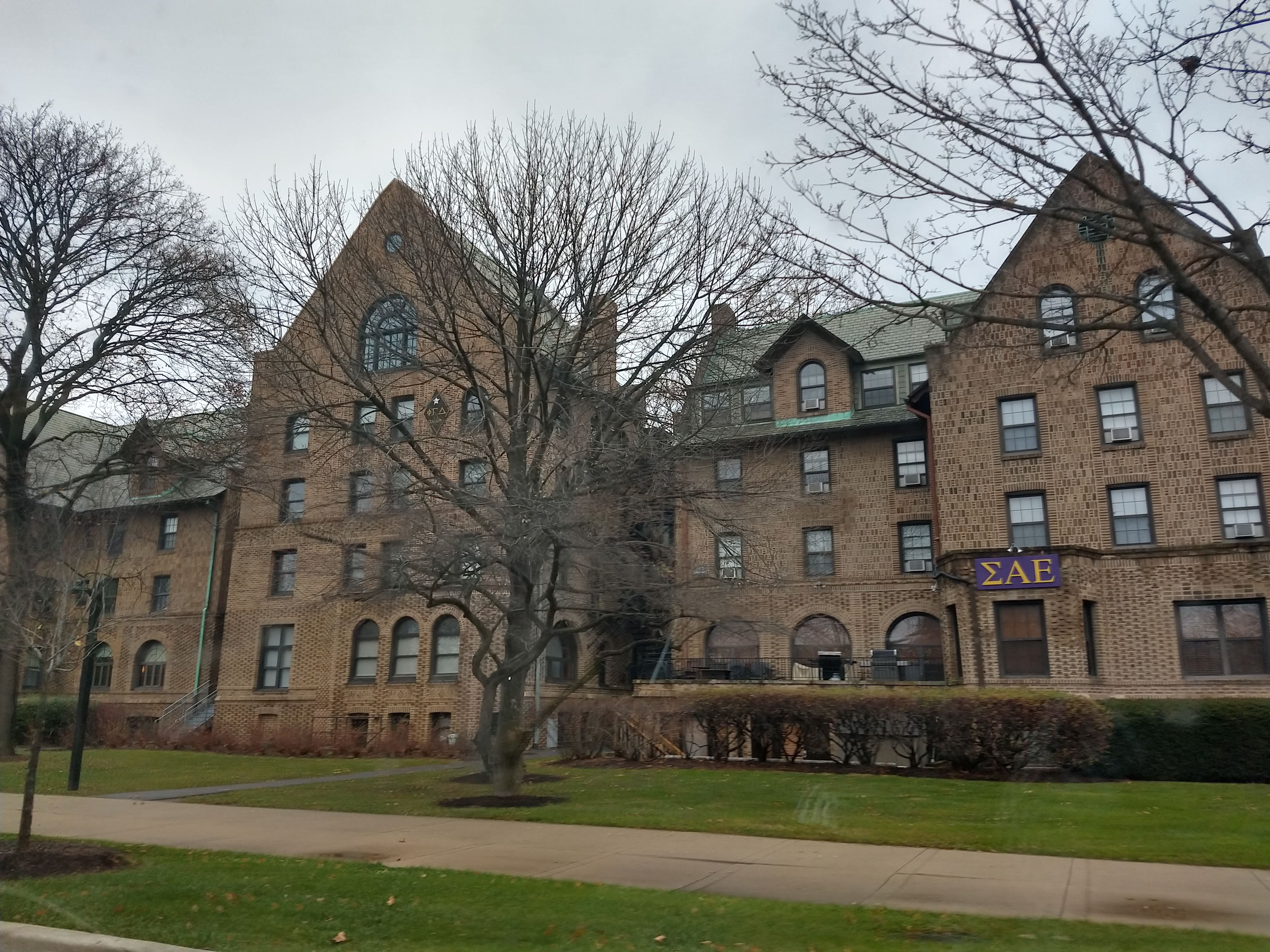
The modern product is collision
Northwestern’s customer list begins with students and extends to parents, employers, research sponsors, patients, corporate partners, alumni and public agencies. Its differentiator is not merely that it offers many subjects. Large universities do that. The proposition is that a student can move between serious versions of journalism, engineering, theatre, business, medicine, law and social policy without leaving one institution. Seventy-four percent of undergraduates combine two or more areas of study.
For researchers, the same idea appears as shared centers and facilities. Northwestern counts more than 90 school-based centers and about 20 university research centers. Synthetic biologists work near engineers and physicians. Materials scientists meet clinicians. Journalism scholars study platforms and politics. This is where its market position sits: not the scale of a public flagship, nor the narrow focus of a specialist school, but a selective, urban-adjacent research portfolio with professional schools strong enough to pull ideas toward practice.
Follow the money, not the brochure
The business model is a portfolio. In fiscal 2025, grants and contracts produced $1.025 billion. Net tuition and fees contributed $816 million. Endowment investment return designated for operations added $556 million. Gifts, services, auxiliary operations and restricted funds filled out the rest. This mix matters because no single constituency pays for the whole machine.
“Everything else” combines auxiliary services, sales and services, professional fees and released restrictions. Percentages are calculated from audited totals.
The model also explains a fact that looks contradictory until you inspect the accounts. Northwestern ended FY2025 with $20.8 billion in assets and $16.2 billion in net assets, yet posted a $147.9 million operating deficit. Rising benefit costs, litigation, labor contracts and a months-long federal research funding freeze put pressure on cash and expenses. Endowment wealth is not a checking account. Donor restrictions, payout rules and long-term obligations make a rich institution less liquid than the headline number suggests.
The price question has two honest answers
For 2025-26, Northwestern published tuition of $69,375 and estimated total undergraduate expenses of $96,236 before aid. That is the first answer and it should make any family sit up straight. The second is that Northwestern says it meets 100 percent of demonstrated undergraduate financial need, uses loan-free need-based packages and spent $638.3 million on financial aid across students in FY2025. Most undergraduates from families earning under $150,000, assuming typical assets, attend tuition-free.
The sticker
$96,236
Estimated 2025-26 undergraduate tuition, fees, housing, food, books and other expenses.
The offset
$638.3M
Financial aid recorded in FY2025, up $20 million from the prior year.
Both can be true because price discrimination is built into elite higher education. Families with resources subsidize the system at a higher rate; grants, gifts and endowment income subsidize others. Whether that arrangement feels fair depends on the aid calculation, not the slogan.
Research becomes a product at the handoff
Northwestern’s expertise spans neuroscience, nanotechnology, biotechnology, materials, AI, media, management and medicine. The interesting number is not the topic count. It is the conversion machinery. In FY2024, the innovation office reported 250 invention disclosures, 639 patent applications, 331 executed agreements and 15 startups. The Garage says it incubated more than 1,500 student startups in its first decade. The university reports $2.6 billion in cumulative patent and licensing revenue.
In July 2026, the National Science Foundation awarded $20 million for DREAM, an AI-directed protein-engineering cloud lab. Researchers will request protein functions through software; AI will propose designs; robots will build and test them after safety review. The four-year target is more than 300,000 proteins and up to 30 million data points, released through an open framework. It is a neat summary of the Northwestern method: shared equipment, several disciplines, public funding and a path from experiment to startup.
The network outside the gates
Universities often describe partnerships as if two logos on a slide create value. Northwestern’s useful partnerships involve operating systems. Feinberg faculty conduct work with Northwestern Memorial HealthCare, Shirley Ryan AbilityLab and Lurie Children’s research institute. Regulatory agreements reduce duplicated review. Sustainability researchers launched an industry affiliates program with Schneider Electric, Fortune Brands Innovations, Heritage Research Group and Elevate Packaging. Fermilab data now supports AI benchmarks for quantum systems.
These relationships expand the classroom into hospitals, companies and national laboratories. They also make Northwestern harder to imitate. A competitor can launch a course quickly. It cannot quickly recreate decades of clinical trust, shared governance, specialized equipment and alumni relationships.
What a builder can steal
The Northwestern playbook is useful if you separate mechanisms from advantages. You do not need a $15 billion endowment to apply the mechanisms.
- Sell the promise before the infrastructure. Early scholarships turned belief into cash and future demand. Make the obligation finite unless you truly mean forever.
- Own an asset with optionality. The unused Chicago land paid rent. A modern equivalent might be data, distribution, a community or reusable software.
- Fund the connective tissue. Collaboration needs program managers, shared tools, common incentives and places where people repeatedly meet.
- Build the handoff. Discovery matters more when licensing, incubators, clinical partners and customers can carry it into use.
- Diversify revenue before a shock. Tuition, grants, gifts, services and investment income respond differently when policy or demand moves.
When the flywheel will not turn
This approach fails when breadth is cosmetic. If departments hoard budgets, shared centers become meeting factories. It fails when promises outlive the economics, when property ties up scarce cash, or when leaders treat restricted endowment assets as available money. It also fails in markets without durable demand for a trusted credential or without partners capable of absorbing research.
Northwestern benefits from 175 years of compounding reputation, a wealthy alumni base, a major-city labor market and clinical affiliates. Copying its outputs without those conditions is expensive theater. Copy the sequencing instead: earn trust, secure patient assets, create repeated collisions, then build a bridge from knowledge to use. The university’s founders did not have a campus. They did have a network, a promise and the patience to let a rejected plan keep paying rent.