For a few minutes on August 14, 2003, Michael Legatt believed he had broken the Northeast. He was a graduate student in New York, low on clean clothes and feeding a quarter into the last dryer in his apartment building. He pressed Start. The room went black. So did enormous sections of the United States and Canada. Fifty million people lost electricity. A domestic chore had achieved impeccable comic timing.
The dryer, naturally, had an alibi. The outage began far away and spread through a grid whose operators were losing the ability to understand what their systems were doing. For Legatt, the coincidence became more than a story to tell at dinner. He was studying neuropsychology, and he was also an amateur radio operator. With ordinary communications failing, he spent the evening near Westchester County's emergency operations center, relaying messages by ham radio.
Months later, he read the blackout investigation with a psychologist's eye. The fascinating part was not a melodrama with a villainous machine or a careless operator. It was the seam. “Did technology fail? Not really. Did humans fail? Not really,” he later said. “It was that meshing of the two that was the real failure point.”
A psychologist enters the control room
Legatt's route to electricity was gloriously indirect. He had started as a programmer, including work on Wall Street, before moving into psychology. After the blackout, he followed his curiosity into energy. In 2006 he joined the Electric Reliability Council of Texas, better known as ERCOT, and remained for a decade as its principal human factors engineer. Along the way he added a master's degree and a second doctorate in energy systems engineering from the University of Texas at Austin.
The collection of credentials sounds eccentric until you picture a grid control room. The operator sits before a civilization rendered as lines, icons, numbers and alarms. Electricity has to be balanced continuously. Weather moves. Equipment trips. Demand changes. Software updates. An intruder may be probing the network. The electrical engineering is unforgiving, but so are the facts of perception: eyes tire, working memory is finite and attention can be captured by precisely the wrong flashing object.
His job at ERCOT was to turn those human limits into design requirements. He interviewed operators and studied how they assembled a picture of the system. One result was the Macomber Map, a visualization named for the ERCOT manager who supported its development. Instead of asking operators to mentally stitch together scattered displays, the map gathered operational information into a common geographic view. It helped teams see where events were happening, how equipment connected and what might be moving toward them.
This sounds obvious, which is often the fate of a good interface after someone has done the hard thinking. Before it exists, every additional data feed looks like progress. Afterward, the question changes: progress for whom?
The million-dollar wall of confusion
Legatt has a particular suspicion of impressive screens. Older control rooms often used fixed “one-line” wall maps with physical indicators. They were limited and decidedly unglamorous, but a crew could stand together and point a laser at the same breaker. As utilities replaced them with flexible high-definition video walls, the new surfaces accumulated tiny labels, extra systems, animated alerts and, occasionally, television. The screens improved. The shared picture did not always improve with them.
A laser pointer may even disappear against a modern LED wall, taking away a cheap collaboration tool while the upgrade adds millions of pixels. There is a neat absurdity in spending heavily to make information harder to point at. For Legatt, this is not nostalgia for painted boards. It is a warning against mistaking display capacity for comprehension.
Illustrative, not measured: technology can multiply inputs; design determines whether a team can turn them into a common picture.
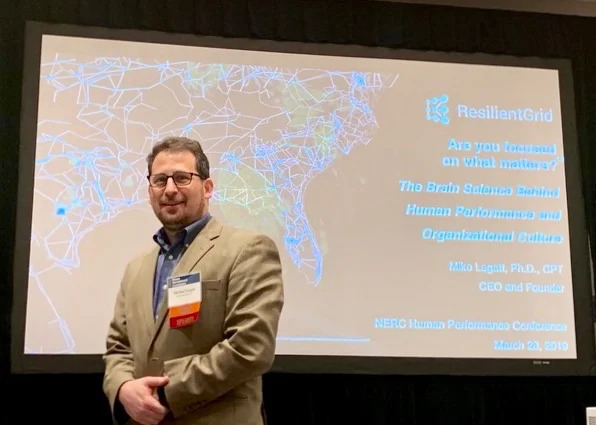
In 2016, Legatt left ERCOT and founded ResilientGrid. He likes to say that many companies are born in garages, while his was born in infrastructure control rooms. The company's software and services focus on situational awareness for the people managing electric utilities. Geography serves as what he calls the “glue”: a familiar surface on which weather, outages, equipment and field constraints can become a single story rather than four unrelated feeds.
The company won a Capital Factory Smart City Challenge investment in 2018. The next year, the North American Electric Reliability Corporation selected ResilientGrid's operating platform for a system intended to give federal and regional reliability organizations a common view of the North American bulk power system. The scale changed. The design question remained intimate: can the person looking at this screen understand what matters?
Reliability is a cultural practice
Software is only half of Legatt's argument. An operator may spot a weak signal and still remain silent if the workplace punishes bad news. A team may possess the correct facts and fail to coordinate under pressure. Procedures written for ordinary conditions can become brittle when events arrive in combinations nobody rehearsed. Reliability therefore lives in culture, training and management as much as in code.
That belief led Legatt to co-found the Human Performance Community of Practice, a meeting ground for utility professionals, researchers and human-performance specialists. Its subjects range from high-stress communication and cybersecurity to learning after errors. The common idea is refreshingly unspectacular: people doing the work know things the organization needs to hear.
It also explains his admiration for control-room operators. He calls them everyday heroes, which in this case means people whose successful shifts make no news. Their best work is measured in uneventful evenings, stable frequencies and lights that continue to obey the switch. Infrastructure offers few applause breaks.
AI arrives at the console
Artificial intelligence makes Legatt's old questions newly urgent. A machine can scan more signals than a person. It can also produce an answer without giving the operator enough understanding to judge it. Automation may reduce workload during normal operations and leave a person stranded outside the loop when the situation becomes abnormal. The faster the recommendation arrives, the more deliberate the design of trust must be.
Legatt led NERC's 2024 white paper on artificial intelligence and machine learning in real-time system operations. Its territory includes explainability, cybersecurity, governance and the relationship between automated systems and human decision-makers. The important word is relationship. A reliable control room is not a contest to determine whether carbon or silicon is cleverer. It is a joint system whose failure modes include misplaced confidence in either.
At Northwestern University, Legatt now teaches Cybersecurity and the Grid in the Master of Science in Energy and Sustainability program. The course puts information technology beside operational technology, then adds the human beings who build, protect and operate both. Students confront a grid that is becoming more software-defined as renewable generation, local microgrids, connected equipment and artificial intelligence multiply its possible states.
A blackout and an emergency ham-radio shift turn attention toward critical infrastructure.
Begins a decade at ERCOT, bringing human-factors engineering into real-time grid operations.
Completes an energy-systems doctorate and founds ResilientGrid.
ResilientGrid's platform is selected for NERC's continental situational-awareness initiative.
Leads NERC's white paper on AI and machine learning in real-time operations.
Brings cybersecurity, grid operations and human performance into Northwestern's classroom.
The useful constraint
Legatt's story is easy to file under “unusual career,” but the sequence is less random than it first appears. Programming taught him how systems express rules. Neuropsychology taught him how people detect signals. Energy engineering taught him what the grid demands in real time. Ham radio taught him what remains when ordinary channels vanish. Each discipline supplied a missing piece of the control room.
His work also offers a bracing correction to the usual technology narrative. Complexity is often sold with the promise that one more platform will tame it. Legatt starts with the operator's finite attention and works outward. The limit is not an embarrassment. It is the useful constraint that makes design possible.
The dryer story survives because it is funny, but also because it compresses the whole philosophy into one instant. A person performs a small action. An immense system behaves in a frightening way. The two events appear connected, then prove to be connected only by timing. Situational awareness is the craft of discovering the real connection before a coincidence, an alert or a confident machine sends everyone down the wrong path.
Twenty-three years after the lights went out, Legatt is still working at that seam between what the grid is doing and what a human can know about it. The screens are brighter now. The data is faster. The old question has not aged a day: what does the person responsible need to see?