A royal charter is a gorgeous way to discover you do not have product-market fit. In 1827, Anglican cleric John Strachan returned from London with permission to create King's College in Upper Canada. The institution had prestige, state backing and an endowment of 225,944 acres. It also had a governance problem: the Church of England controlled it in a colony where Anglicans were a minority.
The result was not stately progress. Political and denominational fights dragged on. The college took 16 years to begin teaching. Chronic money trouble and clumsy land management shrank the original ambition, and several promised academic chairs were never filled. King's finally opened in 1843, then lasted only seven years as a teaching institution under that name.
The pivot arrived through politics. Reformers rejected a publicly supported university reserved for one church. On January 1, 1850, King's College became the non-denominational University of Toronto. The first idea failed before the durable one could start: a university broad enough to earn legitimacy from a much wider public.
“A great institution can survive a failed launch. It cannot survive confusing inherited privilege with customer demand.”YesPress analysis
What the company actually does
Calling U of T a company is useful only if we treat “product” generously. Its front door is education: more than 700 undergraduate programs, plus graduate, doctoral, professional and continuing studies. Behind that door sits the costlier machinery - laboratories, 40 libraries, computing infrastructure, clinical networks, archives, grants administration and a dense market for ideas.
The customers overlap but are not identical. Students buy learning, credentials, community and access to employers. Governments fund public capacity and trained workers. Research sponsors buy the possibility of new knowledge. Companies seek specialist talent, shared projects and licensable inventions. Alumni return as donors, mentors and recruiters. Society gets the spillovers, although it rarely receives an invoice itemizing them.
Its business model is a bundle rather than a clean subscription. Tuition sits beside provincial and federal support, sponsored research, philanthropy, investment returns, ancillary services and some intellectual-property income. The 2026-27 operating budget is C$3.66 billion. That figure is closer to the annual economy of a small municipality than the budget of a teaching shop.
The price of the platform
For 2025-26, first-entry domestic undergraduate tuition generally ran from roughly C$6,100 to C$16,090, depending on program. The international price can be dramatically higher. At the Mississauga campus, selected first-year international programs listed tuition of C$61,720 before housing and ancillary fees. The fee gap is not decorative. Ontario regulates domestic tuition while most international fees sit outside that framework.
One classroom, two price signals
This is U of T's sharpest tension. International reach makes the academic network richer and the revenue mix more flexible, but a high sticker price narrows who can participate. Research scale is impressive; affordability is the argument a ranking cannot settle. The university's value proposition works best when aid, funded graduate packages and public support keep access from becoming a luxury feature.
Its moat is productive collision
U of T's difference is breadth with nearby exits. It can move an idea from a basic-science department to an affiliated hospital, an engineering lab, an industry sponsor and an incubator without leaving the Toronto region. That does not make the path quick or tidy. It makes the number of plausible paths unusually large.

The historical receipts are substantial: insulin, stem-cell science, the electron microscope, early operational computing and breakthrough work in deep learning. The modern system tries to make those collisions less accidental. Its research division reports supporting about 2,100 principal investigators and managing 9,700 grants, while 1,500 startup teams receive support annually.
How an idea gets legs
Faculty + students
Labs + hospitals + IP
Partners + startups + public
The commercial layer is deliberately infrastructural. The Innovations & Partnerships Office helps with patents, licensing, market strategy and investor preparation. UTEST offers a 12-month incubator for startups built on university inventions. ONRamp supplies shared space and community. The university can take fees, royalties or a minority equity stake when it licenses technology, sharing some risk without demanding that every professor become a full-time founder.
Partnership is a product, too
Recent deals make the portfolio legible. BASF is working with self-driving labs. Nissan is studying how electric vehicles interact with power grids. Ericsson is extending a decade of collaboration into wireless networks, advanced computing and applied AI. Konica Minolta renewed work in AI, connected devices and manufacturing. Cohere is helping U of T create a secure path for institution-wide AI adoption.
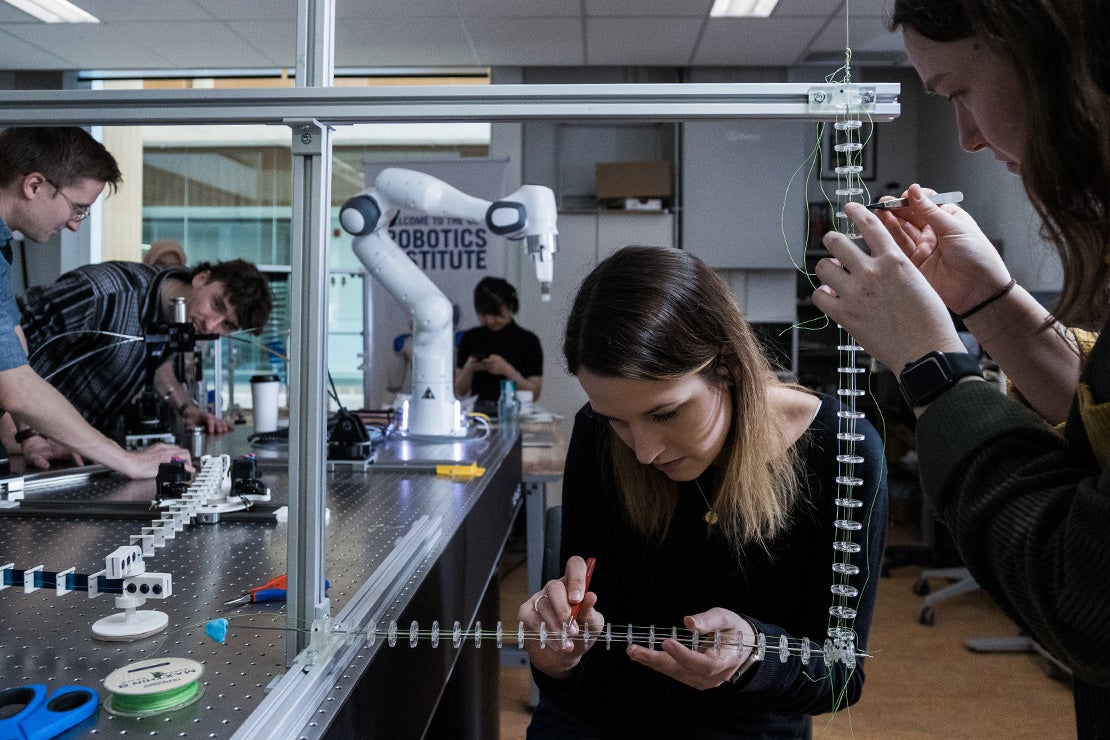
In 2026, the partnership map widened again. U of T joined Ontario's vehicle-innovation incubator network, announced an AI-and-health centre with the Indian Institute of Science, and expanded work with Ericsson. The pattern is consistent: pick a difficult applied problem, add external operating knowledge, place students close to the work, then create routes for patents or ventures. Partnership is not a logo exchange. It is distribution for research.
A city wearing a course calendar
The lived product is more local than the institutional statistics suggest. St. George puts old colleges, professional faculties and hospitals into downtown Toronto. Mississauga operates west of the city with 17,361 students, while Scarborough serves 15,858 in the east. A student enrolls in the same university brand but encounters a particular campus, faculty, department and often a college. That nesting is culture by architecture: the big system offers range, while the smaller unit tries to supply recognition.
It also explains why U of T can feel generous and bureaucratic in the same afternoon. The system advertises more than a thousand clubs, organizations, activities and volunteer opportunities, as well as student-run legal and dental clinics. There are international students from 176 countries and territories. Yet every additional option brings another calendar, eligibility rule or office. The institution's culture is less a single personality than a negotiated peace among intense specialists.
Officially, U of T emphasizes academic freedom, human rights, equity, access and belonging. Those promises matter because the university's own origin story includes exclusion and land. The original endowment came from crown reserve lands appropriated from Indigenous peoples, a fact University College now addresses directly in its history. A modern public institution cannot celebrate the acreage as clever capitalization without accounting for who bore the cost.
For students, the practical payoff is optionality. A life-sciences major can find clinical research nearby; an engineer can enter an electric-vehicle project; a humanities student can work inside one of North America's largest library systems. The risk is that abundance becomes navigation work. U of T is most helpful when advising, funding and small communities turn the catalog into a path. Without that layer, “more” is merely a very handsome PDF.
The market, and the alternatives
For Canadian students, McGill, UBC and Waterloo are obvious alternatives, each with its own mix of place, program and employer pull. Globally, U of T competes with public and private research universities for faculty, graduate talent, grants and prestige. For an industry partner, the alternative may not be a university at all. It could be a corporate lab, a hospital institute, a specialized consultancy or an accelerator that moves faster.
U of T cannot reliably win on intimacy or simplicity. A 103,140-student institution comes with queues, handoffs and acronyms. It competes on option value: more fields, more collaborators, more facilities and more possible second acts. Its collegiate and tri-campus structure creates smaller communities inside the whole, an organizational answer to the obvious problem of feeling anonymous in a crowd.
What a smaller builder can steal
Do not copy the scale. Copy the interfaces. U of T's useful moves are available to a startup, a laboratory or a local college in miniature.
Federate the edges
Let specialist teams keep their identities, then share reputation, data standards and expensive infrastructure.
Build the bridge
Make translation a named function. An IP office or partner lead beats asking experts to improvise sales.
Use a longer clock
Protect work that has no immediate customer. Foundational research often becomes useful after the market catches up.
Publish the scoreboard
Count students, grants, partners, patents and outcomes. Scale becomes credible when outsiders can inspect it.
There is also a lesson in changing one's mind. U of T did not improve King's College through better messaging. Political reform changed the institution's control, constituency and purpose. When the first model excludes most of the market, a new campaign is not a pivot. Governance is.
When the playbook does not work
Do not copy this under false conditions
- If you lack patient public or philanthropic capital, basic research and shared facilities can become an unfunded promise.
- If specialist units share a brand but not standards, federation turns into duplication and political drag.
- If the surrounding city lacks hospitals, employers and investors, research has fewer nearby routes into use.
- If high tuition substitutes for access instead of financing it, international reach can harden into inequality.
The university itself is candid, in governance records, about current pressure: expenses have risen faster than revenue, international enrolment has underperformed plans, and investment returns cannot be treated as permanent rescue money. Its scale offers resilience, but it also multiplies fixed costs. The institution that survived one major reinvention cannot assume history has granted immunity from another.
U of T's most useful achievement is not that it became large. It learned to make breadth productive. The secular pivot widened who the institution could serve; the federation let communities retain shape; the research and partnership layers created exits from scholarship into practice. Nearly two centuries later, the first failure still explains the machine: legitimacy comes before leverage.