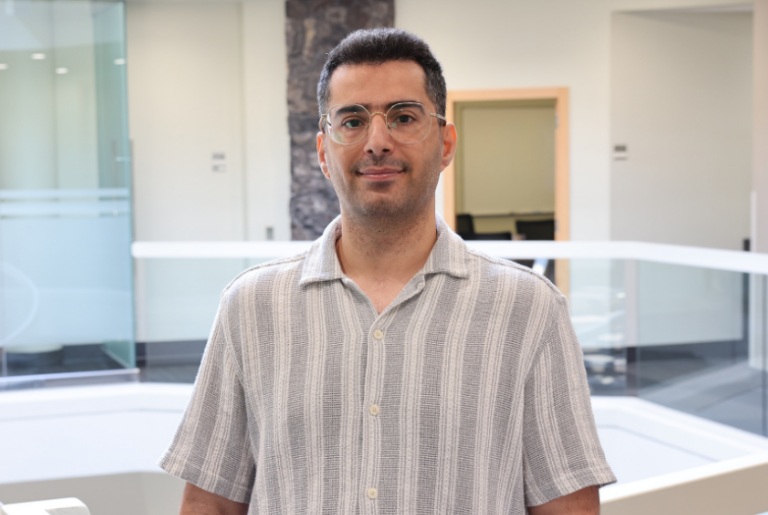
Salar Ghaffarian applied to Innovate Calgary’s Aerospace Accelerator Program. His company, Dronnix, was not selected. This would ordinarily be the point at which an entrepreneurship story changes institutions. Instead, the application began a relationship with the Aerospace Innovation Hub, where he found advisors, other founders and prototyping resources.
- Shared labs and equipment reduce the need to build your own facilities.
- IP advice helps researchers choose between licensing and forming a company.
- Hub membership, accelerator selection and investment are separate decisions.
Dronnix develops drone-mapping tools. Access to 3D printers also supports its longer-term experiments. “You need to test it and see whether it is going to become a real product,” Ghaffarian explained in July 2026. A rejection had left that possibility open.
That is a useful introduction to Innovate Calgary. The University of Calgary’s commercialization company occupies the awkward interval between a discovery and something somebody will buy. Scientific promise arrives with neither a procurement department nor a business plan attached. Somebody has to help assemble the missing pieces.
The laboratory you don’t have to buy
Start with the unglamorous things: washing glassware, sterilizing equipment, disposing of specialist waste. A life-sciences business needs these long before it has enough customers to justify owning the infrastructure. Sharing them changes the size of the bet.
Innovate Calgary’s Life Sciences Innovation Hub publishes a Tier 1 price of CA$600 a month for individual membership, including access to shared lab, equipment and/or office space. It lists more than 100 types of molecular-biology and prototyping equipment. A CA$300 monthly tier provides coworking and business support. Both list up to 30 hours of expert advice.
Advertised membership rates, checked October 2026. These are access prices, not a complete startup budget.
The attraction is the ability to conduct another experiment without first becoming a laboratory landlord. Consumables, staffing and the work itself still need a budget. Membership makes one category of expenditure more predictable; it cannot make the scientific question disappear.
A laboratory membership makes one category of expenditure more predictable. It cannot make the scientific question disappear.
A patent needs a route to market
There is a similar problem with intellectual property. A promising result must become an asset that a company can use. Innovate Calgary’s Technology Transfer Office begins with disclosure, assesses protection opportunities and commercial potential, then helps identify a route to market. That route may be a licence to an existing business or a new venture.
For an industry customer, the office is also a place to find relevant university technologies and negotiate licensing. For a researcher, it offers help with patents, copyright and trademarks. The institution’s practical distinction is this combination of university access, business support and physical facilities. A consultant can advise; a shared laboratory can let someone test the advice.
Its Expert Advisor Program imposes a useful discipline on mentorship. An introductory meeting leads to a statement of work with maximum hours, a timeline and deliverables. The roster spans customer discovery, regulatory matters, finance and engineering. “Get some advice” becomes a smaller, answerable assignment.
Donations with an investment committee
Money is another missing piece, particularly when the evidence is too early for conventional investors. Innovate Calgary manages UCeed, UCalgary’s philanthropy-backed startup investment funds. Returns go back into the originating fund. A donation can therefore keep working after its first investment, provided that investment eventually produces a return.
Selection involves business and technical diligence, sector advisors and specialist review. Investments use milestones; portfolio companies receive mentorship and help preparing for follow-on investors. The model gives a founder a reason to ask what the next cheque should prove.
CA$10.1 million invested in UCeed’s first five years, reported in UCalgary’s June 2025 governance materials.
Those figures describe UCeed’s portfolio, rather than Innovate Calgary’s sales. That distinction matters: a commercialization organization can handle investment capital, operate funded programs and collect membership income without those amounts being interchangeable. The finance follows several different purposes.
An airport is a useful neighbour
The Aerospace Innovation Hub puts incubation and prototyping at Calgary International Airport. Its inaugural industry partners included WestJet, the Calgary Airport Authority and Chapter.ai Ventures. The location gives the idea of “industry engagement” a pleasingly literal address.
In March 2024, the Opportunity Calgary Investment Fund announced CA$3.9 million over four years, following initial PrairiesCan support of more than CA$2.5 million. The commitment came with targets for companies supported and jobs created. Targets describe the intended return on public support; they should not be mistaken for completed results.
The commercial logic is straightforward. An aerospace startup benefits from knowing what operators need, while an established company gets an early look at potential solutions. A polished prototype is more useful when someone with an operational problem can tell its maker what is missing.
The clock on the community room
Infrastructure depends on continuing money. In February 2026, Innovate Calgary announced that its Social Innovation Hub’s physical space and programming had closed. The hub had supported more than 400 ventures since its early-2023 launch. CEO John Wilson said its funding was coming to an end.
The notice changes how a prospective member should read older brochures. A useful program can reach people and still run out of financial runway. Community demand and an enduring operating budget are separate achievements. Founders planning around subsidized facilities need to ask how long the support lasts.
Start with the uncertainty
The part readers can copy is the sequence: identify the risky assumption, find the equipment or expertise that can test it, and define a deliverable before spending heavily. In a June 2026 Canadian IP Voices discussion, Innovate Calgary’s Kevin Dahl and author David Bland explored customer evidence alongside IP protection. Testing must be designed with both in mind.
For a researcher, the first move can be a disclosure conversation. For a lab-dependent founder, it can be a membership enquiry. An aerospace team can investigate the hub’s sector fit. None guarantees investment or admission. But each makes a more useful opening question than asking whether an idea is innovative: what would we need to learn next?
Open the next door
Explore Innovate Calgary, lab membership, aerospace support and company news. Follow on LinkedIn, X or Facebook.
Listen to Now Innovating’s John Wilson interview or Kevin Dahl on testing business ideas.