Andrew Hansen could measure his company’s growth by the people who could no longer fit in the boardroom. At an all-staff gathering in early 2024, colleagues had come together from places including Victoria, Kelowna and Calgary. The room was too small. For a founder accustomed to seeing part of his team through screens, the inconvenience carried a certain satisfaction. There they were, in person, taking up space.
He described that moment with more feeling than the usual procession of business milestones. An expanding agency can be expressed in accounts, offices and revenue. A meeting with insufficient room is easier to picture. Someone has to look around and realize that the thing they started now contains all these other people.
Hansen’s company, SitePartners, had gathered them around an unusually specific brief: help industrial businesses make themselves understood. Construction, manufacturing and resources were the territory. The people building roads, producing materials and moving equipment had work to show. Hansen thought there was a business in helping the rest of us see it.
“nobody could fit in there”
Andrew Hansen, recalling a 2024 team gathering
The advantage of already knowing the mud
He came to that idea through the industry itself. Raised in Langley, British Columbia, Hansen earned a business administration degree from Trinity Western University in 2013. At Ledcor, his career included operations work in the resources and transportation division. Industrial businesses were familiar places before they became his market.
In 2016, he left for Agency Media, taking a vice president of business development role. That move gave him a view from the other side of a client relationship. He could see the workings of a marketing agency while recognizing a group of potential customers whose business he already understood.
Site Marketing Partners, the business that became SitePartners, opened in 2018. His construction network helped him find early clients. The choice of specialization was practical: an agency could arrive knowing something about the work, rather than spend the first conversation learning what the company actually did. Familiarity shortened the distance between introduction and useful contribution.
Starting an agency had been, in his own description, “never the plan.” In a later podcast conversation, he recalled expecting to remain at Ledcor. That makes the career change more interesting than a neatly packaged tale of lifelong entrepreneurial destiny. He found a possibility through work he was already doing, then followed it into a different profession.
By spring 2019, Site’s client list included businesses such as Ledcor, SiteMax and Mainland Construction Materials. Hansen received a BCBusiness 30 Under 30 award. An agency serving industrial companies could itself become a business worth watching, even if its subject matter was more likely to involve an excavator than an espresso machine.
The early agency also experimented with how to put clients in front of an audience. Its account of 2019 described trade-show work involving integrated media campaigns, round-the-clock video coverage and activity on the exhibition floor. It launched a podcast with SiteMax. The industrial focus left room for several ways of telling a story, with the client’s work supplying the subject.
The handshake gets a digital front door
Hansen’s argument for industrial marketing begins with a change in how people meet a company. In a 2020 interview, he described a sector still driven by relationships and word of mouth. Younger buyers and procurement teams, though, might first encounter a contractor online. A website or video could introduce a business before anyone exchanged a handshake.
That first encounter had commercial weight. A prospective customer needed to understand a company’s capabilities and whether it belonged on a tender list. A firm could possess considerable expertise while giving an unfamiliar buyer little help in recognizing it. Hansen saw room to make the expertise legible.
He also talked about two audiences: customers and employees. A contractor might have a full backlog of work and still need people to carry it out. In that situation, explaining the company to potential recruits becomes a business problem with consequences well beyond the marketing department.
Two audiences Hansen identified in his 2020 interview.
By 2024, he was writing about the candidate’s experience in detail. The job advertisement, photographs, website and application process all helped someone form an impression. He encouraged leaders to talk about their businesses through their own accounts, including when they had no immediate vacancy to fill.
He applied that logic to SitePartners’ own hiring. An industrial agency would appeal to people who enjoyed that setting; other applicants would prefer a different kind of work. Hansen described being frank about the agency’s pace and expectations during interviews. The aim was to give candidates a usable picture of the job before they accepted it.
There is a pleasing lack of mystery in the advice. Show people the work. Explain the place. Let them consider whether they belong there. The practical details of an application can say quite a lot about a company that has spent months polishing its description of itself.
A glass company, a church, a film set
For a company that makes industrial work visible, a production studio is a tangible investment in the premise. In 2024, Site introduced a 10,000-square-foot headquarters in Abbotsford, combining offices with space for filming, recording and gathering. The building had previously housed a glass company and then a church. Its next occupants brought cameras.
The old showroom contributed an expansive glass frontage. The warehouse became an open workspace and studio. Tiered wooden seating provided somewhere for people to assemble. A 36-foot-wide infinity wall and an overhead lighting grid gave the production team control over a scene. It was a useful setting for a business whose working life otherwise involved travelling to other people’s workplaces.
At a June 2026 visit by Abbotsford’s mayor and councillors, Hansen explained that he had discovered the building in 2021. He liked the Historic Downtown neighbourhood and the city’s connections with industrial businesses. The tour passed through the office and studio, including a podcast room. The open-plan headquarters also had a slide, which suggests the stairs had acquired some competition.
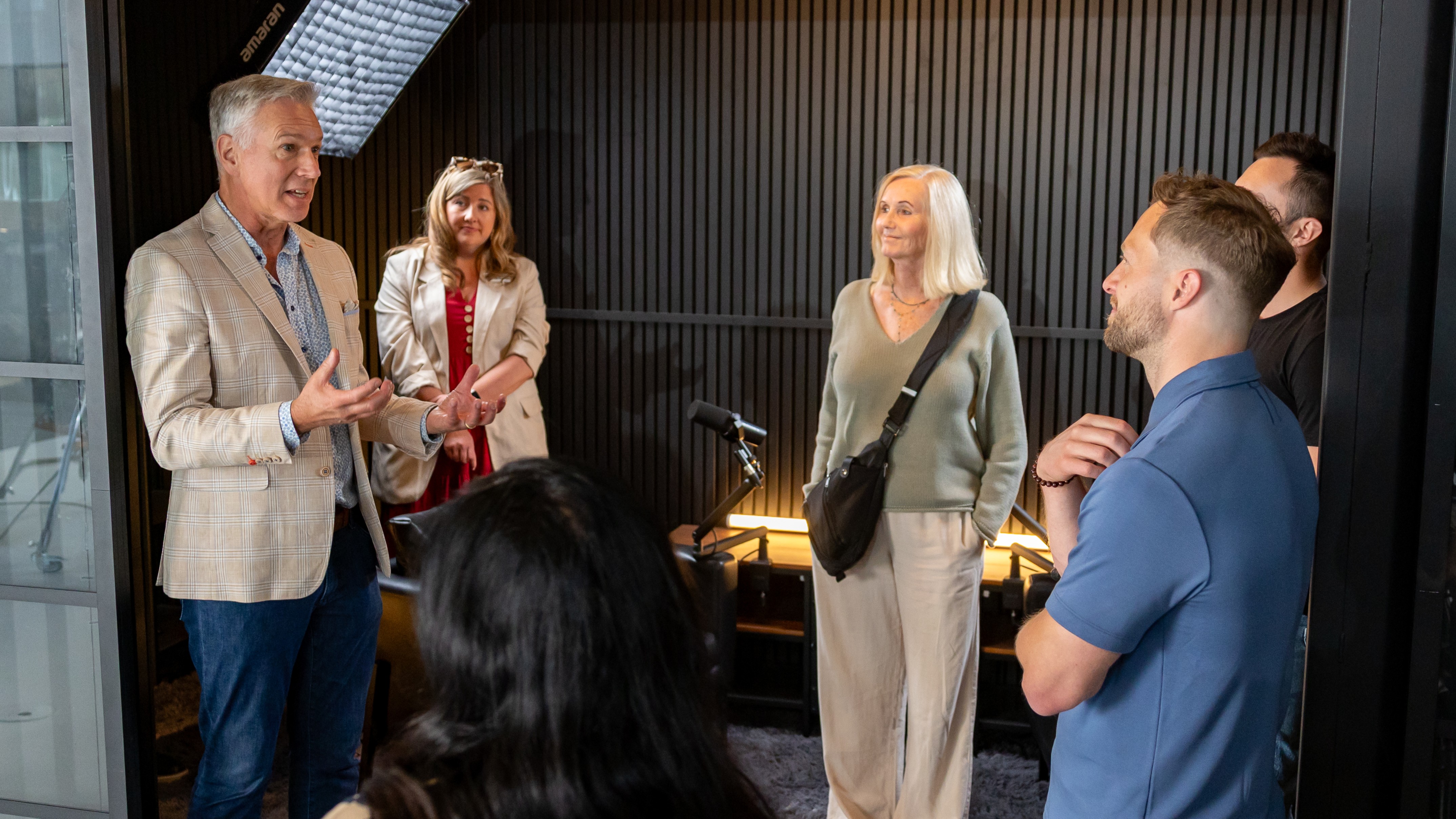
Hansen’s review of 2024 gives a sense of the operation behind those rooms: 500 videos produced and 400 field shoots completed. The field team’s travels included the Northwest Territories and Ghana. A permanent studio provided one kind of control; going where the work happened remained part of the job.
The brief keeps getting bigger
The company’s expansion involved more than cameras. In 2020, SitePartners announced a Calgary office and a staff of 17. It also brought in specialist communications and engagement expertise. Hansen emphasized the need for infrastructure projects to build meaningful relationships with communities and stakeholders. A project’s public life required attention alongside the business’s commercial presentation.
In April 2024, the agency introduced a new identity under the shorter name Site. The explanation was almost conversational: clients and colleagues already called it that. The wider business was developing additional capabilities, while the familiar industrial audience remained at the centre of the pitch.
SiteTechnology and SiteTalent joined that picture in 2024. Technology and recruitment were adjacent to problems Hansen’s clients already faced. A company trying to grow might need a stronger public presence, different systems and new staff. The expanding group gave him more ways to answer the questions that followed the original marketing conversation.
His relationships with other people in the sector also produced places to talk. SitePartners worked with SiteMax on The Site Visit podcast. Hansen appeared in conversations with James Faulkner and Christian Hamm, discussing the business as well as the launch of SiteNews. The industry that supplied his clients was becoming an audience in its own right.
In September 2026, SitePartners announced Scott Boniface as vice president of transformation and Ryan Bannon as vice president of design, both working from its Toronto campus. The announcement described clients asking for help entering markets, modernizing operations and developing brands that could support stronger pricing. The brief had grown along with the agency.
There is still a job site in the picture
Hansen has collected the formal recognition that tends to accompany that kind of expansion. Alongside the 2019 award came a place in BIV’s 2024 Forty Under 40. When SitePartners celebrated the latter, he responded that the honour ought to belong to the team. In the same year, the business marked its third consecutive appearance among The Globe and Mail’s Top Growing Companies.
There are less ceremonial details, too. Asked about an odd job, he named ranch hand. His description of the early creative spark involved being assigned a short company video and recognizing what the industrial world had to show. That connection between practical work and its public telling has lasted through the changes in title, office and scale.
The appeal of Hansen’s story lies in how close the opportunity sat to his original working life. He already knew the sector. He learned a different business, then brought the two experiences together. Each new service has had to make sense to people whose priorities include projects, employees and the next piece of work.
Return to the crowded boardroom and the story becomes pleasantly concrete again. Hansen had assembled a company around helping other businesses explain themselves. Eventually, explaining his own growth required little more than a look around the room. They needed somewhere bigger to meet.
Follow the conversation
More from Hansen and the businesses around him.