A marketing agency with six off-road vehicles sounds like a setup for a joke. At SitePartners, it is logistics. The Canadian firm sends producers and strategists to construction sites, factories, wildfire zones and remote infrastructure projects. The vehicles get the crew close enough to see the work. More important, they signal what the company has spent eight years trying to prove: industrial marketing is not consumer advertising with a hard hat placed on top.
SitePartners was founded in early 2018 by Andrew Hansen, who had worked at Ledcor and in agency business development. That combination matters. Hansen knew how industrial companies operate, and he knew why generalist agency rituals can irritate them. A builder trying to recruit tradespeople or win a billion-dollar pursuit does not need a month of vocabulary lessons before the useful work begins.
So SitePartners narrowed the market and widened the service. Its current menu spans strategy, brand, advertising, communications, digital work, web development, photography and video. Its clients include names such as EllisDon, Chandos, Finning, Canam, Caliber and Wales McLelland. They use the agency to attract workers, explain technical businesses, manage stakeholders, modernize old brands, compete for projects and turn work that happens far from a downtown boardroom into something customers can understand.
01 / The betThe niche is not copy. It is the operating system.
Lots of agencies claim a specialty. Then the same generalist team serves a dentist on Monday, a software company on Tuesday and a steel fabricator on Wednesday. SitePartners followed its positioning further. It hired people for one sector, built a full-time production group of more than ten, invested in field equipment, opened offices across Canada and constructed a studio that can accommodate industrial-scale shoots.
That changes the economics for a client. A single partner can shape a brand, develop a website, film the job site, cut recruitment videos, manage social channels and prepare communications for a complex infrastructure program. The advantage is not merely convenience. Each engagement leaves the agency with more category knowledge, which lowers the cost of understanding the next brief.
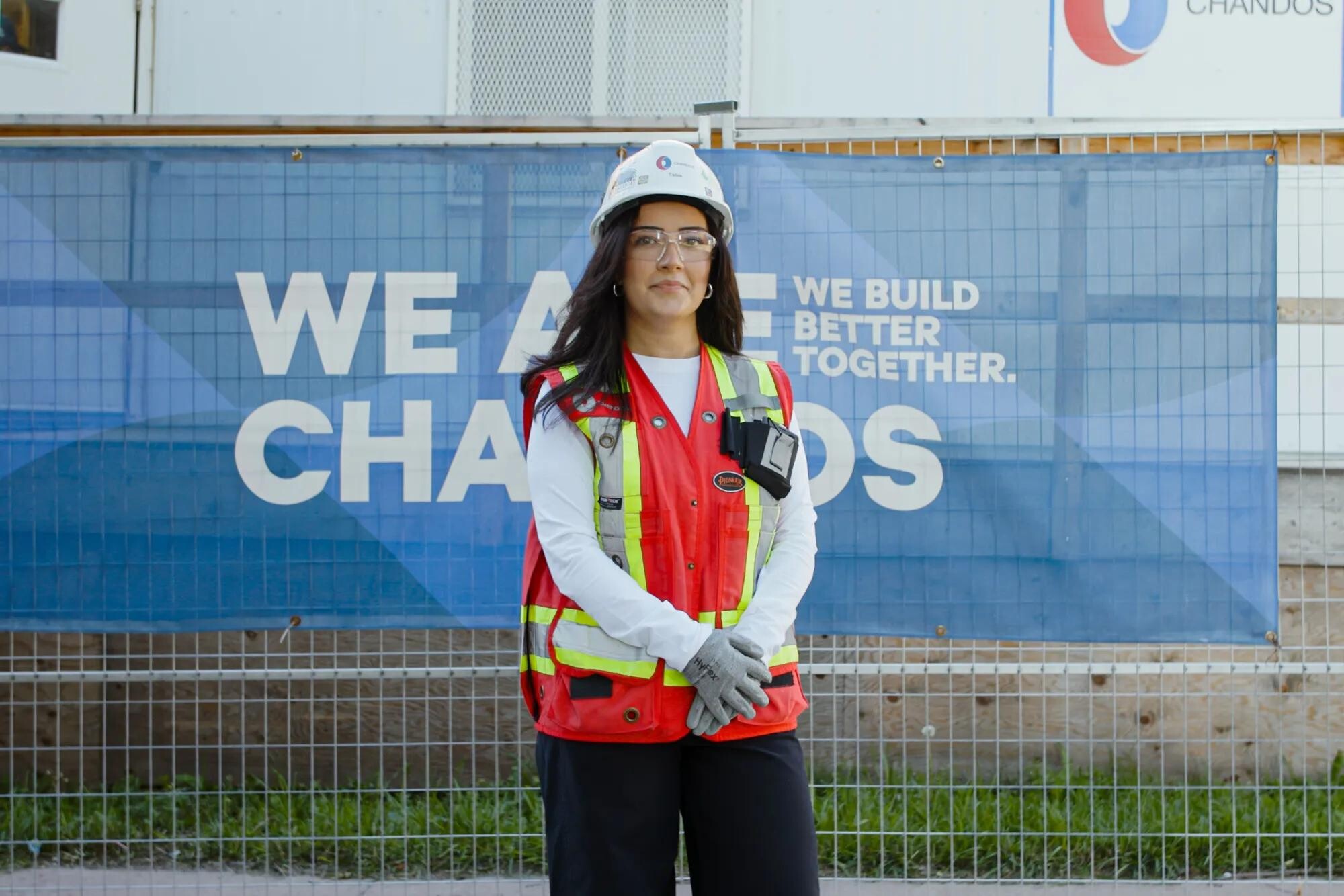
The work shows the pattern. For EllisDon's 75th anniversary, SitePartners avoided a parade of finished buildings and built the campaign around employees: “Our People Are Proof.” For Finning, it made recruitment videos with the people already maintaining heavy equipment. For Canam, it traveled across Alberta, Ontario and Quebec to create bilingual plant and project stories. Even a Peterbilt electric-truck film worked by teasing the macho voiceovers and crunchy guitars that normally announce a truck commercial from three rooms away.
“When everyone has access to the same media buying and digital advertising tools, the big differentiator becomes your creative output.”Brett Rutledge, SitePartners
02 / The mechanismA blueprint before the beautiful things
The most copyable part of SitePartners is not its studio. It is a seven-stage planning loop the company calls its BluePrint process. The agency begins with an audit of the business, brand, market and competitors. It interviews stakeholders. Then it visits the site and speaks with frontline staff and customers. Those observations become a written strategy, followed by a marketing plan with timelines and a finalized budget. Only then do content, campaigns, distribution and measurement arrive.
None of those steps is exotic. Their power comes from sequence. The site visit is particularly useful because industrial companies often hide their distinction in plain sight. The real differentiator may be a supervisor's habit, a maintenance response time, an unusual fabrication step or a culture that employees can describe better than executives. Field observation catches what a polished kickoff deck misses.
The process also answers a common agency problem: what exactly is the client buying? Not an endless stream of “content,” but a linked plan in which research determines positioning, positioning determines creative, and performance data sends the team back around the loop. Public pricing is not part of the pitch. The budget is set inside the approved marketing plan, with advertising and production expenses made explicit.
03 / The first breakWhen the handshake economy stopped shaking hands
The first obvious failure in the market was not SitePartners' specialization. It was the industrial sector's old route to business development. In 2020, trade shows vanished, face-to-face meetings paused and companies accustomed to relationship selling suddenly needed digital ways to win work, recruit people and keep communities informed. SitePartners reported building websites remotely, running strategy sessions by video and filming under new health rules.
That shock changed the urgency. The agency opened a Calgary office in 2020 and grew from 17 people that August to more than 25 by the following year. It reported 1,061 percent revenue growth from its launch through its 2020 ranking on the Canadian Business and Maclean's Startup List. In 2021, Adweek ranked it No. 12 among its fastest-growing agencies, based on 357 percent growth over three years.
Specialization, then staff
Selected public headcount markers, not a continuous employee series. Current figure is from the company LinkedIn profile.| Old industrial habit | SitePartners' replacement |
|---|---|
| Trade-show dependence | Always-on digital campaigns, web and reusable content. |
| Generic company reel | Field footage tied to recruiting, pursuits, reputation and sales. |
| Agency learns on the clock | A sector-specialized team with repeat category knowledge. |
| One polished launch | Measurement followed by adjustment and another campaign cycle. |
Growth did not push SitePartners toward a broader client menu. It pushed the company into adjacent needs around the same customer. In February 2025 it acquired Kelowna-based BlackBean Industrial Marketing. BlackBean brought demand generation, SEO, web development and performance marketing, plus three experienced staff and a formal office in British Columbia's interior. Founder Laura Norup-Boyer became SitePartners' vice-president of client success.
Later that year, the larger Site family added SitePursuits, a partnership focused on major proposals, while SiteNews combined with Actual Media to form SiteMedia. By year-end, the broader ecosystem said it had more than 75 people across five offices, 130-plus returning clients and 250-plus completed projects. Those numbers include the wider Site organization, not only the agency, but they show the direction: serve more of the industrial customer's growth problem without wandering into unrelated markets.
The expansion continued in January 2026 when SiteMedia acquired STOREYS, a Canadian publication covering real estate and development. The deal was made by a related company, not the agency itself, but it widened the audience and market intelligence around the same built-sector customers. In June, Abbotsford's mayor and City Council toured SitePartners' headquarters, including the studio and staff gym - a municipal business spotlight on a firm that had moved its headquarters into the city's historic downtown.
04 / The stealGo deeper before you go wider
The lazy lesson is “choose a niche.” The useful lesson is that a niche becomes defensible only when it changes decisions. SitePartners' focus affects whom it hires, what it buys, where it opens offices, how discovery works and which work it declines. A construction vocabulary on the homepage would be easy to copy. A producer comfortable around active sites, a strategist who understands a project pursuit and a library of category proof are slower to reproduce.
The five-part field guide
- Pick a market with recurring, expensive communication problems.
- Turn discovery into a documented sequence that clients can approve.
- Observe the work before deciding how to describe it.
- Plan every shoot as a library for sales, recruiting and reputation.
- Add fixed infrastructure only when repeated demand proves the bottleneck.
A small consultancy can copy the operating logic without buying a camera crane. Start with ten interviews in one sector. Build a common problem map. Create a standard audit and insist on one field day. Design one piece of research to support a sales deck, a landing page, three posts and a customer story. Measure whether the assets shorten sales conversations or attract stronger applicants. Then repeat.
Where this model breaks
The approach is a poor fit when buyers want a cheap, isolated deliverable; will not grant access to people or sites; or operate in a niche too small to support specialized overhead. It also carries concentration risk. A sector downturn can hit every account at once, while a large in-house team, fleet and studio keep producing costs. Specialization pays when clients have recurring work, complex stories and enough trust to let the agency near the operation.
05 / The positionAn agency built like an industrial supplier
In the market, SitePartners sits between a general creative agency, a production house, a PR consultancy and an outsourced marketing department. Its difference is the combination. The company can position an industrial brand, build its website, film its crews, manage a public issue and distribute the resulting campaign without handing the work through four vendors.
That breadth is valuable only because the center stays narrow. SitePartners is not trying to be the cleverest agency for cereal, sneakers and software. It wants to be the partner that knows why a remote shoot needs the right vehicle, why a bilingual plant story needs careful production, why infrastructure communications involve communities, and why a recruitment campaign must feel true to people who already do the job.
The charming detail is the office slide in Abbotsford. The telling detail is the studio beside it. One belongs in a culture post; the other changes what the company can deliver. SitePartners' growth story is ultimately a lesson in making positioning physical. If a niche never alters the calendar, the payroll, the equipment or the process, it is probably just a tagline.