There is a peculiar difficulty in naming a company after a person: one day the person becomes the past, while the company remains inconveniently alive. Mort Crim Communications had a particularly good person to be named after. Crim was a familiar Detroit broadcaster, a national radio correspondent and a man whose voice carried the authority of a newsroom. The agency he co-founded in 1993 inherited that credibility. It also inherited the clock.
By 2023, the firm had changed owners twice, moved downtown and become a full-service operation. It was producing websites, social campaigns, brand systems, public relations and video for clients that ranged from General Motors and Bosch to municipal leagues and food-rescue nonprofits. The old name described an origin. It no longer described the machine.
So the agency took its own medicine. Mort Crim Communications became CRIMSON. The new name preserved a phonetic wink at its founder while giving the current team room to explain what it had become: a “brand advocacy” agency. This is agency language, certainly. But beneath it sits a useful operating idea. CRIMSON wants to decide what a brand means before deciding where to advertise it.
“CRIMSON exists to find and develop opportunity through creativity.”CRIMSON's stated purpose
The first thing to fail was clarity
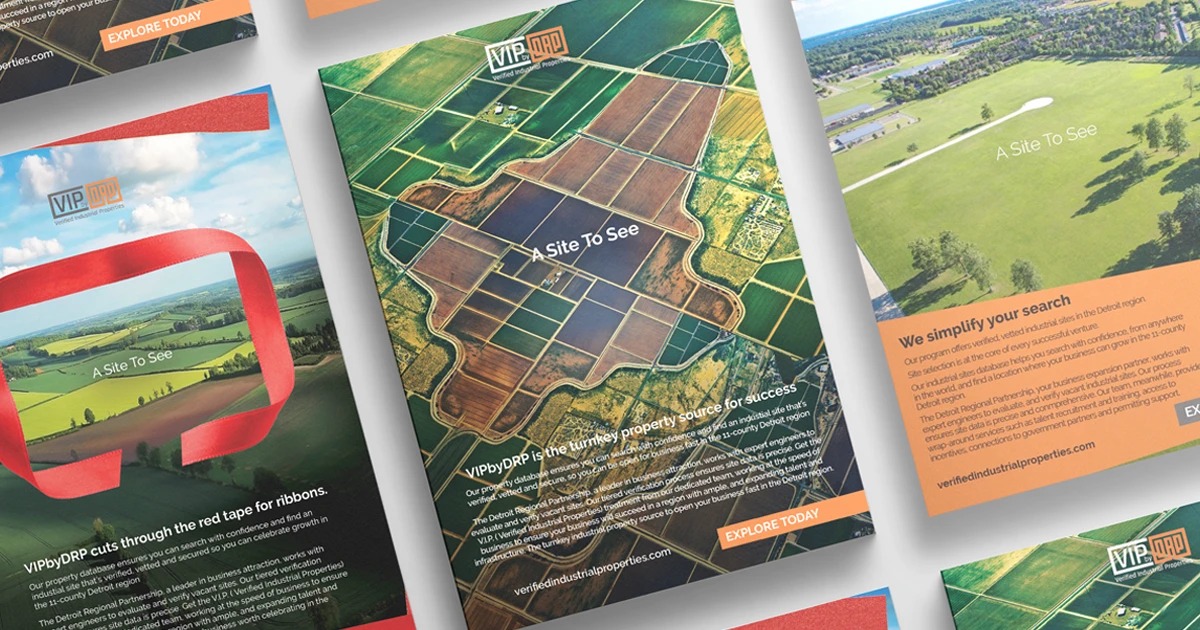
The agency’s case studies return to the same small catastrophe. A capable organization is doing worthwhile work, but the audience cannot see it. The Detroit Water and Sewerage Department was maintaining infrastructure and offering affordability programs, yet residents associated it with bills and shutoffs. The Downtown Detroit Partnership managed parks and civic initiatives, yet its website hid the useful parts. The Detroit Regional Partnership had verified industrial sites ready for development, yet brokers and site selectors were not arriving.
These were not logo problems. They were gaps between institutional reality and public perception. CRIMSON’s answer was to make the hidden thing visible. For the water department, it put frontline workers in an integrated campaign called “Working Hard for You.” For the regional partnership, it organized a new industrial-property portal around the line “A Site to See.” For Downtown Detroit Partnership, it rebuilt the information architecture as well as the surface.
Those numbers are reported by the agency, which means they should be read as case-study evidence, not laboratory trials. Still, the pattern is more interesting than any single percentage. In each case, the campaign began with diagnosis. The portal, billboard, media pitch and video came later.
The order is the product
Nearly every full-service agency can offer six columns of capability. CRIMSON’s list is branding, marketing and advertising, public and media relations, web design and development, social media and video production. The difference it wants buyers to notice is not the ingredients. It is the sequence.
- Find the audience tension
- Define a position people can repeat
- Choose channels that make it travel
This is what another company can copy without copying a color palette. Start with the sentence your customer cannot yet say about you. Test it against competitors. Give it a memorable verbal handle. Then let every channel repeat the same thought in its own grammar. A website explains; a billboard compresses; PR lends outside credibility; social supplies repetition; video makes the people real.
The method is especially suited to CRIMSON’s home field: builders, utilities, civic organizations, economic-development groups and nonprofits. These organizations often do technical work, answer to multiple constituencies and have little room for cleverness that cannot survive a public meeting. Their communications problem is translation with consequences.
What the work costs, in public
Agency pricing usually lives inside proposals. Public-sector work occasionally opens the drawer. A historical federal schedule listed MCCI’s metro-Detroit videography day package at $957.18. In 2021, Detroit’s water department authorized a two-year public-relations and communications contract with the firm for up to $1,199,616. Those figures are different kinds of prices - one day of production versus the ceiling on a broad, multi-year engagement - and together they show the range of the business.
/ day
The listed government videography package covered a ten-hour metro-Detroit day. Strategy, media, creative, development and long-running campaigns occupy a very different budget.
CRIMSON is not software. It cannot sell the same unit a million times while the computers sleep. Its business is paid judgment and coordinated labor, sold through projects, retained relationships and government contracts. The customer buys a multidisciplinary team and, ideally, avoids stitching five vendors into one uneasy sentence.
The rebrand changed the agency's mind about itself
The most persuasive clue is what happened after the rename. CRIMSON did not erase its journalism heritage. It reframed it as proof of an enduring habit: find the human stakes, establish what is true and make the story legible. Then it became more explicit about the kinds of work it wanted - construction and engineering, public purpose, industrial systems, energy and economic development.
In 2025, it named Jennette Smith Kotila president and promoted leaders in strategic communications, account service, web and digital experience, creative and production. CEO Chris Heaton described the changes as formal recognition of roles people were already performing. That is a revealing cultural move. The org chart caught up with the work, just as the brand had caught up with the company two years earlier.
Copy this
Make the strategy visible in the sequence. Research first, positioning second, channel choice third. A buyer should understand why each deliverable exists.
Check this first
The model depends on access to leaders, users and evidence. If a client wants decoration without discovery, or cannot align internal owners, integration becomes an expensive word.
There are conditions where this approach loses its advantage. A tiny direct-response campaign with one audience and one measurable action may not need a brand excavation. A mature global brand may need a specialist to solve one narrow technical problem. And an organization unwilling to change its product, service or behavior cannot repair the gap with messaging. Advocacy works only when there is something defensible to advocate.
That may be the quiet lesson of CRIMSON’s own rename. The agency did not merely swap signs. It changed ownership, leadership, scope and market focus first. The new identity arrived after the substance had moved. In an industry that is paid to make change look instantaneous, CRIMSON’s story is an argument for the slower direction of travel: become different, then name the difference.