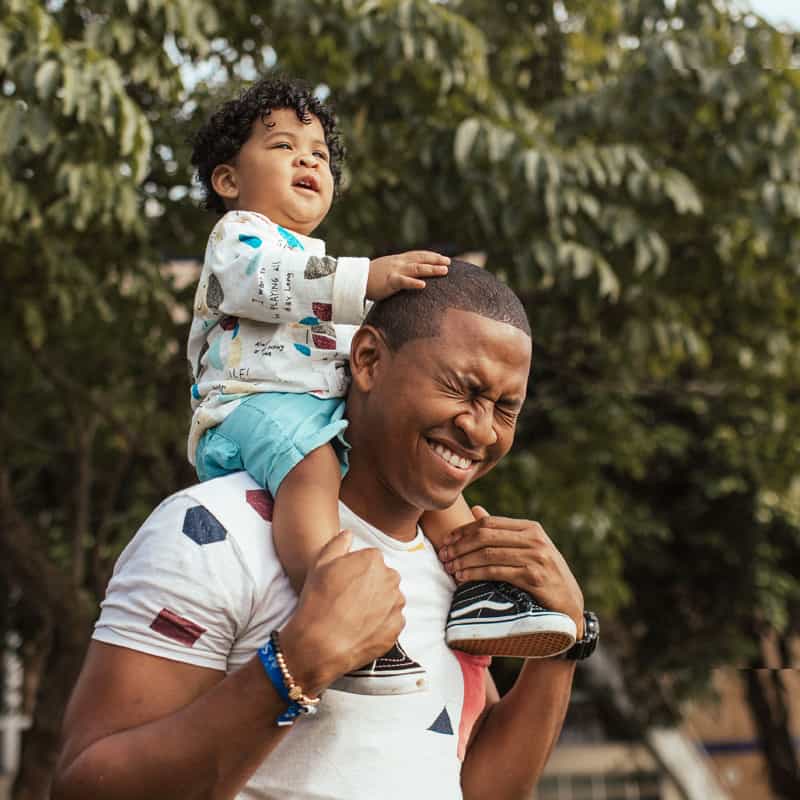
At most American sporting events, somebody in the crowd holds up a sign saying “Hi Mom.” Frank Borres noticed the missing sign. Where was Dad? It is the sort of observation a former television reporter makes: ordinary enough to be invisible, until it becomes a story. Borres and his Bridgeport agency, American View Productions, turned that omission into a traveling video booth where Connecticut residents could sit down and talk about fathers, father figures and the complicated space between the two.
The booth is the prop. The actual product is everything around it. AVP found the festivals, moved the equipment, secured releases, recorded interviews, edited clips, refreshed the website, made graphics, posted to social media, called reporters and assembled the final film. In 2024, four stops produced 73 videos. The original target was 10 per stop. The campaign nearly doubled it.
A production company learns to carry the whole table
AVP began in 1984, founded by Borres after work in radio, television journalism and public relations. The early identity was documentary production. A 2003 Connecticut film directory described a shop with PBS experience and an interest in Latino and socially relevant subjects. The company still shoots documentaries, corporate films, explainers, events, facility tours and drone footage. But it has widened sideways into photography, websites, search optimization, graphic design, brand strategy, public relations, social media, podcasts and streaming.
Its phrase for this is “your plug-in marketing department.” This is more than a list of services. The conventional alternative is a small institutional client trying to conduct an orchestra of freelancers: the web developer waits on the writer, the writer needs the strategist, the videographer has not met the publicist, and nobody remembered that the event photos must be vertical by noon. AVP's bet is that coordination itself is valuable. The people who frame the campaign are still present when a participant walks into the booth.
That breadth is useful to organizations with missions larger than their communications teams. AVP's visible client list leans toward Connecticut nonprofits, civic programs and regional institutions: the Connecticut Fatherhood Initiative, Alliance for Community Empowerment, Connecticut Housing Partners, Optimus Health Care, the Bridgeport Regional Business Council and The Connecticut Project. It also includes professional and commercial work for the likes of LTKE Law, PSEG and local businesses. These clients are not shopping for a single clever ad. They need annual reports, event coverage, donor-facing stories, websites and press attention to agree with one another.
The rare campaign with a price tag attached
Agency case studies usually treat money like a family secret. The public documents behind Dear Dad Tour do the opposite. AVP's 2023 proposal estimated $25,000 to $31,000 for preparation, production, four live locations and post-production. Extra stops were priced at $4,000 each. Connecticut's later meeting record put the 2025 budget at $27,500.
THE 2023 ESTIMATE / $2K-3K prep + $3K-4K ongoing production + $14K-16K for four tour stops + $6K-8K post-production.
The largest slice was not editing. It was launch and tour: transportation, people, coordination, equipment, materials, public relations, social posting and video management. That is an instructive correction to how marketing is often discussed. The idea may fit on a sticky note. Execution requires a van, a calendar, a release form and somebody willing to call a newsroom again on Friday.
“A campaign can be a place people enter, not merely a message they pass.”The operating idea behind the Dear Dad Tour
The first tour visited five Connecticut locations in 2019. Then the pandemic arrived, and the in-person mechanism was the first thing to go. When the project returned, its logic was sharper. A 2023 proposal argued that a conventional statewide media buy, grassroots push and social campaign would be prohibitively expensive. So AVP leaned on free press, a ready-made Father's Day moment and the distribution power of the participants themselves. In 2024, the graphics were revised to connect the tour more explicitly to the Connecticut Fatherhood Initiative. Surveys and sign-up sheets asked whether visitors knew the initiative. United Way 211 cards gave the warm story a practical next step.
The unglamorous loop is the advantage
At New Haven's Taking Back the Hill event in 2024, AVP recorded 18 videos. Norwich added 12. Danbury produced 23. Hartford contributed 20. Between stops, the team posted clips and testimonials, updated the site and followed up with reporters. WFSB, the New Haven Register, Connecticut Post, Journal Inquirer and CT Insider covered the tour. Each part fed the next: a physical event created video; video made the social feed useful; the feed made the campaign legible; press coverage made the next stop easier to notice.
The repetition matters. In 2025, one planned festival was cancelled, but three remaining stops still generated 70 videos. AVP published 47 Facebook posts and 47 Instagram posts. Reported views rose 45 percent on Facebook and 28 percent on Instagram versus the prior two months. The team's recommendations were practical rather than triumphant: find a public or private sponsor, test alternative venues, arrange cross-promotion and, with enough funding, consider a mobile unit. After absorbing unforeseen costs in 2024, it also asked for a modest budget increase. A good case study includes the invoice that pinched.
Copy the sequence, not the scenery
The most portable lesson is not “buy a booth.” It is to locate an existing social ritual and make contribution easier than indifference. Father's Day supplied a deadline. Festivals supplied foot traffic. The booth supplied privacy and visual curiosity. A short prompt supplied permission. Fast editing turned each answer into distribution before the tour had moved on.
There are limits. This approach depends on a topic people want to discuss, a venue where the right community already gathers, consent that can be handled cleanly and a distribution network ready to carry the stories. It is poorly suited to confidential subjects, abstract products with no natural community, or organizations that cannot publish quickly. It also asks a small agency to absorb coordination risk. AVP's own request after the 2024 tour - account for the extra costs - is the caution label.
American View Productions occupies a peculiar middle of the market. It is broader than a video shop and more physical than a strategy consultancy. Its advantage is not that it can perform eight unrelated services. It is that, on a good assignment, those services become one loop. The camera produces the post. The post supports the press call. The press call brings attention to the next event. And a person who arrived for a street festival leaves having made the campaign's most important piece of media.