The State of Florida had a problem that will feel familiar to anyone who has ever stood under fluorescent lights clutching the wrong form. Beginning in January 2010, new federal Real ID rules meant that residents needed to bring a precise bundle of documents to receive or renew a driver license or identification card. Explain it badly and people would make two trips. Explain it like a lawyer and they might make three.
Kidd Group, the Tallahassee communications firm hired by the Florida Department of Highway Safety and Motor Vehicles, reduced the whole ordeal to an itinerary: Gather. Go. Get. Gather the documents. Go to the office. Get the new card. The name was not merely a slogan pasted above the work. It was the work - a three-stop route through bureaucracy.
Collect proof of identity, status, and residence before leaving home.
Visit the correct driver-license or tax-collector office.
Receive the compliant license or identification card.
Before making the campaign, the agency met tax collectors, front-line employees, and customers. That detail matters. The first thing to fail in a rules change is rarely the rule itself. It is the translation between the institution that wrote it and the person carrying a folder to the counter. The interviews exposed where confusion lived. The creative answer was a phrase short enough for a poster and literal enough to follow.
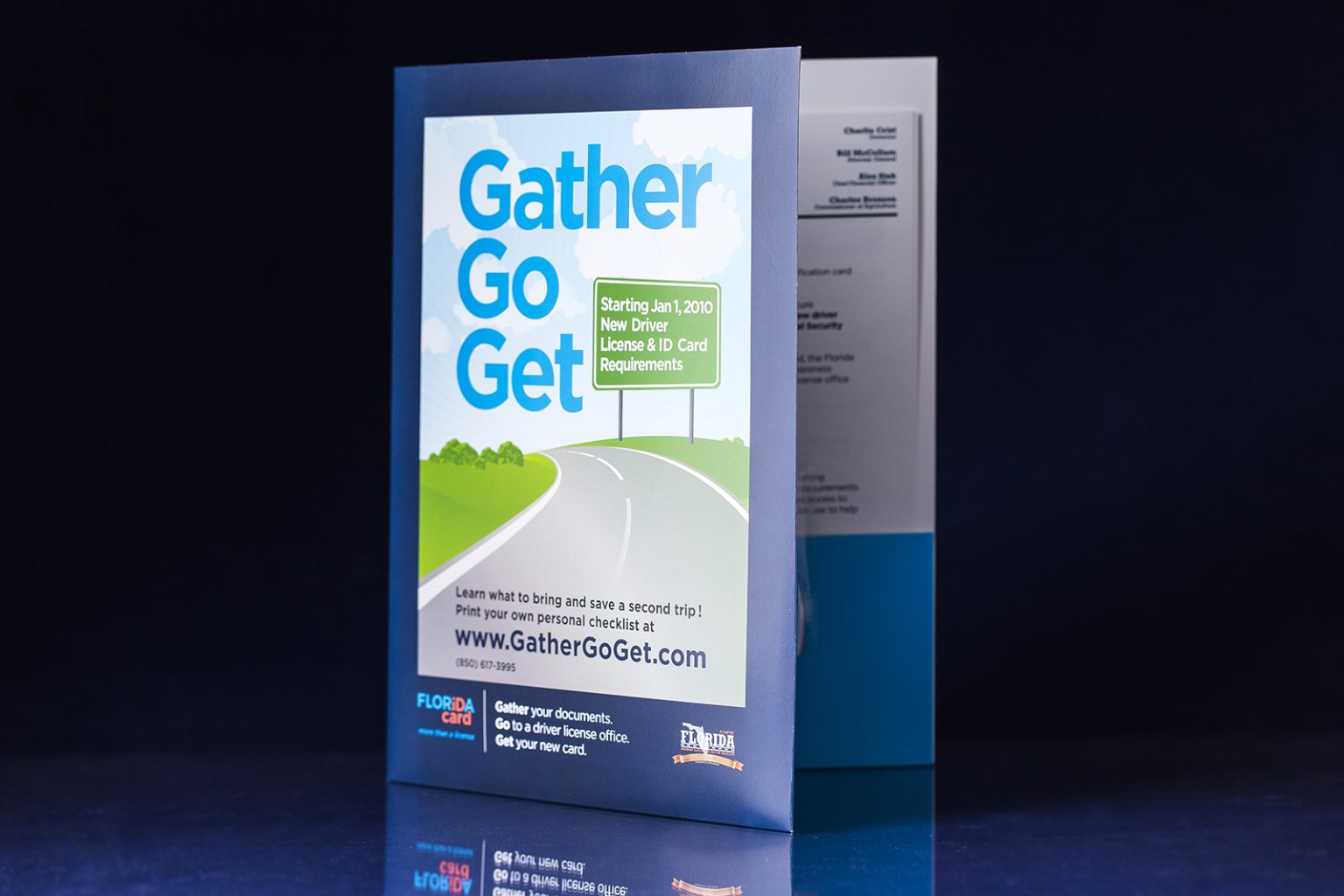
The campaign stretched across collateral, a website, advertising, outreach, and interactive tools. Materials appeared in English, Spanish, and Creole. The department reported that residents were turning up with the required documents before the deadline. In 2010, the Coalition for a Secure Driver's License gave the department a Homeland Security Award that cited the initiative.
The cleverest part of “Gather. Go. Get.” is that the line does not describe the campaign. It performs the service.Kidd Group’s public-information lesson
A garage acquires three rooms
The company that produced this piece of usable language began in 1980 as one designer in one garage. Jerry Kidd's small design practice became an advertising agency in 1988. A public-relations division arrived in 1992. In 1996, while plenty of executives still spoke about “the information superhighway,” Kidd added a web-development arm called 3W Studios.
That sequence is a miniature history of the agency business. First make the thing look coherent. Then distribute the story. Then build the place where the story lives. Kidd Group still presents itself through those three connected practices: advertising and design, public relations, and web. The menu now includes strategy, brand identity, graphic design, copywriting, media, social campaigns, paid search, video, trade-show exhibits, websites, SEO, hosting, and maintenance.
One brief, four kinds of work
The bars are not market shares. They are a picture of the operating idea: begin with identity, carry it into a campaign, ask an audience to do something, and give them a useful digital destination. A buyer could hire four specialist shops for that chain. Kidd Group's business model is to sell the chain - sometimes as a defined project, sometimes as ongoing support, sometimes through a multiyear public contract.
The unglamorous advantage of staying
A statewide launch makes a tidy case study. A 13-year utility account shows the less photogenic skill: continuity. Kidd Group started helping Jacksonville Beach Utilities become Beaches Energy Services in 2002. Then it kept going - informational videos, television spots, monthly newsletters, brochures, social channels, and a Drupal website where customers could pay bills, inspect accounts, and find rebates.

This is where Kidd Group differs from a studio that hands over a logo and disappears. Its portfolio treats the identity, the customer letter, the television commercial, and the account website as parts of the same promise. In regulated or high-trust categories, inconsistency is more than untidy. It creates doubt.
The firm's customer list makes sense through that lens. It includes government departments, healthcare providers, municipal utilities, courts, contractors, technical manufacturers, real-estate developers, and travel properties. These are organizations with complicated offerings, multiple audiences, or both. For Bay Medical Sacred Heart, Kidd Group turned a clinical distinction - the area's only open-heart surgery program - into the “One Heart. One Hospital” spot, which won Gold at the 2014 Cardiovascular Advertising Awards. For biopolymer businesses that became Meredian Holdings Group, it worked across identity, web, public relations, collateral, social media, and merger communications. For Allstate Construction, 3W Studios built and maintained a project-led WordPress site.
The thing a client can copy
The portable lesson is not to name every campaign with three one-syllable verbs. It is to make the message share a skeleton with the desired behavior. If people must complete three steps, the line should help them remember three steps. If customers need account tools, the brand website should contain account tools. If a technical company is approaching a trade show and a merger at once, the booth, site, press work, and corporate identity should not tell four different stories.
The five-line brief
Write down the action. What must the audience do next? Interview the handoff. Talk to the employee who receives the confused customer. Count the steps. Let the structure of the task shape the message. Translate the system. Language, channel, and access all matter. Keep the promise alive. The website and service experience must finish what the ad started.
There are limits. Integration helps when the channels genuinely share a strategy and when the client wants one accountable team. It is less persuasive when a company needs rare technical depth in a single channel, wants competing specialist ideas, or lacks the internal discipline to approve a common message. Simplicity also fails when it is used before research: a short line can clarify a process, but it cannot rescue a process nobody understands.
Kidd Group's public footprint is quieter than those of newer agencies built for feeds and daily self-promotion. Its own blog archive tapers off in 2017. But the firm's most instructive work was never about producing more noise. It was about giving a person with a folder, a utility bill, a health concern, or a technical product the next useful thing to do. In advertising, that is an unfashionably sturdy ambition.