Andy Gay was looking for women’s designer shoes when the future of his beverage company required his attention. There were investors to speak to, and there was a department-store job to do. Gay took calls from the back room. A business that would later announce a billion-dollar valuation was being advanced in the intervals between somebody else’s purchases.
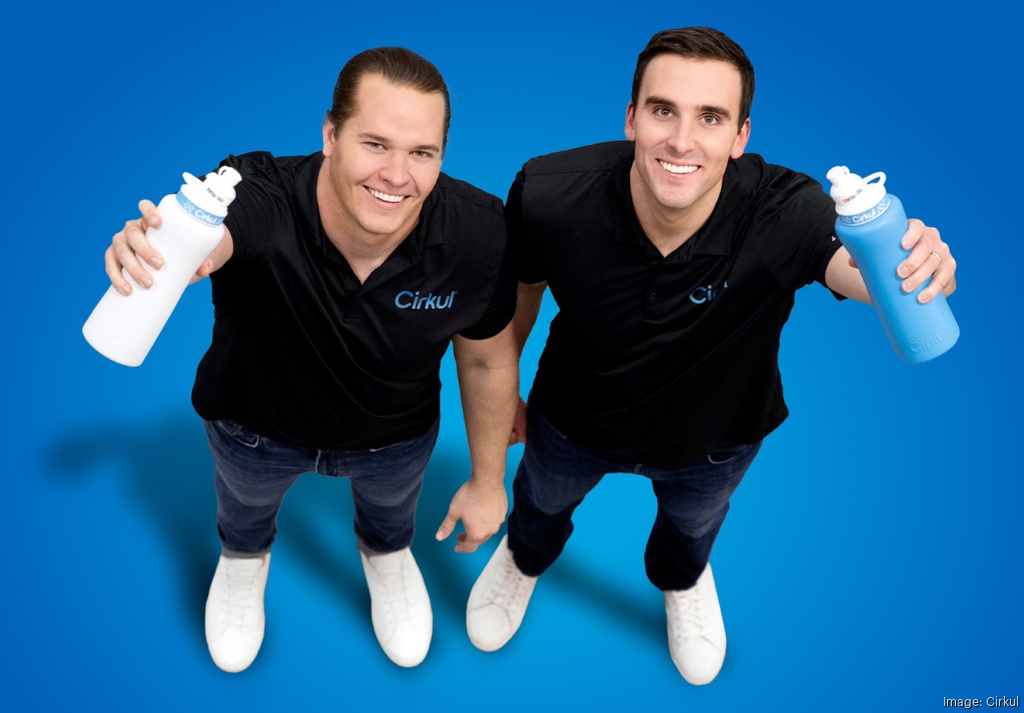
The detail is worth keeping beside the polished photograph of the founders holding their bottles. In one picture, everything has come together: matching shirts, finished products, a bright blue background. In the other, a recent graduate is trying to make two kinds of work fit into one day. The second picture explains rather more about the distance traveled.
Gay co-founded Cirkul with Garrett Waggoner, his Dartmouth football teammate. Their product lets people adjust the intensity of a flavored drink with a dial. It is an unusually literal promise of personal choice: the customer can put a finger on it. Reaching that small convenience involved years of development, other jobs and a prototype that was helpful chiefly because it proved there was more work to do.
Number seven, with a camera
Before Cirkul, Gay’s public record had a different set of numbers. At Dartmouth he wore number seven and played quarterback. His hometown was listed as Mill Creek, Washington; his high school was Henry M. Jackson. During his final two high-school seasons, he threw 31 touchdowns against five interceptions. He had also played basketball and pitched his team to a 2007 AAU national championship victory.
Those achievements give the college-athlete origin some texture. There was more than one sport in his childhood, and more than sport in his college plans. Gay studied Film and Media Studies. His football biography listed video production, jet skiing and an interest in improv. The future brand executive was already interested in things that happen in front of a camera, though water bottles had yet to take the leading role.
In Dartmouth’s 2011 spring game, Gay completed eight of 14 passes for 113 yards and a touchdown. His side recovered from a 10-point deficit to draw. A spring scrimmage is a modest item in a business biography, but it restores the scale of the beginning. Before the national retailers and financing rounds, he was a student with a position, a course of study and another practice to attend.
He graduated in 2014. Retail work followed while he continued developing Cirkul with Waggoner. Gay also spent a short period with a New York market-research firm, gaining exposure to consumer brands including Pepsi and Mountain Dew. His route into beverages passed through both the study of customers and the rather more immediate experience of serving them.
A good idea meets a stubborn object
The original inconvenience was small enough to be dismissed. In a Dartmouth locker room, Waggoner was pouring sports-drink powder into a narrow bottle and spilling it. Gay and Waggoner were studying for exams. Waggoner wondered about something a person could simply insert and drink through. Gay’s answer, as they later recalled it, was “Why not?”
That question was inexpensive. Answering it required a physical object. A powder can miss a bottle opening; a cartridge has to fit, work and keep working. The founders’ first prototype demonstrated the underlying concept but performed inconsistently. It could establish that the idea deserved attention without establishing that anybody ought to buy it yet.
This is an awkward stage for any consumer invention. Enough works to make stopping feel premature. Enough fails to make selling feel premature too. Gay and Waggoner used the early model to attract advisers and investors, and a design team helped develop the product. They had to turn an interesting mechanism into something a stranger could use without a founder standing nearby to apologize for it.
The pair have described roughly six years between idea and launch. Their account includes three years of research and development. The objection they heard was familiar: the concept looked promising, but the people proposing it were young and inexperienced. They responded by bringing experienced people around them. A gap in their résumés became a reason to seek help.
“We don’t want to run before we can walk.”
Andy Gay and Garrett Waggoner, in their early joint interview
During those years, Gay held side jobs. Waggoner continued playing professional football in Canada before leaving the sport to concentrate on the company. Their partnership had to survive the less sociable part of an idea’s life, when it requires time and money but cannot yet reliably provide either. A locker-room conversation had become an appointment neither could casually cancel.
Film and Media Studies
Cirkul reaches customers
Walmart rollout
A 30-second commercial
The decision inside the cap
Cirkul’s eventual proposition is easy to demonstrate. Put water in the reusable bottle, fit a flavor cartridge and adjust the dial. The cartridge adds flavor as the person drinks. Intensity remains a choice rather than a decision made once, somewhere upstream, before the customer enters the story.
Consider the difference in the transaction. A finished bottled drink offers one particular taste at one particular strength. A powder asks the customer to measure and mix. Cirkul puts an adjustable control at the drinking point. The founders found room for another option in a task familiar enough that most people could recognize the inconvenience without an explanation.
The dial also gives the brand a useful demonstration. A shopper can see that something is adjustable. An advertisement can show a hand turning it. A conversation about taste, usually an exchange of adjectives, gains a piece of equipment. For Gay, whose public role is co-founder and chief brand officer, the product supplies a remarkably concrete subject.
The simplicity is doing two jobs. It helps somebody use the object, and it helps somebody understand the reason to try it. Both matter in a consumer business. Even a product with a persuasive origin story eventually has to spend the day with a person who has never heard it. The customer gets the bottle, not the founders’ presentation.
The shelf is another kind of audience
Cirkul launched commercially in 2018, the date used in the company’s financing announcement and Gay’s speaker biography. It began as a direct-to-consumer business. By 2022, it was moving onto national retail shelves, including a rollout in 4,200 Walmart stores. The change put the product in front of people who might encounter it while shopping for something else entirely.
That is a different introduction from a website visit. Online, there is room for a demonstration, an explanation and another click. A store shelf offers packaging and a brief opportunity. The bottle has to look familiar enough to invite a closer look, while the cartridge has to explain why this bottle deserves one. Gay’s work in brand sits close to that practical problem.
Cirkul’s announced pre-money valuation, alongside a $70 million Series C led by SC Holdings.
The financing gave the young company a conspicuous number. It also put a precise date on a moment of confidence in the business. The valuation belonged to Cirkul, and the round helped support expansion. For Gay, the distance from department-store calls to national distribution was now visible in an announcement a reader could skim in seconds.
Behind the retail growth was the question of making enough cartridges. The founders struggled to find manufacturing partners willing to produce their particular format. As the business developed, they invested in its own manufacturing capabilities. The customer-facing novelty required a less visible industrial commitment: a new kind of package needed a dependable way to be made.
The founders had once filled that gap with their own evenings. Waggoner has described calls during the day and cartridge-making at night, with gloves and a hairnet replacing the outward costume of running a business. It is an unglamorous companion to the shoe-department story. Before there is a team to hand work to, the work tends to return to the same hands.
Back to the game, on a different screen
Sport remained part of Gay’s public work as Cirkul grew. In 2024, the company announced its partnership with USA Swimming and identified him as chief brand officer. A business conceived by football teammates was introducing itself to another community of athletes and families. The setting had changed from a college locker room to a national sporting organization.
In February 2025, Gay and Waggoner appeared together around Super Bowl LIX in New Orleans. Cirkul aired a 30-second commercial featuring Adam DeVine. Gay’s Film and Media Studies degree now sat in the same biography as a company advertising during the Super Bowl. The pairing is pleasing without requiring a claim that a college course had somehow planned the whole thing.
By June 2026, the pair were discussing more than 150 flavors, direct sales, manufacturing, retail and a soda platform on the Pour Decisions podcast. The range of the conversation showed how far the business had moved beyond its first powder problem. Gay’s stated company ambition remained rooted in making the experience customizable, convenient and enjoyable.
The shoe-department call and the Super Bowl spot belong in the same story because they make each other legible. One shows a founder borrowing minutes from a working day. The other shows what a company can eventually purchase with 30 seconds. Between them sits the patient, material business of making an object that works when its inventors leave the room.
Gay and Waggoner gave their customer a dial. The customer can turn it whenever they like. Getting to that freedom took the founders considerably longer.