The first Cirkul product demonstration was a minor domestic comedy staged in a football locker room. Garrett Waggoner was trying to tip sports-drink powder into a narrow disposable bottle. Some of it went where intended. The rest took the scenic route. He looked at his Dartmouth teammate Andy Gay and wondered aloud why flavor could not simply be inserted into a bottle. Gay added the important refinement: what if the drinker could turn the flavor up or down?
Gay's reply, as the founders later remembered it, was brisk: “Why not?” It is the sort of line that sounds wonderfully inevitable once a company exists. At the time, it was two students studying for exams beside their pads and lockers, irritated by a powder with poor aim. A useful question had arrived. The useful product would take roughly six years.
This is the less photogenic beginning of Cirkul. The company is now recognized by a white cap, a cartridge called a Sip and a dial that lets the drinker choose anything from plain water to a stronger flavor. But before the satisfying click and the neat retail packaging came an ungainly prototype, a long development cycle and the discovery that a clever object is not obliged to be manufacturable.
A quarterback studies the customer
Gay came to Dartmouth from Washington State in 2010 and played quarterback for the Big Green. Waggoner, from Florida, played on defense. Their positions put them on opposite sides of practice, but the same recurring inconvenience put them on the same side of a business idea. Athletes wanted flavored drinks and functional ingredients. Powders were messy. Bottled drinks were fixed in advance. A cartridge might preserve the portability while letting the person holding the bottle decide what came through the nozzle.
Gay did not study engineering. He graduated in 2014 with a degree in film and media studies, a detail that makes more sense the longer one looks at Cirkul. The bottle's appeal depends upon engineering, certainly, but the proposition has the clarity of a well-edited scene. Fill. Insert. Turn. Sip. The mechanism tells the story in four beats.
After college, the story remained resolutely uncinematic. Gay worked retail and other side jobs while he and Waggoner improved the concept. One account has him taking investor calls from the back room of a department store while searching for women's designer shoes. Waggoner played professional football in Canada before joining full time. Their first muddled prototype proved that the idea could work, but its performance was inconsistent. Consumer hardware is impolite in this way. It can validate the dream and reject the launch in the same test.
The founders surrounded themselves with experienced advisers and brought in a design team. They worked through product development, patents, fundraising, operations and accounting. In an early interview they were candid about the criticism following them: good idea, too young, not enough experience. Their answer was neither a defiant slogan nor a sudden reinvention. It was to recruit the experience they did not yet have.
The customer turns the plot
A conventional bottled beverage arrives as a settled argument. The flavor, sweetness and strength were chosen at a factory. Cirkul moved that decision to the last possible moment, onto a dial held inches from the drinker's mouth. Gay and Waggoner described their ambition by borrowing an analogy from coffee: where Keurig changed a pot into a cup, Cirkul would make a beverage “sip by sip.”
The product explains the pitch
One reusable bottle, one replaceable cartridge and an adjustable dial. The person drinking chooses the flavor intensity while the bottle stays filled with water.
That control gave Gay, now the brand leader, something unusually tangible to market. Personalization is a word companies routinely sprinkle over products that remain stubbornly identical. Here it had a moving part. A parent and a teenager could use the same system without agreeing on a flavor. One person could want a light fruit taste in the morning and turn it higher later. Plain water remained one click away.
“We believe everyone's beverage should be unique as they are,” the founders said while the product was young. The grammar was slightly hurried; the idea was precise. Difference among customers was not a nuisance to average away. It was the operating principle.
Applause with a shipping label
The crowdfunding campaign supplied the first loud answer from outside the founders' circle. It was oversubscribed by nearly 700 percent and sold more than $150,000 in a little over a month. Success promptly became a logistics problem. On the first day of launch, the team shipped 5,000 bottles and 40,000 cartridges.
An online launch did more than produce orders. It taught the company which explanations landed, which audiences responded and how customers actually used the product. Cirkul's direct relationship with buyers became a development instrument. People asked for tea, lemonade, coffee-style drinks, energy formulas and unsweetened options. The portfolio widened, but the little physical grammar remained the same.
Manufacturing became its own education. A proprietary cartridge did not fit neatly into an existing beverage supply chain, so Cirkul took greater control of production. What began as necessity matured into strategy: tighter feedback between product, factory and customer, plus the freedom to keep adding varieties around the same bottle.
That arrangement also changed the job of the brand team. A new drink usually requires another bottle, label and block of shelf space. Cirkul could introduce a new taste through a cartridge that belonged to an already familiar ritual. Each addition had to feel distinct enough to invite curiosity and familiar enough to need no fresh instruction. For Gay, whose role joined the founders' product memory to the public voice of the company, brand architecture became a practical matter of organizing choice. Too little variety would waste the system. Too much, presented badly, would turn freedom into a homework assignment.
Then came shelves. Cirkul expanded beyond direct-to-consumer sales and entered Walmart in 2022. More than 1.5 million bottles sold there after the April debut that year. The retail move tested whether a product born online could explain itself without a long tutorial or a founder nearby. The dial, once again, did useful work. By 2022, a funding round gave the company a reported $1 billion pre-money valuation.
Retail introduced another audience: the person who had never watched an unboxing video, answered an online ad or heard the origin story. On a crowded shelf, Cirkul had seconds to make its oddity legible. The cartridge sat visibly in the cap. The numbered dial implied adjustment. The bottle still looked like a bottle. This balance, novel but not alien, is difficult to fake with advertising. It has to be designed into the object. Gay's film training may not have specified injection molding, but it did concern attention: what the eye notices first, what needs explanation and what can be allowed to reveal itself.
From flavor to system
Gay's title has shifted in public descriptions from president to chief brand officer, but his recurring subject has stayed steady: Cirkul is larger than a list of flavors. “Now, instead of thinking of Cirkul as having great flavors, you can think of Cirkul as a system,” he said as the company introduced beverage lines spanning iced tea, lemonade, electrolyte mixes and energy drinks.
The distinction matters. Flavors compete for novelty. A system earns its place by accommodating novelty without asking the customer to learn a new ritual each time. The reusable bottle is the constant; the cartridge is the changing cast. Cirkul could behave like a beverage company, an accessories business and a subscription service while keeping one piece of interaction at the center.
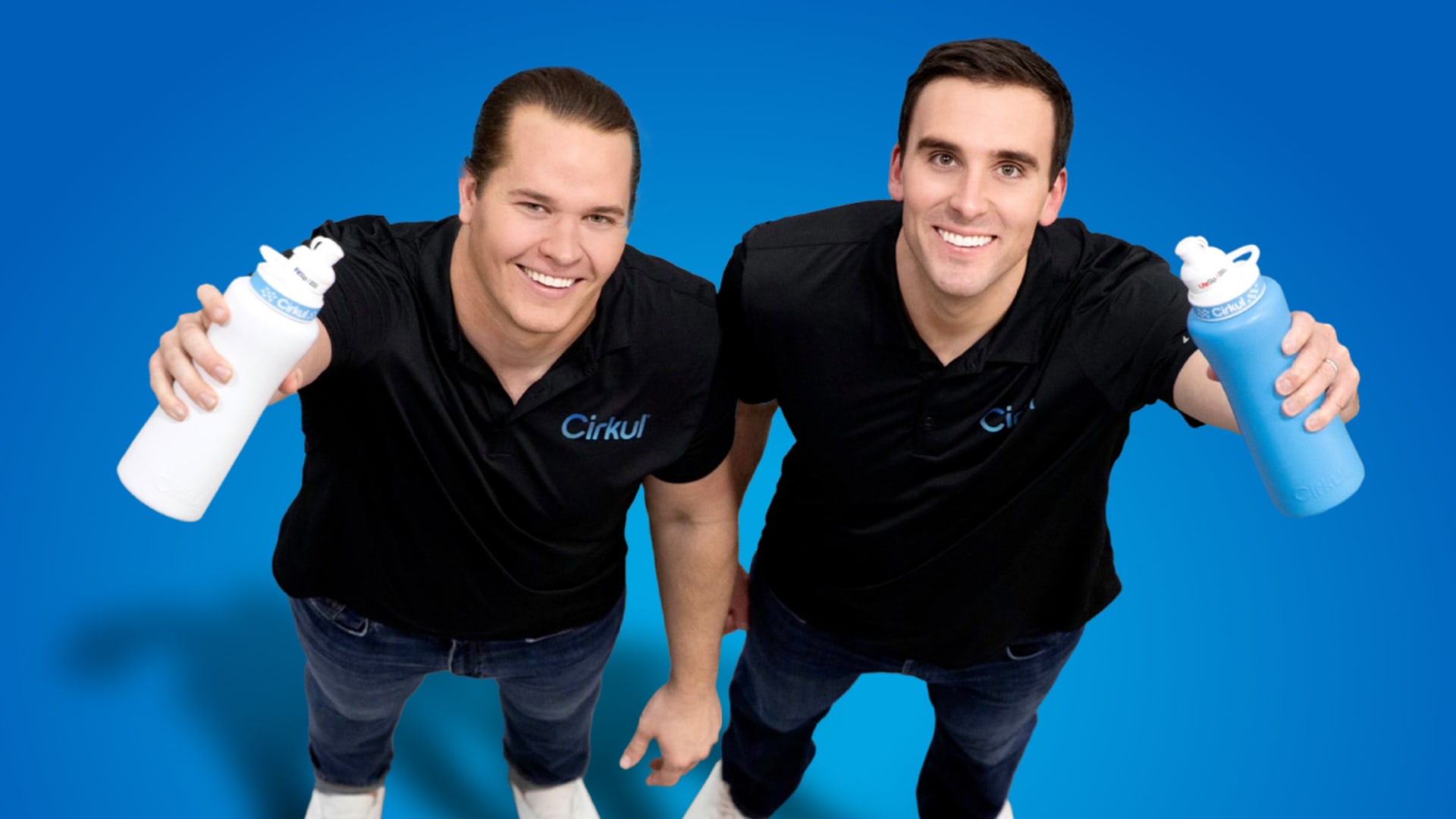
Gay has carried that idea into partnerships and public appearances. In 2024, he represented Cirkul when it became an official hydration supplier of USA Swimming, a neat return to a company conceived by two college athletes. In 2025, he and Waggoner appeared around the Super Bowl as Cirkul aired its first commercial during the game. By 2026, they were discussing more than 150 flavors, vertical manufacturing and retail growth on a beverage-industry podcast.
There is a sporting flavor to that advice, though Gay's company was built less like a breakaway run than a long series of short gains. Prototype. Test. Miss. Recruit. Revise. Pack. Ship. The famous origin occupies perhaps a minute; the work between the question and the shelf occupied years.
The bottle itself offers a fitting summary of Gay's part in the business. Its complexity is tucked away. The user sees a simple choice and feels a small click. Brand, product and habit meet at one numbered dial. All those patient years disappear into the ease of a sip, which is exactly where good consumer design likes to hide them.