Bruce Lucas had a perfectly respectable reason to stay put. He had helped build Heritage Insurance, taken it into the public markets and watched it expand beyond Florida. Another contract would have allowed him to continue a business he understood. Instead, he left. There is a particular inconvenience to succeeding at something: people expect you to keep doing it.
In 2021, he co-founded Slide. The new company would sell property insurance, a business in which a promise made today can become a very expensive obligation later. Lucas wanted to bring more technology to the decisions behind that promise. He also brought an old-fashioned advantage: he had already spent years finding out how an insurance company works.
That combination gives his second venture its interest. The startup vocabulary is there, including artificial intelligence and data. So are acquisitions, independent agents and the balance sheet of an actual carrier. Lucas’s career makes a useful case study in what happens when someone starts again with experience, capital and a few acknowledged mistakes.
The company he already knew how to build
His route into insurance began elsewhere. Lucas grew up in Indiana, where his father drove a truck for three decades. He has described starting at community college while working and saving to continue his education. Those beginnings supply a more concrete picture of ambition than the usual founder mythology: work first, then work out how to afford the next step.
At Indiana University Bloomington, he earned a bachelor’s degree in geology and environmental science. A law degree from Indiana’s Maurer School followed. His later professional life included work at Weil, Gotshal & Manges and a role leading Infinity Investment Funds. Rocks, contracts and investments were successive entries on the résumé before homeowners insurance became the central subject.
Heritage was founded in 2012. Within two years it had completed an initial public offering. By the second quarter of 2014, the company was reporting 171,000 policies, a newly launched commercial residential program and the acquisition of policies from Sunshine State Insurance. Growth involved a series of transactions and operating decisions, with real households attached to every policy count.
The stock market offered no exemption from ordinary disappointment. Heritage’s 2014 offering raised less than its highest projections. The company nevertheless continued to expand. By the time Lucas’s tenure ended in 2020, he had helped turn a single-state startup into an insurer operating across 15 states with more than $1 billion in annual revenue. A modest entry on a timeline contains a great deal of administration.
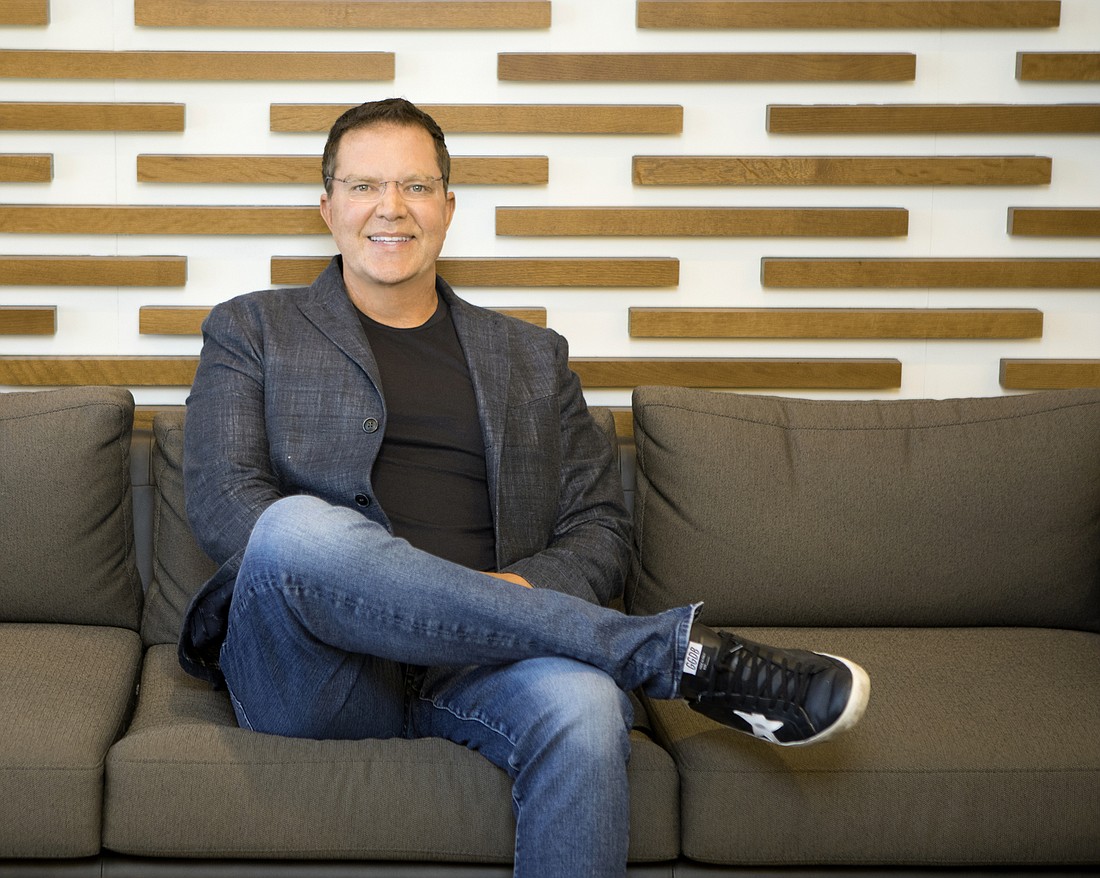
In discussing his departure, Lucas said he wanted to rethink insurance and make its operations and customer experience more efficient. He chose to build a carrier from the beginning, taking responsibility for underwriting risk rather than starting only as an intermediary. He knew that model. Slide would be an attempt to apply that knowledge with a different set of tools.
A founder learns to get out of the way
The revealing admission in Lucas’s account of his earlier career concerns his own management. He said that too much had once needed to pass through him. Insurance was a new field for him, with underwriting, claims, reinsurance and capital management all demanding attention. The instinct to remain involved in everything had a consequence: it made him a constraint on growth.
“In my early days, I was a roadblock.”Bruce Lucas
He described moving toward a more collaborative approach and trusting senior colleagues to make decisions. It is an unusually useful detail in a founder’s account because it gives success a mechanism. More capable people can accomplish more when the chief executive stops requiring every decision to make a personal appearance at his desk. Even ambition has office hours.
Slide’s story also includes Shannon Lucas, his wife and fellow co-founder, whose career in insurance predates the company. She has held roles across several carriers and now serves as Slide’s president and chief operating officer. The partnership places two people with insurance experience at the center of a business often described through its technology.
Shannon has credited Bruce with encouraging her to speak up professionally. In an account of joining Heritage in 2013, she described learning from his willingness to ask for a deal and pursue it. Her recollection adds another perspective to his delegation lesson: a leader can create room both by relinquishing a decision and by encouraging someone else to claim a voice.
The argument about tomorrow
Lucas’s underwriting argument begins with a timing problem. A carrier can study yesterday’s claims carefully and still charge too little for tomorrow’s repairs. He has advocated a more prospective approach, looking ahead at loss costs during the policy period. The contention is straightforward enough. Building a system that consistently makes useful judgments from it is the harder assignment.
Slide describes its internal analytics tool, ProCast, as a way for personnel to assess property risk and support underwriting and portfolio decisions. The distinction matters: an insurer accepts a collection of risks, and the relationship between them matters alongside the merits of each individual home. The technology sits inside that process of judgment.
Slide also grew by taking over business that already existed. After St. Johns Insurance failed, Slide absorbed a substantial policy portfolio in 2022. The next year it purchased exclusive renewal rights for 91,400 UPC homeowners policies. These transactions gave a young carrier scale quickly. They also meant that rapid growth involved serving people whose previous insurer was leaving the picture.
For former St. Johns customers, the change became effective on March 1, 2022. Payments and correspondence now had a different destination. Slide would handle claims for losses from that date onward. The administrative particulars help explain the scale of the task: inheriting a portfolio also means making the handover work.
In 2023, Lucas connected his willingness to take on UPC business with changes in Florida’s insurance litigation rules. His explanation placed regulation beside technology as a reason for confidence. It is a reminder that his operating environment includes legislation, reinsurance and the availability of capital. A clever interface has many colleagues working behind it.
Data and analytics support the carrier’s decisions about the risks it accepts.
There is a similarly practical quality to his treatment of distribution. Lucas has publicly emphasized the role of independent agents. Slide’s proprietary agent platform, Violet, is intended to simplify tasks such as obtaining underwriting answers and using prefilled information. In this version of technological change, software gives an established human network more useful tools.
For a homeowner, that argument reaches its test in small encounters: getting an answer, understanding a choice, finding out what a policy covers. These are ordinary experiences with considerable consequences. Lucas’s ambition for easier insurance depends on how well the machinery helps people through them, long after the introductory presentation has ended.
The bell and the bill
On June 18, 2025, Bruce and Shannon Lucas rang Nasdaq’s closing bell. Slide had reached the public market under the symbol SLDE, giving its co-founders a ceremony for four years of company building. For Bruce, it was another encounter with a ritual he already knew from Heritage: a private venture becoming a business watched and valued in public.
Public-company life brought attention to the rewards as well as the growth. Ahead of Slide’s listing, disclosures showed that Lucas’s 2024 compensation exceeded $21 million, including salary, bonuses and stock awards. Shannon’s package was approximately $16.5 million. The figures drew criticism from consumer advocates and others in Florida’s insurance industry.
Slide said it could not comment further during the IPO quiet period. The criticism touched a tension that follows an insurer selling an expensive necessity: shareholders examine profitability, while customers have their own bills to consider. A successful company and an affordable policy are both intelligible ambitions. The distance between them is a legitimate subject of scrutiny.
That scrutiny belongs in Lucas’s profile alongside the listing. It gives the account its full stakes. The same business that allows a founder to demonstrate operating skill also creates obligations to policyholders, colleagues and investors. Nasdaq supplied the bell. Public ownership supplied a larger audience with questions.
Another stretch of coastline
By July 2026, Slide was reporting second-quarter gross premiums written of $508.0 million and net income of $134.9 million. Those are different measures: premiums written describe insurance business booked, while net income captures the resulting accounting profit after expenses and other items. Neither figure, on its own, supplies a verdict on the next storm season.
In September, the company expanded its South Carolina offerings, including homeowners coverage, a product for higher-value homes and condo coverage. Slide had served the state since 2022. Lucas framed the expansion around coastal opportunity and a disciplined approach to risk. Geographic diversification remained part of the work, as it had been during Heritage’s growth.
His longer-standing ambition has been for Slide to become a familiar insurance name associated with ease of use and fair prices. That aspiration is easy to say and demanding to deliver. It requires the business to keep making sound decisions, including the unglamorous ones, while customers judge the result in their own terms.
Lucas started again because he wanted to build differently. His experience gave him a route to capital, a carrier model he understood and a record that others could examine. He also carried the knowledge that a founder can get in his own company’s way. The next chapter depends on how well those lessons travel, one decision and one policy at a time.