Try describing your sofa to someone who has never seen it. Brown, perhaps. Leather, possibly. Three seats, except that everyone remembers it as the place where one person fell asleep. Now imagine having to do the same for every possession in your house, after a fire. The sofa was the easy question. What was in the drawer?
That thought experiment gets close to Enservio’s business. Property insurers need inventories and values before they can settle contents claims. Policyholders need help assembling them. Between those two needs sits a surprisingly intricate job: turning the things people lived with into information an insurer can act on.
- Software helps insurers inventory, price and manage lost belongings.
- People help reconstruct lists and appraise items a retail database cannot adequately describe.
- Carriers can handle the work themselves, outsource it, or call for overflow help.
A very good calculator needs a very good list
In a December 2012 interview, then-chief executive Jon McNeill recalled an unexpected development. Enservio had imagined a business built around software. Customers pulled it toward a mixture of software and services. The problem was upstream of the calculation: someone had to identify what had been in the home and get that information into the system.
“we thought we were going to be a software company only.”Jon McNeill, CEO at the time, 2012
There is an appealing business lesson here, provided we keep it modest. A tool can perform its assigned task beautifully and still leave its buyer with most of the work. For Enservio, collecting a usable inventory belonged inside the offering. Listening to customers changed the shape of the company.
Today its inventory services include Service On Site for large losses, LiveScribe transcription for adjusters and ListAssist for policyholders. The routes differ, but they address the same bottleneck. A person needs to help turn recollection, evidence and whatever remains on site into a detailed list.

The price of a television is only half the question
Once an inventory exists, the next question is what the listed possessions are worth. A generic label such as “television” leaves plenty unresolved. A defensible comparison needs the characteristics that make one model a reasonable replacement for another. Enservio calls this like-kind-and-quality matching.
Its ContentsExpress cloud platform combines that matching with claims workflow. Adjusters can route valuation work internally, to Enservio or to a third party. Built-in insurance logic can apply carrier rules for depreciation, tax and policy limits. A retailer’s price becomes useful only after the insurance context has been applied.
The company’s TrueLKQ database is refreshed nightly. Its ContentsExpress page cites 15 million products; its separate Contents Valuation page describes 17 million and more than 385 vendors. Those are company-reported figures from different pages, rather than a single, reconciled count. The useful point is the design: a maintained pricing dataset supports the matching process.
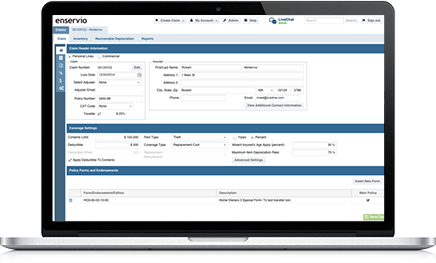
The Customer Portal brings the policyholder into that workspace. Users create inventories, upload photographs and receipts, and respond to requests from the adjuster. The portal works on phones and tablets and can carry the insurer’s branding. Its practical ambition is to cut the repeated pursuit of missing lists and missing details.
Receipt handling matters after replacement purchases, too. ContentsExpress includes a Receipt Manager for matching receipts and processing recoverable depreciation. The claim is a sequence of tasks, with different evidence needed at different moments. Putting those tasks together is more useful than treating every upload as another attachment in an inbox.
- 01CaptureInventory, photos, receipts
- 02MatchComparable items and prices
- 03ReviewRules, risk, specialist needs
- 04SettleA report the parties can use
Workflow illustration, not a promise of automatic payment.
The antique refuses to be a spreadsheet cell
Then there are belongings whose value cannot sensibly be inferred from the nearest retail listing. Enservio’s Select service covers fine art, collectibles, antiques and unusual possessions. Its specialists include certified gemologists, former auction house specialists, gallery curators and art history professors. An insurance operation turns out to have room for people who know their way around a collection.
The service also handles collection cataloging, appraisal and art advisory work. Its listed areas range from books and manuscripts to musical instruments, couture and fine wines. For complicated losses it offers project management, including coordination of conservation or restoration. Different objects demand different kinds of judgment; Enservio has made that distinction a service line.

Let the routine move; keep the exceptions visible
Enservio also sells ContentsAnalyzer, which scores risk at both claim and individual-item level. It combines household, contents and property data, lets carriers configure alert thresholds, and supports referrals to special investigation units. A score is a reason to review a claim. It does not, by itself, establish that a policyholder has committed fraud.
Straight Through Contents takes the automation further for eligible claims. Solera’s product brochure describes an inventory-to-settlement workflow with carrier-defined thresholds. The distinction matters: the carrier determines which claims fit the automated path. Self-service needs enough information to work, and unusual possessions still deserve specialist attention.
For a buyer, the sensible evaluation would begin with real claim types. Can policyholders supply the necessary detail? Where do inventories require assistance? Which referrals need human judgment? That is an editorial inference from the product design: a faster workflow earns its keep when its inputs and exceptions are handled well.
A specialist that works inside someone else’s system
Enservio occupies a particular part of the insurance market. It serves contents work for property carriers, claims teams and adjusters, including losses in homes and businesses. It supplies both the technology to manage that work internally and people to take it on. Policyholders encounter the service through the claims process.
That makes flexibility part of the commercial proposition. A carrier with experienced staff can use the software; one short of capacity can use services or overflow assistance. Enservio markets the offering through sales conversations and demonstrations. The costs a buyer needs to evaluate include the software arrangement, service workload and integration effort; the appropriate mix depends on the operation.
There are alternatives. Verisk’s XactContents provides contents estimation, including retailer pricing and item searches. Carriers can also retain their own inventory and valuation teams or use independent specialists. Enservio’s distinguishing proposition is the combination of a contents platform, assisted inventory and specialty expertise. That combination is worth comparing against the buyer’s actual staffing needs.
Guidewire is a partner in this picture. In December 2021 the companies announced a ClaimCenter Marketplace add-on that lets adjusters submit assignments, reuse populated claim data and view status updates and reports without leaving ClaimCenter. The advantage is wonderfully unglamorous: fewer repeated entries and fewer journeys between systems.
The business inside the belongings
Founded in 2004, Enservio expanded through its 2012 acquisition of Insurers World. Solera announced an agreement to buy the company in July 2016; Enservio now identifies itself as Solera-owned. At announcement, the attraction included more than $10 billion in historical property-contents information. That figure described the data behind the business, not the purchase price.
The lesson a reader can copy is smaller than an acquisition strategy. Make the list before making the calculation. For software builders, that means paying attention to the work customers must do before they can use the product. For anyone documenting possessions, it means recording the distinguishing details while those details are available. “Brown sofa” is a beginning. A useful inventory goes further.