Payroll is the rare product that succeeds by leaving no memory. The money arrives. The taxes are withheld. The forms exist when they are needed. Nobody applauds the software, which is rather the point. Andrew Brown has spent the better part of a decade engineering this useful absence. At Check, the company he co-founded and leads, the work is to gather thousands of rules, hundreds of agency relationships, payment rails and awkward exceptions, then tuck them behind infrastructure other software companies can use.
It is an odd second act for someone whose first startup sold access to beautiful books. Oyster, founded in 2012 by Brown, Eric Stromberg and Willem Van Lancker, offered a subscription library and was routinely introduced as the Netflix for books. Brown was its CTO. The service had the sheen of a consumer idea: elegant reading, curated shelves, a monthly invitation to wander. Google acquired the company in 2015, and the team moved into Google Play Books.
Brown had already been through Google once. After studying economics and computer science at Duke, he joined as an associate product manager in 2011. By the time the Oyster chapter ended and his Google years resumed, he had seen both ends of the startup arc: the clean promise at the beginning, and the complicated machinery required to make it real.
The romance of the awkward problem
When Brown went looking for another company to build, he did not choose a glamorous sequel. He chose the workflow people mention with a sigh. Payroll looked frozen beside the software revolution happening around it. Restaurants, contractors, salons and clinics were adopting industry-specific operating systems, yet employers still exported hours, copied figures and opened a separate payroll product to finish the job.
Brown's insight was less about making another payroll app than changing where payroll belonged. If a platform already understood a business's workers, schedules and wages, payroll should live inside that platform. Check would supply the difficult layer beneath it: calculations, filings, money movement, compliance and the controls required when mistakes affect actual paydays.
The model placed Check one floor below the visible product. Partners could design and sell payroll under their own brands; Check would be the structural steel. It was an infrastructure bet made in 2019, publicly introduced in 2021, when the company announced a $35 million Series B led by Stripe and Thrive. A $75 million Series C led by Stripe followed in 2022, bringing disclosed funding to $119 million.
Those numbers are tidy. Payroll is not. Brown says the United States has roughly 10,000 taxes administered across about 1,000 agencies. The written rules are only the beginning. In one story, a 13-cent tax notice becomes a miniature detective novel. The amount was irrelevant; the notice revealed that a process could be technically correct and still collide with the way an agency actually worked. Infrastructure earns trust in these tiny, irritating seams.
“We think payroll today is fundamentally broken.”Andrew Brown
Indifference as a product goal
Most consumer software courts affection. Brown offers a more mischievous target: indifference. People may love a new phone provider after escaping a bad one; with payroll, they can dislike the old system and still resent the switch. His ideal end user does not become a Check fan. They become someone whose day proceeds without payroll occupying it.
That aim is modest in feeling and enormous in execution. A payroll run has to remain boring while moving large sums, reconciling bank activity and interpreting rules that vary by place and worker. The system must absorb complexity without pretending it has vanished. Brown's product taste is therefore closer to civil engineering than entertainment. Nobody wants a bridge to have personality at the crucial moment.
The crucial moments arrive without an appointment. In March 2023, Check's leadership team was meeting in New York when Silicon Valley Bank began collapsing. Brown's phone rang for hours. The bank was then one of Check's primary routes for moving payroll money, so a financial news event instantly became a payday problem. The team had to find new paths for funds while protecting employers and workers from the drama. It was the infrastructure bargain in miniature: absorb the emergency so Friday can remain Friday.
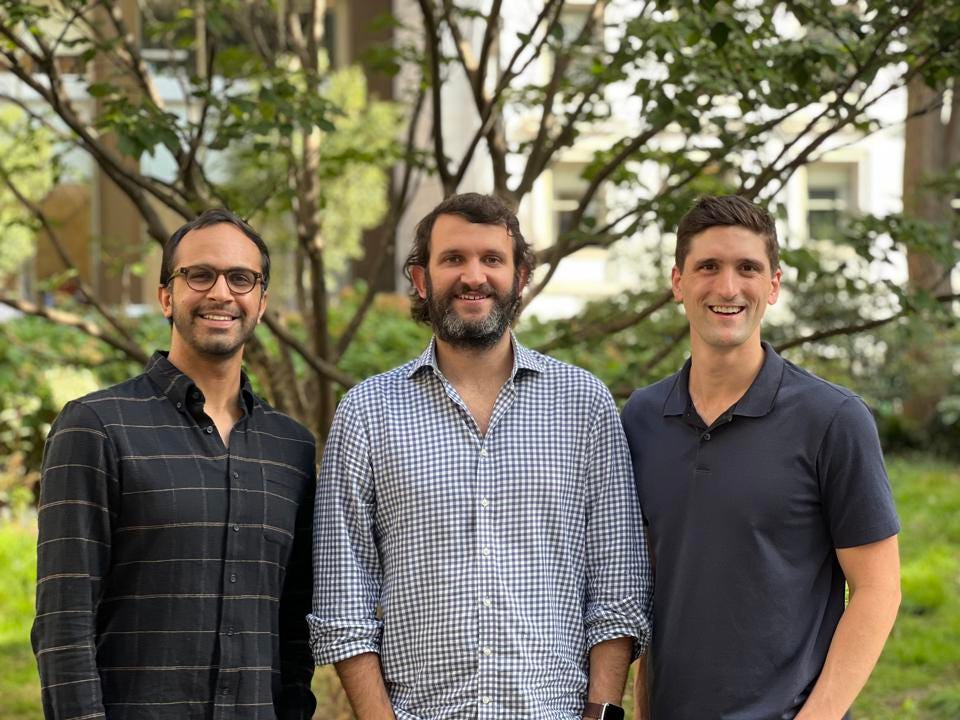
The quiet exterior depends on what Brown calls unglamorous, obsessive work: tax calculations, agency integrations, redundant payment systems, risk controls and the long tail of forms. Check announced in 2026 that it had paid more than one million people through partner platforms. The milestone is striking because most of those people may never have heard of Check. Invisible infrastructure can have a very large census.
A CEO with a commit history
Brown has resisted one conventional promotion: moving entirely away from the work. He still ships code. His explanation is practical. Small jobs expose the grain of the system, and that contact improves larger decisions. “There's no job too small for anyone in the company to do,” he has said. It is easy to embroider such a line on company swag. It is harder to keep opening the editor.
The habit supports his favored description of Check's people: load-bearing. Every teammate should materially alter what the company can carry. Projects stay with teams of fewer than ten, preserving the clarity that disappears when responsibility is divided until it becomes vapor. Brown concedes the model can be stressful. It can also be unusually legible. A person knows where the structure rests.
Keep the team small enough that contribution remains visible, and the leaders close enough to the work that their abstractions stay honest.
His public description of the culture combines intensity, care for partner success and a willingness to nerd out about payroll detail. The phrase is cheerfully uncool. It is also precise hiring language. Check is not selling the glamour of an industry; it is selling the satisfaction of mastering something consequential. “The best people are attracted to hard problems,” Brown says. Payroll supplies them by the thousand.
The company is distributed, with offices in New York and San Francisco, regular team gatherings and concentrated working sessions. The format reflects the same taste for deliberate structure. Flexibility alone does not create closeness, and a room alone does not create a good team. Brown's answer is cadence: remote work, planned collisions, then long stretches of responsibility.
The mountain guide's boundary
Away from payroll, Brown climbs mountains. He and his wife, Cornelia Miller, summited Mount Rainier in 2022 on their second attempt. Later he used mountaineering to explain a lesson that surprised him at Check. The more his company tried to do for a partner, the worse that partner's payroll business could perform over time. Help had begun to remove the very repetitions that build ability.
A guide can bring the ropes, know the route and read the weather. The climber still has to climb. In Check's version, the infrastructure handles the machinery while the partner talks to customers, learns the edge cases and develops a payroll business worth owning. “There are no shortcuts to the top,” Brown wrote. A founder who chose payroll was unlikely to believe otherwise.
“Like all entrepreneurs, I'm both an optimist and a builder.”Andrew Brown
The boundary is a useful correction to the usual language of frictionless software. Some friction is waste. Some is the resistance through which a company learns what it is. Remove the first. Be careful with the second. Check's work is to carry complexity its partners should not rebuild, while leaving them responsible for the customer knowledge no API can provide.
An accidental head start on agents
Years of designing for developers produced an unexpected dividend when AI agents became useful software customers. Check's payroll capabilities were already expressed through APIs. In 2026 the company released an MCP server and command-line tool that let assistants and agents interact with more than 260 operations, from onboarding and bank accounts to reports and payroll workflows.
Brown called AI an unintended strategy credit. The phrase is better than claiming clairvoyance. Check did not foresee every interface; it built clean primitives and received options in return. The same infrastructure originally meant for human developers became legible to agents. Architecture had preserved a future nobody needed to predict precisely.
There is continuity here with Oyster. Both companies reorganized an unruly catalog behind a simpler door. Books carried romance on the surface; payroll carries consequence underneath. Brown's career moved from helping readers forget the bookstore shelf to helping employers forget the tax machinery. In each case the interface says, quietly: start here, and let the system manage the shelves.
Check's ambition is that this machinery becomes a utility, the dependable layer through which people are paid. Utilities are noticed most when they fail, so success produces few fireworks. The paycheck arrives. The worker gets on with Friday. Somewhere underneath, thousands of rules have agreed to behave for another week. Boring, at last.