On a Friday afternoon, the best payroll software in the world is the software nobody mentions. Wages arrive. Taxes are accounted for. A manager closes the browser and goes home. There is no toast to the calculation engine, no thank-you note to the system that found the right state withholding rule. Worklio has made a business of this splendidly thankless position. Its software sits under other companies' brands, running payroll and human capital workflows for the firms that sell those services to employers.
In brief
- The job: supply white-label payroll, tax, benefits and HR infrastructure.
- The buyer: PEOs, payroll bureaus, staffing firms and software platforms.
- The scale: Worklio reports more than $35 billion in payroll and taxes paid through its platform since 2018.
- The bet: partners keep the customer; Worklio handles the difficult machinery underneath.
That last arrangement sounds simple until you ask what “underneath” contains. A pay run must reconcile time worked, pay rates, deductions, benefits, bank details, tax jurisdictions and employer entities. The payroll provider also has to file taxes, move money and answer the phone when a number looks wrong. A software company can add a tidy “Payroll” tab in a sprint. It cannot improvise the entire operating system behind that tab by next Friday.
The invisible name on the payslip
Worklio sells to intermediaries. A professional employer organization, or PEO, may manage payroll and benefits across thousands of workers employed by many client companies. A bureau may serve a book of small businesses. A vertical software platform may already know a restaurant's shifts or a contractor's job costs and want payroll beside them. These partners can use Worklio's branded interface, embedded components or APIs, then present the service under their own names.
This is a peculiar kind of ambition. Most young software companies want users to remember the logo. Worklio wants its partners to own that recognition. The partner earns the relationship, sets the client price and decides how much of the surrounding service to provide. Worklio earns its place by making that relationship easier to keep. Its public list pricing runs by module and person per month; the full published retail stack adds to $81 for 19 modules, while the stated payroll-and-HR starting wedge is $15. Those are list-price illustrations, not a universal invoice. Agreements, usage, setup fees and volume discounts change the actual bill.
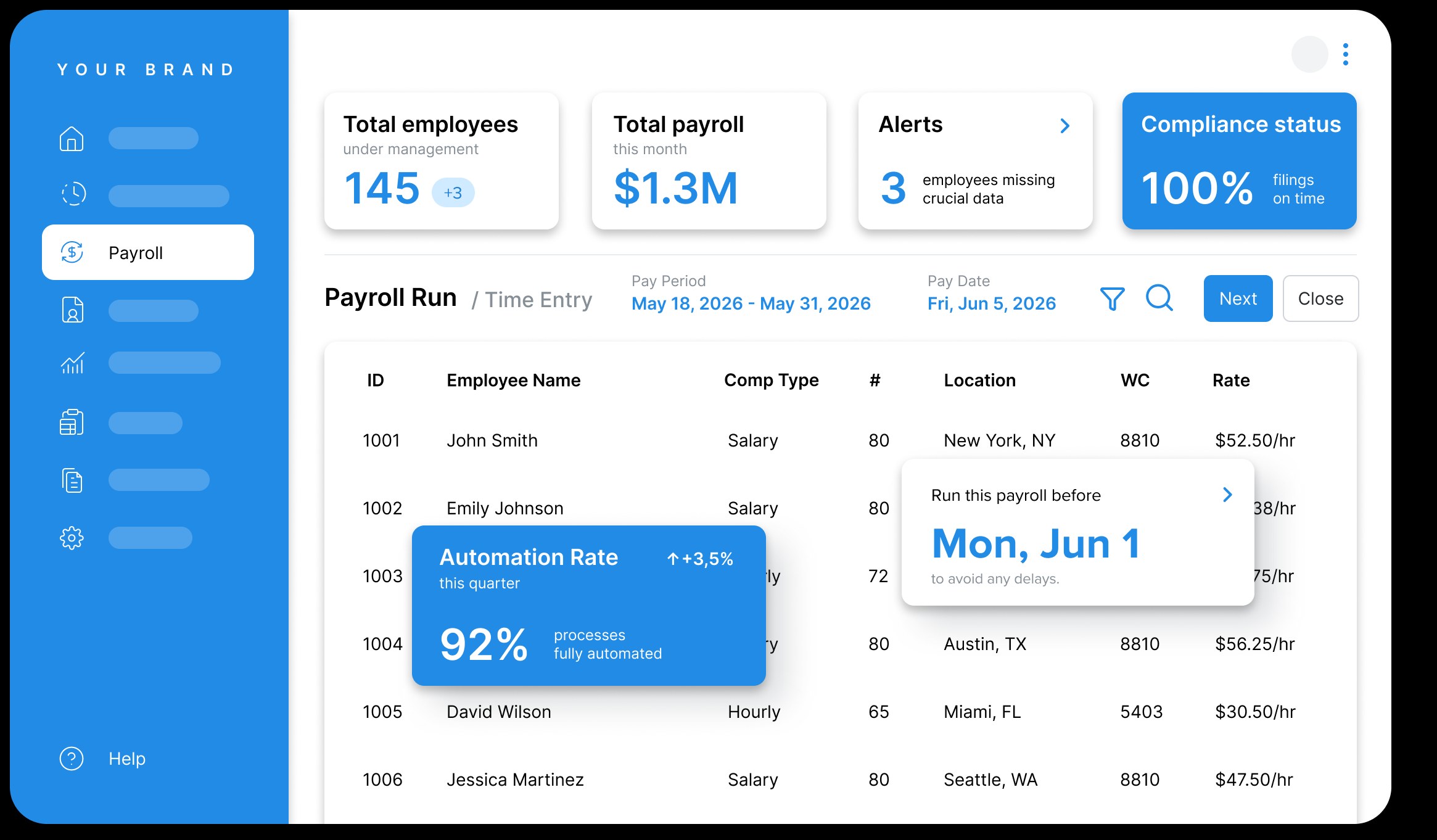
The product has grown from payroll into tax filing, payments, employee self-service, HR, onboarding, time, benefits and workers' compensation workflows. That range is useful because payroll is a consequence of everything around it. A changed shift alters hours; a benefit election alters a deduction; a move across state lines changes the tax problem. Put those facts in separate systems and someone must carry them across the gap.
The expensive lesson in what matters first
The company dates its original idea to 2014: connect payroll, HR, benefits, insurance, time and workforce management. Worklio LLC was established in 2017, and the platform went live with reseller and beta partners in 2018. Its own account of those early years describes a change in emphasis. The market taught the team that payroll was the center of the system, not merely another feature on the menu. It connected compliance, benefits and worker data, and it imposed a deadline no product roadmap could postpone.
That is the closest thing in the public record to a founding pivot. It was not a famous crash or a dramatic rescue. It was a less theatrical discovery: everything else depended on getting pay right. The company's 2026 product work still follows that logic. Certified-project and union-payroll modules bring prevailing wage rates, union dues and WH-347 reporting into the pay run. Expanded APIs connect time and attendance, benefits, electronic W-4s and general-ledger exports to that same core. The interesting question is not how many endpoints exist. It is whether a changed fact travels from the first clock punch to the final payroll journal without someone copying it by hand.
Worklio's founders say they have put approximately $20 million into the company and have not sought venture capital. The company describes itself as entirely founder and employee owned. That is a material choice in a business where customers may spend months converting old payroll records before they can switch platforms. A buyer is not just shopping for a feature list. It is betting that the vendor will still be invested in tax notices, support desks and product maintenance years later.

Scale is a test, not a slogan
One early proof point was DecisionHR, a Florida PEO that moved onto the platform in 2019. Worklio describes that operation at roughly 27,000 worksite employees. In 2021, FrankCrum selected Worklio as its HCM technology platform; the announcement described 4,000 client companies and 70,000 worksite employees. Those figures describe the partners at the time of announcement, not a count of active Worklio users today. They matter because multi-client payroll makes the ordinary employer problem repeat itself across many companies, tax accounts and workflows.
The same distinction matters in Worklio's broader numbers. Its site reports more than $35 billion in payroll and taxes paid and more than 2.8 million employees paid since launch. Those are cumulative operating figures, not annual revenue or current headcount. What they do show is that Worklio has spent years in production, where theoretical elegance meets real bank files and real paydays.
Migration is where that experience becomes particularly useful. In its buyer guidance, Worklio tells providers to inventory clients, federal employer IDs, tax jurisdictions, benefit plans and integrations; clean the data; reconcile year-to-date balances; and run payroll in parallel before switching over. The warning is practical. A bad year-to-date balance can surface months later in a W-2 or quarterly filing. The first system to fail in a migration may be the old data, long before the new interface gets a chance to shine.
A playbook worth stealing
There is a lesson here for software companies tempted to add payroll, payments or another regulated service. Start with the transaction that must be right on a particular day. Map every upstream fact that can change its answer. Price the recurring product, but budget for conversion, support and exception handling. Worklio's model also suggests a distribution choice: let partners own the front door when they already own the customer's daily workflow. That can make a deep infrastructure company valuable without forcing it to become everybody's favorite app.
It is not a universal shortcut. A platform that only needs to pay a handful of straightforward employees may find a direct payroll product simpler. A partner without staff to manage migration, support and client expectations can still disappoint its customers with excellent underlying software. And an embedded API does not absolve anyone of the operational work around money and tax. Worklio's pitch is strongest where payroll complexity and an existing customer relationship meet.
There is something almost old-fashioned about the result. The company has built a business around being dependable on a day when nobody wants a surprise. If the pay run works, the visible brand gets the credit. If it fails, everyone notices. Worklio has chosen the narrow space between those two outcomes as its market.