A shift ends at 5 p.m. The work is finished; the accounting begins. Someone must approve the hours, calculate taxes, check a worker's status, move money, produce a paystub and, in a staffing business, bill the client who ordered the labor. The worker sees a paycheck. The operator sees a procession of handoffs, each with a chance to delay the next shift.
Kirti Shenoy and Pranab Krishnan met that procession while running Puzzl, a gig staffing company. Their early model used 1099 contractors. When customers needed W-2 employees, the founders discovered that the available payroll machinery did not suit a workforce moving among jobs, employers and pay schedules. They looked for a way to run high-volume, dynamic payroll. The search became Zeal.
The short version
- Zeal supplies the infrastructure behind staffing platforms' worker onboarding, payroll, payments and client billing.
- Its point of difference is the awkward middle: W-2 and 1099 workers, shifting schedules, many jurisdictions and fast pay.
- Customers can put their own brand on the worker experience while using Zeal's APIs, components and admin tools behind it.
The form that changed the company
The story starts with a classification. A contractor can be paid through a relatively simple payout flow. An employee brings withholding, overtime, wage rules, filings, eligibility verification and a stack of state-by-state duties. The difference is legal, operational and remarkably unfriendly to improvisation. Puzzl's move toward W-2 workers made that difference impossible to ignore.
Zeal was founded in San Francisco in 2019 and joined Y Combinator's summer cohort that year. It raised a $1.6 million seed round in 2020 and a $13 million Series A led by Spark Capital in 2021. A $15 million Series B, announced in October 2024 and led by Portage, financed a wider product push. Those are financing amounts, not the cost of implementing Zeal for a customer. Zeal does not publish a standard customer price list; an operator needs a commercial quote to know that number.

What changed the founders' minds was not a grand theory of financial technology. It was the practical burden of turning flexible work into compliant employee pay. Their answer was to sell the missing infrastructure to other companies that face the same collision. Zeal's own mission is to ensure every American worker gets paid correctly, on time and without friction. That sounds plain. The engineering required to make it plain is the business.
One worker, several systems
Today, Zeal groups its offer into three verbs: onboard, pay and bill. Onboard collects documents and tax forms, signatures, certifications and remote Form I-9 verification with E-Verify. Pay calculates gross-to-net wages, handles taxes and filings, and supports direct deposit, paycards, digital wallets and faster payment options. Bill turns approved worker pay and assignment data into client invoices and collections. The platform offers an API, embeddable components, an admin dashboard and a white-label mobile app.
That last point matters. A worker at a staffing agency may never know Zeal's name. They can see their staffing company's branding while completing paperwork, checking paystubs and receiving wages. Zeal is selling a branded operating layer, not asking every customer to send workers to an unrelated payroll portal. It is useful to the staffing company precisely because the worker's first experience and last payment can belong to the same product.
A general payroll provider can serve a company with stable salaried staff quite well. Zeal is pointed at the messier cases: a nurse who works per diem, an event crew hired for one night, a marketplace that pays both employees and contractors, or a fiscal management service handling many employer records. Its customers include staffing firms, labor marketplaces, employer-of-record and professional-employer organizations, and software platforms that want payroll inside their own products. Wonolo, Qwick, Lawtrades and WorkGenius appear among publicly named users.
The first broken step was before payday
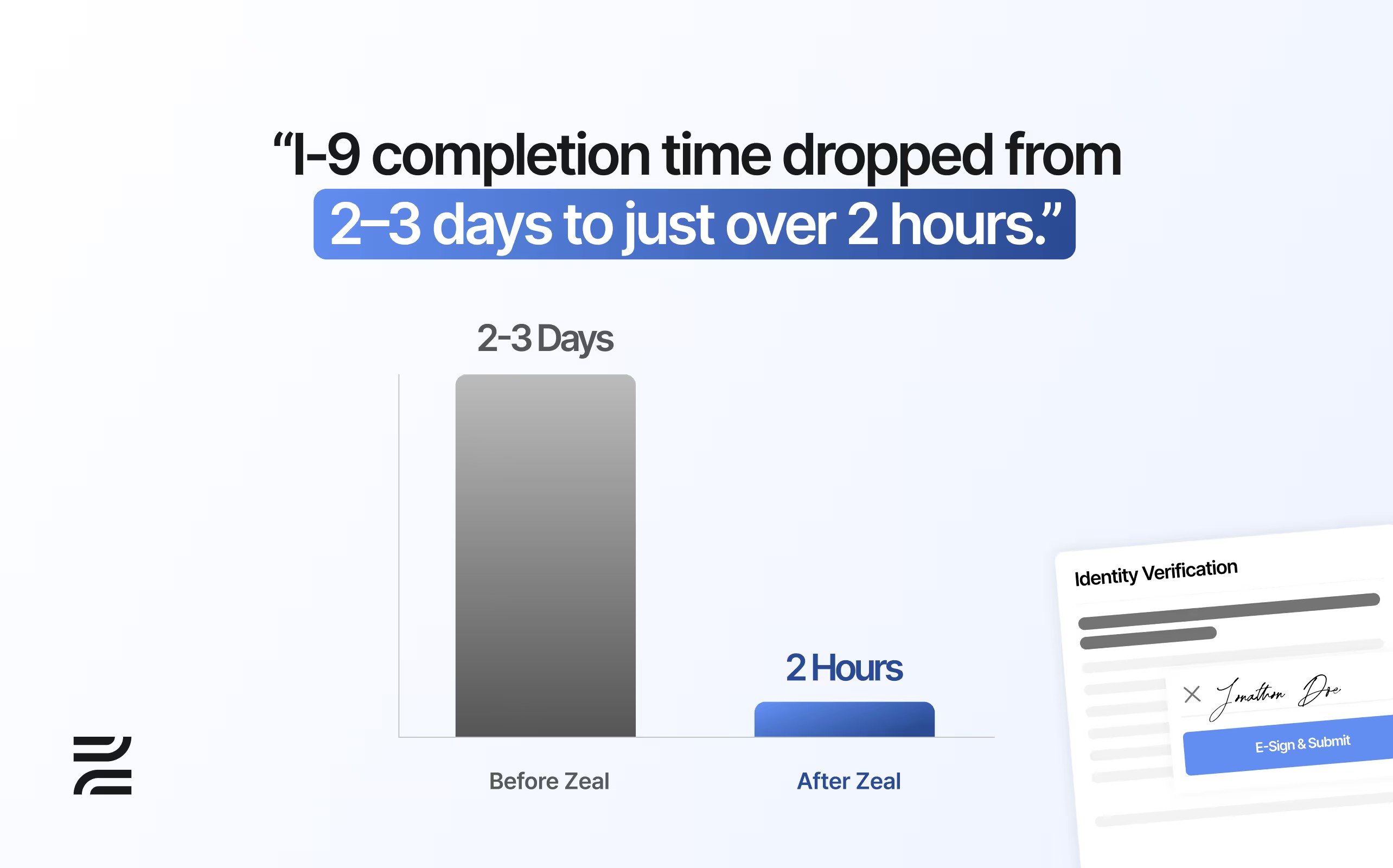
After building payroll, Zeal found another obstruction: I-9 verification. Its product team wrote that workers could be ready and jobs available, yet a slow eligibility check could stop a shift before it began. Zeal folded remote I-9 and E-Verify into its onboarding environment instead of treating them as paperwork outside the worker journey. This is the revealing feature of its strategy. If the first shift never happens, the fastest paycheck in the world has nothing to pay.
Zeal's 2026 benchmark, based on more than 200,000 worker signups on Zeal-powered platforms during 2025, puts numbers around that early friction. In its cohort, contractor onboarding completion stayed near 90%, while employee onboarding averaged 34%. The report also found roughly ten days from signup to first shift and about 96 hours from finished shift to money in the bank. These figures describe Zeal's platform cohort, not all U.S. staffing. They still make an operator's priorities difficult to miss.
The invisible system, seen in one customer
ACE FMS, a California service that helps families manage caregiver employment, offers a useful test. It needed to pay thousands of workers through a model involving many employer records. ACE says a previous Paychex setup brought limited APIs, slow submissions and support delays. It moved employee information into its own portal and used Zeal to synchronize that information with payroll. ACE reported roughly a 50% reduction in payroll processing time, with worker updates driven through the API rather than re-entered in another system.
“We don't want our clients or employees logging into five different systems. Our portal is the hub. Zeal lets us keep everything in sync behind the scenes.”Peyman Dadmehr, CEO of ACE FMS
That outcome depends on the shape of the customer. ACE already had a portal and a team prepared to integrate its data. A small employer with one location and an ordinary monthly payroll may get little benefit from embedding an API, a branded app and client invoicing. A platform that operates across states, handles both W-2 and 1099 workers, or needs to turn shifts into invoices has more of the problem Zeal was built to solve. The copyable lesson is to map the whole worker journey before buying another isolated tool: where does data get typed twice, and where does one delay hold up the next step?
The economics behind the button
Zeal's customer pays for B2B software and payment infrastructure through negotiated commercial terms. The company also pitches a different possibility to staffing operators: faster payments, paycards and wallets can create fee, interchange and wallet-related revenue for the platform. Its website models such possibilities, but model outputs are illustrations, not earnings promised to every buyer. The worker's choice and the price of speed matter as much as the operator's new revenue line.
There are rivals at every edge of this market. General payroll systems process wages. Embedded providers let software companies offer payroll. Staffing suites cover recruiting and operations. Zeal's wager is narrower and more concrete: the workforce platform needs one connected route from eligibility to earnings to the customer's invoice, with the complicated tax work out of sight. Its 2025 work with Bullhorn illustrates the position: let an established applicant tracking system handle recruiting, then connect the steps that follow a placement.
The best test of the idea is not how quickly an app can put a “cash out” button on a screen. It is whether the amount is right, the worker is eligible, the taxes are handled, the money arrives, and the client can be billed without a second round of typing. A shift may end at five. Zeal's business begins in what happens next.