The first renovation Andreea Plesea describes was financed with pocket money. As a child, she bought replacement knobs for the living-room furniture, fitted them, and decided she had transformed the room. Her parents returned to a domestic redesign they had not commissioned. There are cheaper ways to announce an interest in management, but few with such immediate results.
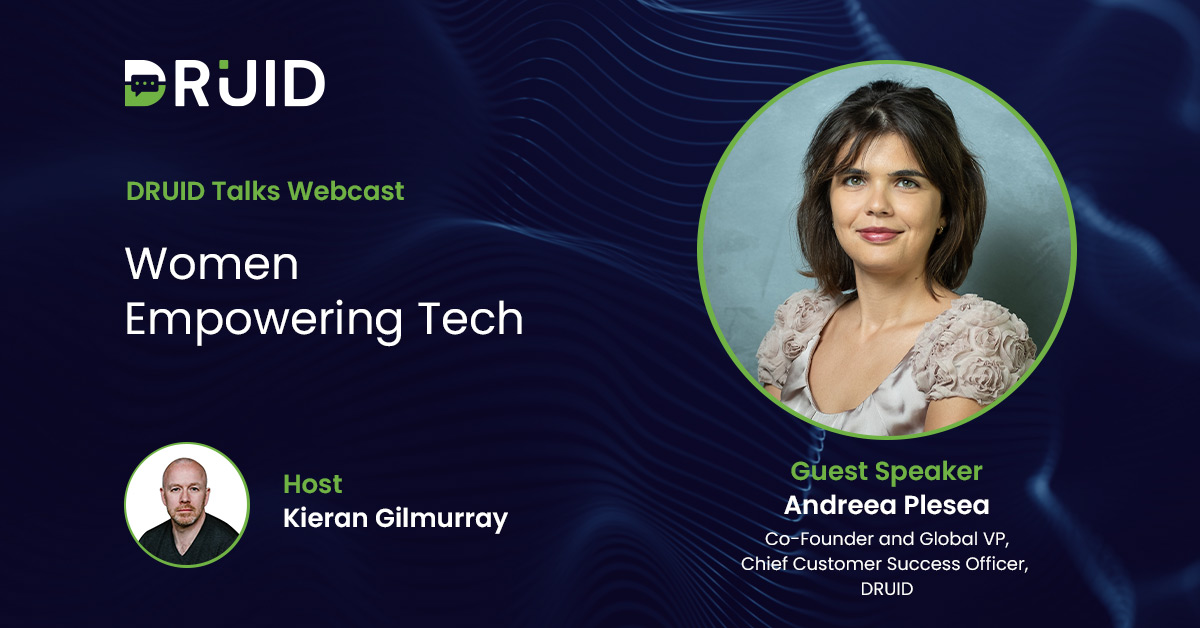
Today she is co-founder and chief operating officer of DRUID AI. The objects requiring attention have become more complicated: enterprise applications, implementation teams, customer relationships, the machinery of a growing software business. The old question still makes a useful opening to her story. What could work better here, and what would it take to change it?
Her career offers an unusually practical answer. Plesea has written software, helped sell it, built teams to deliver it, and worked with the people expected to use it. She also served as interim CEO. Read those jobs together and a pattern emerges: each puts a different test to the same idea. Can it be built? Will somebody buy it? Will it help them on an ordinary working day?
A developer in the family
Software was a profession she could see at close range. Her mother was a developer, and Plesea wanted to become one too. She considered a polytechnic education, then chose business computer studies at the Bucharest University of Economic Studies because the physics required for the alternative did not appeal to her. Even a future AI founder is entitled to have a least favourite subject.
That choice placed computing beside the concerns of a business. Her studies included cybernetics and informatics; artificial intelligence caught her interest. During her doctorate, she also spent time at Rome's Tor Vergata university, where she recalls working in a programme led by AI researcher Maria Teresa Pazienza. A technical career, in her account, had visible women in it from the start.
The combination matters. Business software has to represent both information and the things an organisation wants done with it. An elegant answer in a classroom has room to be elegant. An answer in an office must also cope with somebody's deadline, somebody else's permissions, and the fact that the information may be filed in an entirely different application.
Doctoral research in AI, semantic web technologies and ontologies. DRUID followed in 2018.
The colleague before the co-founder
Plesea joined TotalSoft as a .NET programmer in 2008. She was also pursuing her doctorate. Software development became team leadership, then broader management of business applications. The years preceding DRUID were an apprenticeship in the many obligations that gather around a product once customers depend on it.
There is a good origin story inside that apprenticeship. At university, an assignment asked her to describe a Romanian entrepreneur. She chose Liviu Drăgan. His interest in art and his ambition to build proprietary software in Romania caught her attention. When she later had job offers to consider, that earlier encounter with his story helped draw her to TotalSoft.
Drăgan became her mentor. She describes learning to listen, negotiate, and combine ambition with attention to other people. The relationship continued into DRUID, which they co-founded with Daniel Balaceanu, Bogdan Pietroiu and Bogdan Grigorescu. It is a useful reminder that founding teams have histories before they have company names.
That history gives the familiar phrase “team chemistry” some substance. People who have already built together have seen more than one another's introductions. They have encountered decisions, disagreements and delivery. Experience cannot remove the uncertainty of a new company, but it can reduce the uncertainty about who is sitting beside you.
A thesis finds an office
DRUID was founded in 2018. Plesea's doctoral work had explored semantic web technologies and ontologies, ways of structuring meaning so intelligent systems could use it. Years later, the startup gave that academic interest a business setting. She had not expected her research to return in quite this form.
“Honestly, I never dreamt I could use my Ph.D. like this.”
Andreea Plesea, 2022
The founding ambition was to give employees virtual assistants. In a large organisation, even a modest request can send someone through several departments and applications. Plesea described companies with more than 10,000 employees using assistants to interact with functions including finance, procurement and HR. The attraction lay in making an organisation easier to navigate.
Taking that ambition abroad required more than a working product. Plesea credits the global reseller agreement with UiPath in 2020 with opening international markets. DRUID's $15 million Series A in 2022 supported further expansion. Familiarity helped at home; partnerships helped the company enter rooms where its name was less familiar.
There is an unglamorous virtue in that account of growth: asking for help. A founder can know a product thoroughly and still need someone who knows a market, a language or a buyer. International expansion turns competence into a collective activity. The sales conversation has to travel farther than the founder's own address book.
Every job asks a different question
Her DRUID responsibilities expanded with the business. Development gave way to building a delivery team, commercial work and customer success. The sequence is more revealing than any single title. Selling introduces the promise. Implementation discovers the conditions attached to it. Customer success stays around long enough to find out whether the promise holds.
In a 2025 interview, she described DRUID's core advantage as its team's experience building enterprise solutions. She emphasised integrations, the speed of getting systems into use, and monitoring business indicators. Her interest was in software that could act within a business process, carrying a request beyond a conversation into the work itself.
The examples can be delightfully ordinary. At a 2021 energy event, Plesea discussed linking window sensors to a chatbot so a consumer could be told an open window was increasing energy consumption. An AI conversation need not concern the future of civilisation. Sometimes it can concern the window you forgot to close.
Retail supplies another setting. She has discussed assistants used in recruitment at Auchan and Carrefour, and internal operations at Auchan. These are businesses where hiring, onboarding and fulfilling orders recur constantly. The value of a tool has to survive repetition, with different people asking for help at different moments.
- 01RequestA person asks
- 02ContextSystems and rules
- 03ActionWork gets done
- 04ResolutionAn outcome to check
Put those examples beside her career and the relationship becomes clearer. A programmer knows the difficulty behind an apparently simple action. A commercial leader knows the expectation attached to it. Someone responsible for customers sees the distance between those two views. Plesea has worked on each side of that distance.
The CEO chair, then the next chapter
In September 2025, DRUID announced a $31 million Series C led by Cipio Partners and appointed Joseph Kim as CEO. The announcement identified Plesea as co-founder and COO, and confirmed that she had been interim CEO. Her public response welcomed Kim's focus on customers and on developing the solutions they needed.
A funding announcement makes an easy milestone for a profile: a date, a sum, a new appointment. It is less useful as an ending. Investment creates room to work and a fresh set of expectations. A change at the top also asks the people who built a company to continue building alongside someone new.
DRUID AI's Series C, announced 16 September 2025 alongside Joseph Kim's appointment as CEO.
As COO, Plesea remains part of that continuing work. The title connects the founding story to the present organisation. It also fits the breadth of her earlier responsibilities: a company has to deliver what its product and its sales conversations say it can deliver. Someone must keep those conversations in touch.
The people who grow with it
Her public description of herself is concise: “I build technology, but I lead with people.” She credits Drăgan with shaping her approach to leadership. Outside work, she describes herself as a wife and mother of two boys, linking family life with patience, resilience and curiosity. Those are her own terms for the connection.
Her involvement with Women in Tech Romania makes the interest in other people's careers visible beyond DRUID. She appeared on the chapter's January 2023 launch panel about continuous learning and growth mindset, and on a September 2024 panel about allyship, sponsorship and mentoring. These subjects belong beside the technical ones.
A career can become harder to enter when its successful participants appear fully formed. Plesea's route supplies a more useful picture: study, a first programming job, people to learn from, then responsibility that changes shape. Mentoring has a practical purpose when it makes those intermediate steps visible.
What survives the demonstration
By 2026, her writing was concerned with the gap between an AI pilot and everyday operations. She argued for integrating with existing systems, respecting access rules, and treating adoption as an organisational change. A product has to make sense to the people who will work beside it. A successful demonstration leaves that question open.
In her August 2026 interview, Plesea described production as a demanding teacher. Users change their minds, information arrives incomplete, and systems fail. Her emphasis was on dependable execution and on bringing people into the process when needed. The assistant's usefulness has to survive the conditions in which its customer actually works.
That is a fitting present-day concern for someone whose career has repeatedly moved closer to the customer. An idea can be compelling while its implementation remains awkward. Plesea's different jobs have exposed her to both. The work becomes judging the awkwardness accurately enough to do something about it.
She still gardens and enjoys DIY. She also likes escaping into the British countryside between meetings, and baking with her children. Teaching is the other profession she says would appeal to her. The small furniture renovation has acquired many successors. Some involve software, some involve people, and some, happily, can still be accomplished in a kitchen.