Josh Schachter received photographs of a Porsche he had no reason to receive. A venture capitalist in New York had selected the wrong name in her email autocomplete. She meant to write to Joshua Schachter, the founder of the bookmarking service del.icio.us. Instead, she had reached the entrepreneur who would build UpdateAI. He replied with his pitch deck. The investor declined. That might have been the end of an ambitious response to somebody else’s photographs.
It became an introduction. Years later, Schachter asked his namesake to invest in UpdateAI. Another refusal: the other Joshua’s experience was in consumer businesses, rather than business software. Schachter tried a different appeal. Two people with the same name on the capitalization table would give his general counsel something to puzzle over. The joke worked. Joshua wrote a $10,000 check.
Schachter tells the story as a lesson in asking, with humor and respect. It also supplies a useful opening to his career. His opportunities have repeatedly begun with people whose work he wanted to understand. The product, the job title, and sometimes the investment followed the conversation.
A mistaken email became a relationship, then an investment in UpdateAI.
A career assembled backwards
In 2010, after winding down HockeyBarn, a sports social network he had founded, Schachter wondered where to go next. He wanted eventually to run a technology company as a president or general manager. He opened LinkedIn, found people doing those jobs, and read their careers from the bottom upwards. It was an unusually literal way of working backwards from an ambition.
He saw two recurring routes: product and marketing. Engineering school and a childhood enthusiasm for Lego made product feel like the sensible choice. An entry-level product job at eHarmony took him to Santa Monica. Southern California kept him for the next ten and a half years.
The subsequent résumé crossed NFL product work, Intuit, an education startup, an MBA, and venture building at BCG. He also became founding general manager of Setel in Malaysia. These were different settings for the same professional question: how does an idea become something a team can actually operate?
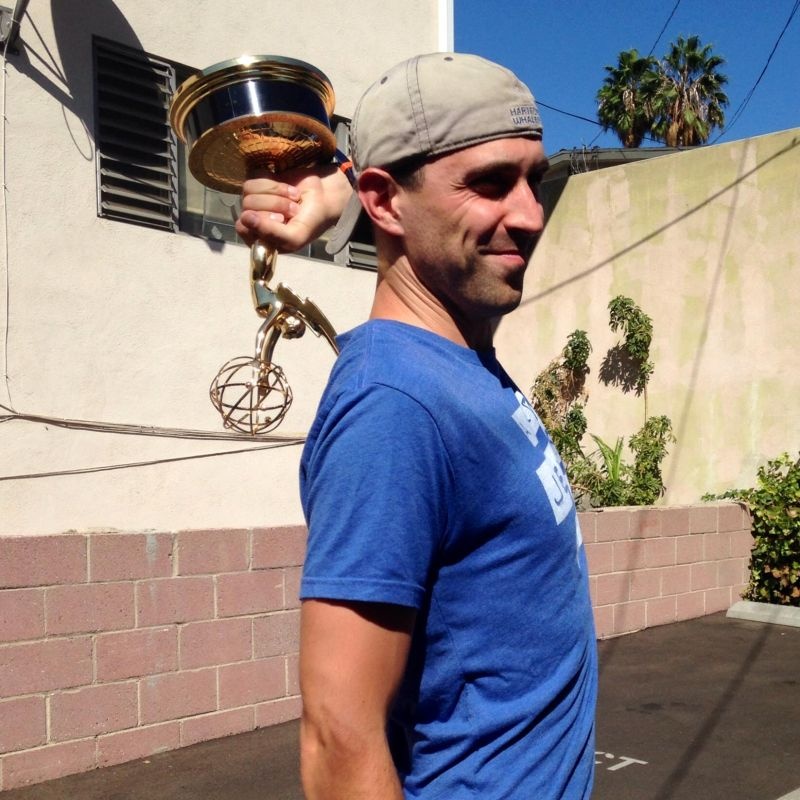
His formal education paired industrial engineering and operations research at Columbia University with an MBA at UCLA Anderson. The combination fits the work that followed: designing a system, then figuring out how to run the business around it. His NFL chapter also produced an Emmy, which he has cheerfully photographed being put to less ceremonial use.
The pyramid before the meeting bot
In 2018, Schachter published a framework for operating startups, later called The Startup Pyramid. It grew out of his experience launching a digital wallet with a corporate partner at BCG Digital Ventures. He wanted a multidisciplinary team to share goals rather than retreat into separate disciplines.
The model worked down from a vision through supporting pillars, measures, milestones, and an assigned workplan. A supportive culture sat underneath. He preferred a simple collaborative spreadsheet or Airtable base for the workplan. The mechanism mattered more than acquiring another elaborate piece of software.
One detail is especially telling. An early workshop to establish team values had fallen flat. The group tried again four months later, after spending time working together, and the exercise became more productive. Familiarity gave the discussion something real to work with. A room can agree to be a team long before its members have learned how.
Shared culture supports the whole structure.
Learning a profession from its practitioners
UpdateAI began around late 2020 with a broad idea about helping busy teams communicate. Schachter’s consulting experience had shown him capable people struggling with information overload. Bill Gross, the founder of Idealab, backed the venture. Discovery interviews then brought Schachter into customer success, a profession he had not previously understood. He found people responsible for the ongoing customer relationship after a software sale, carrying substantial administrative work alongside it.
That discovery narrowed the business. UpdateAI would help post-sales teams extract useful information from their meetings. By July 2025, Gainsight had acquired the company, and Schachter joined as senior vice president and general manager of Atlas. The path from broad collaboration idea to acquisition ran through learning the work of a particular group.
Early in that journey, he chose to make his lack of expertise visible. In a 2022 interview, he described the team reaching out daily to customer-success practitioners and openly discussing gaps in its knowledge. Advice from Gross had helped: keep learning something new each day. Schachter added a qualification that prevents the idea becoming a greeting-card slogan. Eventually, learning alone is insufficient.
He had also been influenced by Carol Dweck’s Mindset, with its emphasis on treating difficulty as an opportunity to develop. His advice to his younger self began simply: “Be patient.” It suited a founder still preparing to launch a customer-success platform, collecting understanding before pretending to possess it.
The relief of handing something over
Some of the useful lessons arrived through infrastructure. UpdateAI initially captured meetings through Zoom Cloud Recording, which limited it to users who hosted the meeting and had a paid Zoom plan. Reaching customers on Google Meet and Microsoft Teams meant solving a much larger recording problem.
The team tried building its own meeting bot. The edge cases multiplied. Schachter estimated that maintaining the infrastructure would consume a full-time person even after the initial build was finished. He eventually selected Recall.ai to handle recording, allowing the team to return to its own product.
He remembers relief across the engineering team, including a thank-you from his head of engineering. For an entrepreneur, that is a useful kind of recognition: somebody can get back to doing the work they were hired to do. The decision also let UpdateAI serve customers using other meeting platforms. A product vision still has to survive the ordinary question of whether the recording starts.
What the conversation was really for
Schachter’s interests extended beyond an accurate recap. In a 2024 essay, he argued that the advantage in AI applications would come from relevant context: understanding the company, its customers, and the history between them. His proposed customer knowledge graph would connect those interactions to outcomes such as purchases, renewals, and expansion.
A favorite example was pleasingly mundane. A chief customer officer took a screenshot of UpdateAI’s portfolio dashboard and put it in a presentation to the board. Information from everyday customer conversations had reached a consequential discussion. The screenshot was evidence of usefulness without requiring anyone to admire the machinery.
Product updates in April 2025 showed how that intention translated into controls. Teams could create custom topics, pin useful ones, and disable irrelevant ones in the voice-of-customer dashboard. Commercial-value visibility helped them prioritize signals about risk, expansion, or product requests. Planned CRM enhancements would move meeting and account insights into the records where teams already worked.
- 01 ConversationWhat the customer says
- 02 ContextAccount and relationship history
- 03 Shared signalsTopics, requests, follow-ups
- 04 DecisionsWhat the team does next
A conceptual map of UpdateAI’s approach, not a performance chart.
Three years online, then a table in Porto
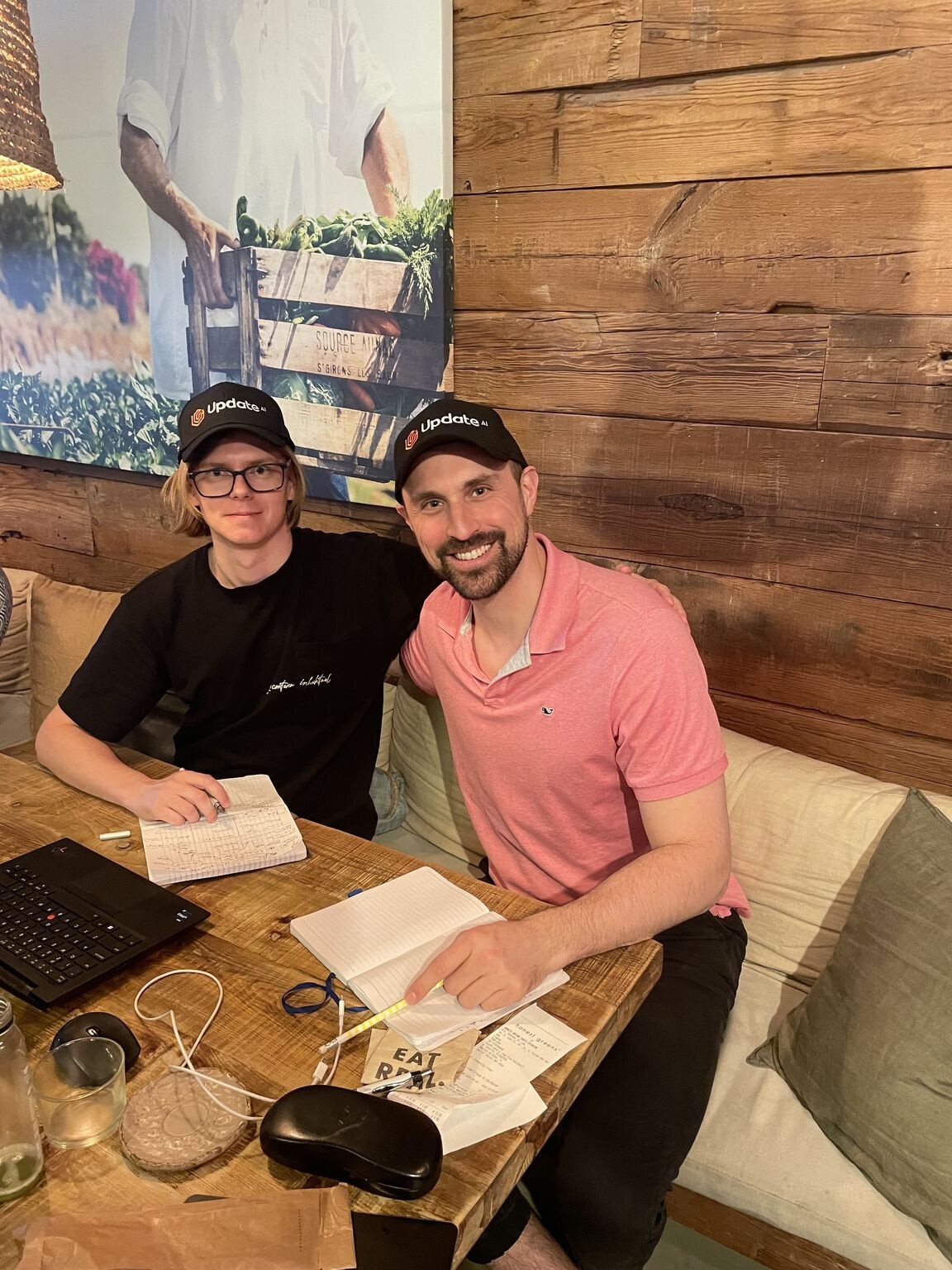
In April 2024, Schachter traveled to Porto to meet Sergey Kondratiuk, UpdateAI’s head of data science, face to face for the first time. They had already been working together for more than three years. The photograph has matching company caps, open notebooks, a laptop, and the welcome untidiness of people sitting down to work.
They broke bread, drank Port, and planned the next phase of the company’s AI strategy. Schachter described insights organized across meetings, accounts, customer stakeholders, and the entire portfolio. The image offers a small correction to the usual picture of a startup: important collaborators may know each other’s thinking long before they have shared a table.
The microphone went with the company
Schachter also built a place for those conversations outside the product. On [Un]Churned, he hosted customer-success discussions alongside Kristi Faltorusso and Jon Johnson. Guests included Airtable chief customer officer Cait Keohane, GitHub customer-success leader Michael Goetz, and AngelList’s Carly Van Kirk. The show gave practitioners room to explain how their organizations worked.
When Gainsight acquired UpdateAI, it acquired the podcast too. Its announcement explicitly connected community and storytelling with the company’s technology ambitions. Schachter would continue hosting. An audio show is an unusual item to find alongside conversational AI in an acquisition, but it belonged to the way he had built the business.
By 2026, an episode with QuotaPath co-founder AJ Bruno introduced him as Gainsight’s SVP of Strategy and Go-to-Market Development. Their discussion covered the shift toward AI-native services, the difficulty of pricing outcomes, and the trust required when software companies offer to perform work for customers. The questions had grown larger than meeting notes.
The title can change. The curiosity stays.
Schachter has written about how difficult it was to release his identity as a product manager. Founding UpdateAI required him to act as CEO. At Gainsight, he found himself leading marketing without having previously held a marketing job. The growth mindset he recommended to his teams suddenly demanded something of him.
“Where my career goes next, I have no idea.”
Josh Schachter, reflecting on moving beyond a product-management identity
There is room in that admission for the career he once mapped so carefully backwards. In July 2026, Gainsight appointed Grant Clarke to lead Atlas as EVP and general manager. Schachter’s own work had moved into strategy and go-to-market development, while the interviewing continued.
Outside work, he enjoys tennis, hockey, and exploring New York with his wife Jessica and their puppy Jackson. Another ritual is coffee near Grand Central with David Karp of DISQO. A meeting intended to collect advice about an AI hackathon devoted about a minute to that agenda, then drifted into life and work.
Schachter has described friendship as the unexpected reward of building UpdateAI. Karp even traveled from Dallas to London for his wedding for a 48-hour visit. It is a different measure of what a company leaves behind. The wrong email produced a check; years of asking and listening produced people who stayed.
Continue the conversation
Read, watch, or listen to more of Schachter’s work.