Andreas Kellas found an unusually convenient way to finance an expensive childhood hobby. At twelve, he persuaded a hobby shop to hire him and pay him in store credit. The wages went straight back into remote-control aircraft. His employer had acquired a worker and retained a customer. The young pilot had found a way to keep flying.
Business was already close to home. Kellas grew up above his grandfather’s auto-parts shop in England. His grandfather had brought the family from war-torn Cyprus, started a restaurant and then moved into car parts. Watching him handle customers and employees gave Kellas an early education in running things. Later came MIT, an unsuccessful first attempt at a company, and a second venture with Adam Ray and Bobby Cohanim. In his recollection, the two left their jobs and joined him on his couch.
MORSE was established in 2014. The furniture was temporary. The question of who would sit beside him turned out to matter a great deal.
A wing with a mind of its own
Kellas graduated from Drexel University in 2005 with a degree in mechanical engineering. His business administration minor covered subjects that would be useful when an aircraft enthusiast became an employer: accounting, economics, marketing and contract law. Engineering supplied one set of tools; running a company would require the others.
At MIT, his 2007 master’s thesis concerned a guided samara: a single-bladed vehicle that rotates as it descends. The arrangement sounds eccentric until you consider that a winged seed already manages a version of this maneuver without a flight controller or a procurement department.
Under advisers Mark Drela and Timothy M. Barrows, Kellas investigated whether the form could become a steerable delivery vehicle. He developed a computer simulation, built models and assembled a control system using a microprocessor, a hobby servo and an electronic compass. The work required understanding both how the vehicle fell and how an intervention could change its direction without making the whole arrangement unstable.
The unguided-flight simulation predicted descent and rotation rates within ten percent of test observations. A guided prototype went to NASA Langley for flight testing. Weather and test circumstances left the final demonstration inconclusive. The thesis preserved that distinction: promising analysis and hardware, with a demonstration still to be settled.
Supplies that steer themselves
By 2011, Kellas was discussing autonomous airdrop as a business leader at Draper. A cargo parachute makes an appealingly simple picture. The engineering underneath is less obliging. Wind changes. Terrain intervenes. The right landing point can be a very small part of the available landscape.
Draper’s software for the Army’s Joint Precision Airdrop System allowed a load to guide itself after release from a cargo aircraft. Its July 2011 account described a rapid development effort begun the previous February, completed in less than a year for under $1.5 million. The system had flown its first operational mission in Afghanistan that May.
The software was non-proprietary, government-owned and usable across different hardware platforms. That detail would have a familiar echo in Kellas’s later company. The practical value of an engineering solution includes what the customer can do with it after delivery.
At MORSE, even the parachute itself became a research question. A 2017 Army small-business research award named Kellas as principal investigator for a concept called Parachute Olefin-polysulfone Obfuscating Film. POOF is an unusually obliging acronym. The proposal involved a transparent canopy designed to depolymerize into gas when triggered, reducing what remained visible or recoverable. It was a research proposal with an award, rather than proof of a fielded capability.
A company designed to share control
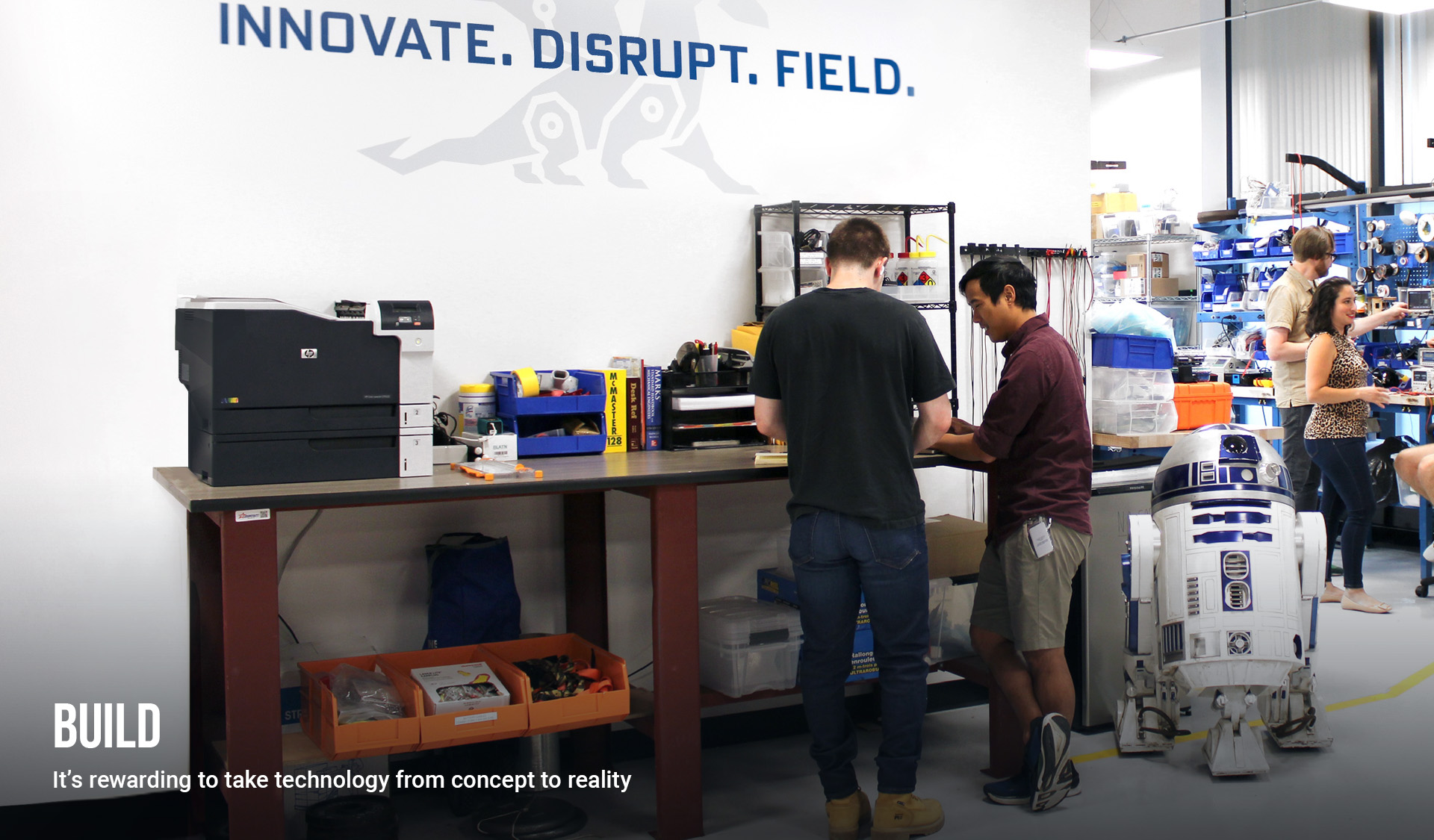
MORSE expands to Mission Oriented Rapid Solution Engineering. Kellas, Ray and Cohanim built it around technical work for the U.S. national security ecosystem. Its disciplines span software, engineering and science; its public description puts difficult problems ahead of a single product line.
Kellas has called its model the Anti-Prime contractor. In his 2022 account, that meant providing unlimited government data rights, maintaining a transparent customer relationship and working without a product-based business model. He also described growth beyond 150 employees without outside funding. More revealing was the accomplishment he chose to emphasize: recruiting colleagues who had made the organization capable of continuing without any particular individual, himself included.
In January 2024, MORSE made the ownership arrangement explicit: all full-time employees were shareholders, with no non-employee shareholders. That gives the familiar recruiting word “ownership” something firmer than a motivational meaning. There is an actual company to own.
employee owned
All full-time staff are shareholders.
No non-employee shareholders.
The company’s development process has a similar preference for staying close to the people doing the work. Teams engage users throughout a project and test alongside them in conditions resembling actual operations. The intended result is equipment that fits the user’s constraints. A system can be technically elegant and still be awkward to prepare, carry or operate.
The growing AI practice introduced another version of the same demand for evidence. In February 2022, MORSE announced its selection for an AI test-and-evaluation agreement with a $250 million ceiling across five years. That figure described the agreement’s ceiling, not revenue already received by MORSE.
“Without T&E, we cannot accurately determine the value AI solutions provide.”
Andreas Kellas, 2022
The work covered software services, testing across different AI domains and integration into the government’s development infrastructure. MORSE described independent evaluation as a service customers could use when assessing technology bought from other contractors. That creates a practical responsibility for an engineering team: describing the conditions of a test clearly enough that someone else can understand what its result means.
The assignment included developing testing services and helping customers assess AI capabilities. For an engineer whose thesis distinguished predictions from demonstration, it is a recognizable concern: what, precisely, has this thing shown it can do?
Recognition followed the company’s growth. Kellas was selected for the Boston Business Journal’s 40 Under 40 in 2021, from a field of more than 200 nominations for that year’s group. Drexel included him in its own 40 Under 40 the following year. The university identified an alumnus applying both sides of his education: mechanical engineering and the business subjects he had studied alongside it.
The paperwork has to fly, too
The company’s record also contains a serious failure to meet its own contractual obligations. In March 2025, MORSE agreed to pay $4.6 million to resolve allegations involving cybersecurity requirements in Army and Air Force contracts. The company admitted specified facts about its security practices.
Those facts included incomplete implementation of required security controls, gaps in written security plans and shortcomings in requirements applied to a third-party email host. MORSE had submitted a security assessment score of 104 in January 2021; a consultant assessed it at minus 142 in July 2022. The reported score was not updated until June 2023, after a government subpoena.
Kellas signed the settlement as president. It was a corporate civil settlement resolving allegations, with admitted company facts, rather than a personal criminal conviction. Its relevance to his leadership is direct: a company building technology for government customers also has to deliver the protections its contracts require.
In June 2025, MORSE announced that it had completed a CMMC Level 2 assessment with a score of 110, no findings and no outstanding plans of action and milestones. That later assessment belongs beside the settlement in the chronology. It records a subsequent company announcement; the earlier obligations and the settlement remain part of the account.
Making room for the next people
Expansion continued. After opening an Arlington office in 2024, MORSE announced a Seattle location in June 2025. Kellas described three conditions for choosing an office: a leader who understood the company’s methods, nearby customers and a technical talent pool. Eddy Scott, who had joined in 2017, was assigned to lead Seattle.
In August 2025, the company announced a five-year Army agreement worth $48,054,384 to develop long-range autonomous aircraft for environments where GPS could be unavailable. In September came an announced DARPA Albatross contract, aimed at aircraft that exploit environmental energy to fly farther and longer. The career that began with model aircraft was still occupied with the question of how to keep a vehicle usefully aloft.
Albatross brings weather into the aircraft’s decision-making. The announced work combines forecast-informed mission planning with onboard responses to changing conditions, seeking to harness energy available in the environment and reduce the demand on the aircraft’s power supply. MORSE’s named capabilities for the program include autonomy, platform integration and flight testing. An aircraft that can use the air around it more effectively presents a different engineering task from simply installing a larger battery.
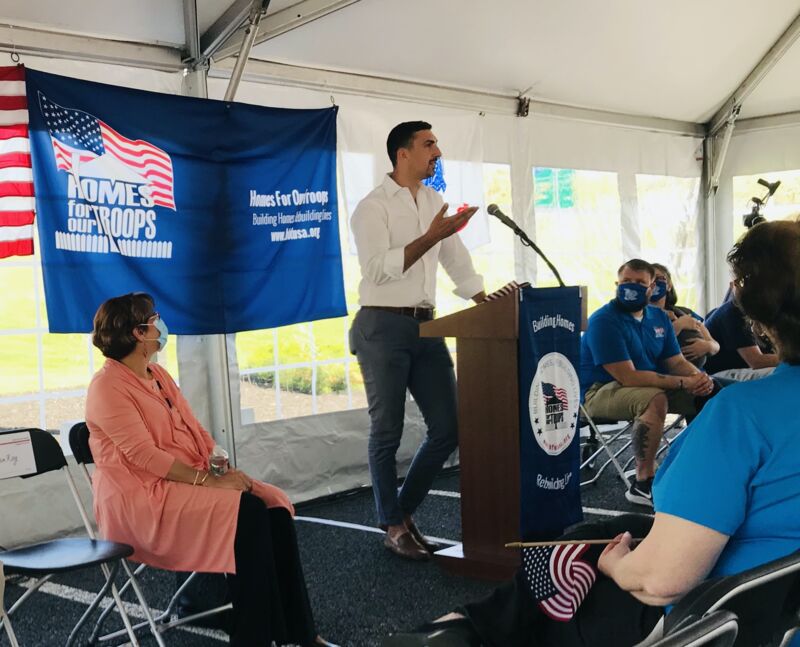
Some of the work happens at a more ordinary altitude. In October 2021, 120 MORSE employees collected 1,163 pounds of trash in Cambridge. The haul included furniture and construction materials. The company received a community partner award later that year. Kellas also appeared at a Homes For Our Troops building kickoff in Derry, New Hampshire. A podium and a neighborhood project offered a different setting from a flight test.
By October 2026, the founder still had a scheduled role in welcoming recruits. New employees were introduced at the weekly company meeting, learned the company’s story on their first day and met Kellas as a cohort within their first month. Follow-up conversations came at 30, 60 and 90 days. Growth had acquired a calendar.
Back in 2022, he had set himself the goal of becoming the CEO a 500-person company would need. He framed the task around delegation, communication and building teams. The number was an ambition. The work he attached to it was personal.
His grandfather had learned to manage a business across a counter. Kellas’s own responsibilities now stretch across offices, contracts and engineering disciplines. The challenge is to make the organization work when the founder is elsewhere. It is a reasonable next assignment for someone who spent so much time figuring out how things could steer themselves.