When Kevin Langjahr became chief executive of nLogic on January 1, 2026, his predecessor already knew rather a lot about him. Tim Thornton said the two had worked together for more than 26 years. An executive search can establish qualifications. A working relationship of that length has had time to encounter deadlines, changing assignments and the less photogenic parts of running a business.
The appointment had been prepared in stages. Langjahr had served as vice president, then became president and a board member in 2024. The CEO responsibility followed two years later. Thornton moved to strategic advisor and stayed on the board. The arrangement gave the change a definite shape: a transfer of authority, with an experienced colleague still available for corporate development and advice.
There is a second constituency in this story. nLogic is owned by its employees through an Employee Stock Ownership Plan. Langjahr, a co-founder, now leads people who have a beneficial ownership interest in the business as well as work to complete. A new title sits inside an older promise about who should share in what the company builds.
A handover with a long introduction
Langjahr’s opening statement as CEO placed employee ownership near the center of the conversation. He associated it with continuity, responsibility and thinking beyond the immediate moment. He also set out an intention to develop strategic partnerships and work alongside employee-owners as the company changes. These are useful priorities to hear at a succession: they identify the relationships the incoming leader intends to carry forward.
The sequence of appointments matters as much as the announcement. Becoming president and a director in 2024 put Langjahr in the company’s executive and governance structure before he assumed the chief executive role. The 2026 change extended an existing responsibility. For colleagues and customers, the incoming CEO was already part of the organization’s working life.
“I am truly honored and excited to step into the role of CEO.”
Kevin Langjahr · January 2026
Thornton’s move also kept the boundary between the two jobs visible. Langjahr took the CEO position. Thornton became an advisor supporting corporate development, while retaining his board seat. Experience remained available, with executive responsibility assigned to the successor. It is an orderly arrangement on paper, which is a sensible place for an orderly succession to begin.
+ board member
+ CEO
as strategic advisor
Before the corner office, the interfaces
Langjahr came to executive leadership through technical work and program management. His earlier roles included program manager at Davidson Technologies and program director at Torch Systems. At nLogic, his responsibilities have included directing missile-defense weapon programs. The career passes through the places where a technical problem acquires a schedule, a customer and a team expected to resolve it.
His technical background encompasses missile-defense systems analysis, integration, and test and evaluation. Those disciplines deal with relationships between components and evidence about their behavior. The distinction is easy to appreciate outside engineering: owning several competent parts does not, by itself, produce a competent whole. Interfaces have a way of requesting their own meeting.
nLogic’s work makes that setting concrete. Its services include requirements allocation, interoperability and verification. Its modeling work spans digital simulations and tests involving software or hardware in the loop. Testing extends from components to ground, flight and integrated tests. This is the environment around Langjahr’s career, where design intentions must eventually meet observed results.
Two early recognitions mark his professional record. He was nominated for the Missile Defense Agency’s Contractor Employee of the Year in 2014. In 2015, he received the Project Management Institute’s North Alabama Chapter Leadership Award. The nomination and the award are distinct, and together they place recognition of his work well before his appointment as president.
The owners are already at work
nLogic’s ownership story began with investment from its initial employees when the company was founded in 2009. An ESOP and an incentive stock option plan created routes to future ownership. In 2017, the business became fully ESOP-owned. Langjahr’s succession therefore took place within an arrangement established years before his promotion to CEO.
Employee investment at founding in 2009.
Full ESOP ownership in 2017.
Planned CEO succession in 2026.
The benefits describe what ownership means in the company’s own arrangements: employees have beneficial ownership through the plan, and the board approves company contributions each year. That is a more useful level of detail than treating ownership as a pleasant adjective. There is a plan, there are contributions, and there is a recurring governance decision.
Other provisions concern the development of the people doing the work. nLogic offers tuition reimbursement for eligible coursework, supports job training and provides interest-free loans to eligible employees buying computer equipment for personal or family use. These are company programs, rather than personal inventions credited to Langjahr. They are part of the organization he now has responsibility for leading.
His letter to employees and clients connects ownership to delegated decisions and customer goals. It argues that staff should be able to solve problems efficiently, with attention to cost. The idea gives ownership an everyday setting: the person doing the work has room to exercise judgment, alongside an obligation to understand the client’s requirements.
“We believe pride of ownership results in a firm commitment to excellence.”
Kevin Langjahr · Letter to employees and clients
A president goes back to the questions
Langjahr’s education traces a change in the scale of the problems under consideration. He earned a bachelor’s degree in computer science at Jacksonville State University and a master’s in management information systems at the University of Alabama in Huntsville. His current biography also lists doctoral study in executive and organizational leadership at Trevecca Nazarene University as ongoing.
In January 2025, while serving as nLogic’s president, he published a LinkedIn article titled Transformational Leadership & Multi-generational Cohorts. Its introduction connected the subject to his doctoral journey. The topic puts a human question beside his technical background: how leadership works among people whose experiences of work may span different generations.
The timing is revealing in a modest, concrete way. He was studying leadership after becoming president and before becoming CEO. Formal authority and formal learning occupied the same professional period. There is something appealing about a career that can accommodate both a board seat and coursework. The reading list, at least, has no obligation to be impressed by the title.
That combination also gives his profile a particular texture. Computer science, information systems and organizational leadership belong to different academic conversations. Langjahr has pursued all three. The progression does not supply a ready-made explanation for every management decision, but it does show continuing attention to how technical work and organizations are understood.
The serious business of showing up
Langjahr’s professional connections include the NDIA Space & Missile Defense Working Group and local chapters of the Association of the United States Army and the Space Force Association. These memberships place him within the defense community around his work. The public record also catches him in the less formal business of meeting people at industry gatherings.
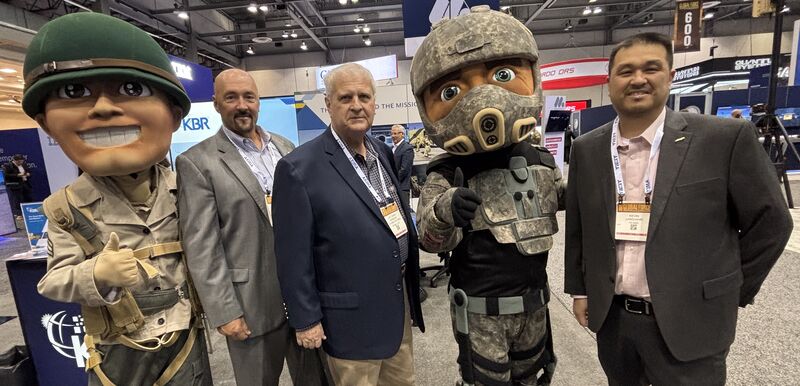
A March 2025 symposium photograph puts Langjahr at the right of a group that includes two costumed military mascots. The image is an agreeable reminder that even a defense conference can make room for a very large foam head. The accompanying post by nLogic COO Joe Paschall names Langjahr and Terry Kennard at AUSA Global Force.
Later in 2025, nLogic identified Langjahr and Paschall as attending the National Cyber Summit in Huntsville. The company invited conversations about cyber threats, IT and mission systems. The two appearances connect different parts of its work: defense engineering on one floor, cybersecurity on another, with company leaders available to talk about both.
Another presidency, another kind of vote
There is another presidency in Langjahr’s public record. nLogic nAbles, the employee-operated charitable organization, lists him as president of its volunteer board. The role connects him to a different expression of employee participation: deciding where charitable contributions should go in the communities where employees live.
Employees fund the grants through voluntary payroll deductions or direct donations. Eligible charities can apply or be sponsored by an employee, and contributing employees vote to select grant recipients. nLogic provides infrastructure support, including the website and payroll collection. Volunteer employees handle the charity’s other operations and committee work.
The distinction between the two presidencies is useful. One concerns a commercial business with customers, programs and an ownership plan. The other helps organize voluntary giving, with contributors participating in the grant decision. Langjahr appears in both structures. His connection to employee participation extends beyond the language of the CEO announcement into a named role on the charity’s board.
What the next chapter asks of him
The organization Langjahr leads has customers across government and industry and operating locations in multiple U.S. states. Its technical services extend through software development, testing, information technology and program management. That range gives the CEO responsibilities beyond any single technical specialty. The work must be coordinated across disciplines, customers and locations while remaining attentive to individual assignments.
His letter to employees and clients names technology, schedule and financial constraints together. They are a useful trio for understanding the job. A technically attractive answer still needs a workable timetable and a cost the engagement can support. Langjahr’s background in programs and business development belongs directly in that conversation, alongside the engineering experience.
Employee ownership adds another obligation to the picture. Decisions about the company’s direction take place inside a business in which staff participate through the ownership plan. His stated ambition to strengthen partnerships and build the future alongside those owners gives the next chapter its terms. The executive title is singular; the enterprise described in his statement is shared.
For Langjahr, January 1, 2026 was a clear milestone in a career already tied to the company. He arrived with technical experience, earlier executive responsibility, a longstanding relationship with Thornton and studies still underway. The work ahead has familiar participants and a wider scope. After a long introduction, he has the CEO’s job to do.