In February 2019, Dr. Amit Kharat completed an executive programme called “Artificial Intelligence: Implications for Business Strategy” at MIT Management School. DeepTek, the company he had helped start in 2017, was already under way. He was studying the subject while building a business around it. A founder’s calendar seldom suffers from an excess of spare time. He had found room for another course.
There is something appealing about that sequence. Expertise usually arrives with permission to stop explaining yourself. Kharat had professional qualifications, research experience and a teaching career. Yet the next item on his record was a qualification in a different discipline. The familiar story of the expert becoming an entrepreneur gains a useful complication here: the expert also becomes a student.
Kharat is based in Pune and is DeepTek’s co-founder and CEO. His working life has crossed professional practice, academic writing, teaching and company building. Those roles ask different questions. An academic must make an argument examinable. A founder must persuade other people to act on it. A student has to admit that the answer may be elsewhere. His career has made room for all three.
Then, complete the AI strategy course.
A paper trail before the pitch deck
Long before the executive course, there was a journal article. In 2014, Kharat co-authored “Data mining in radiology” with Amarjit Singh, Vilas M. Kulkarni and Digish Shah. Among its concerns were the practical arrangements that make information useful: organising records, cleaning data, finding patterns and presenting results. Even its discussion of business analytics touched on equipment and personnel utilisation. The operational questions were already there.
The attraction of such work is easy to underestimate. Data mining sounds rather grand until someone asks whether two records use the same word for the same thing. Then the grand project acquires a broom. Kharat and his co-authors considered structured information and searchable terminology, the sort of groundwork that receives fewer invitations to a launch party than an algorithm does.
In 2017, he and Shubham Singhal published “A peek into the future of radiology using big data applications.” Its title now has the agreeable quality of a dated prediction you can revisit. Together, the two papers establish a public record of his interest in computing before DeepTek had years of company history behind it. He was writing about the machinery of information as well as working inside a profession that produced it.
That matters to his story because a company’s founding date can obscure everything that made it possible. The incorporation document gives a beginning to the business. The questions can be considerably older. In Kharat’s case, the publication dates let us see some of those questions taking shape before they became a venture.
Three dates, one continuing interest
- 2014Co-authors a paper on data mining
- 2017Co-authors a big-data paper; DeepTek is incorporated
- 2019Completes an executive AI strategy programme
Pune, and the people outside his discipline
Kharat’s education took him through Fergusson College, B.J. Medical College, Rural Medical College and D.Y. Patil University. He has described asking technology specialists to help him understand unfamiliar tools. His named intellectual influences extend to Michio Kaku, Carl Sagan, C.V. Raman and Srinivasa Ramanujan. It is an unusually expansive reading list for a business biography: physics, astronomy and mathematics all get a seat.
“Technology is fascinating and evolving,” he has said. The pleasure in that sentence is its lack of a sales target. Curiosity can exist before the market analysis. It can also survive the discovery that the thing you find fascinating has standards, compatibility problems and a manual. His early writing suggests an appetite for that less photogenic work too.
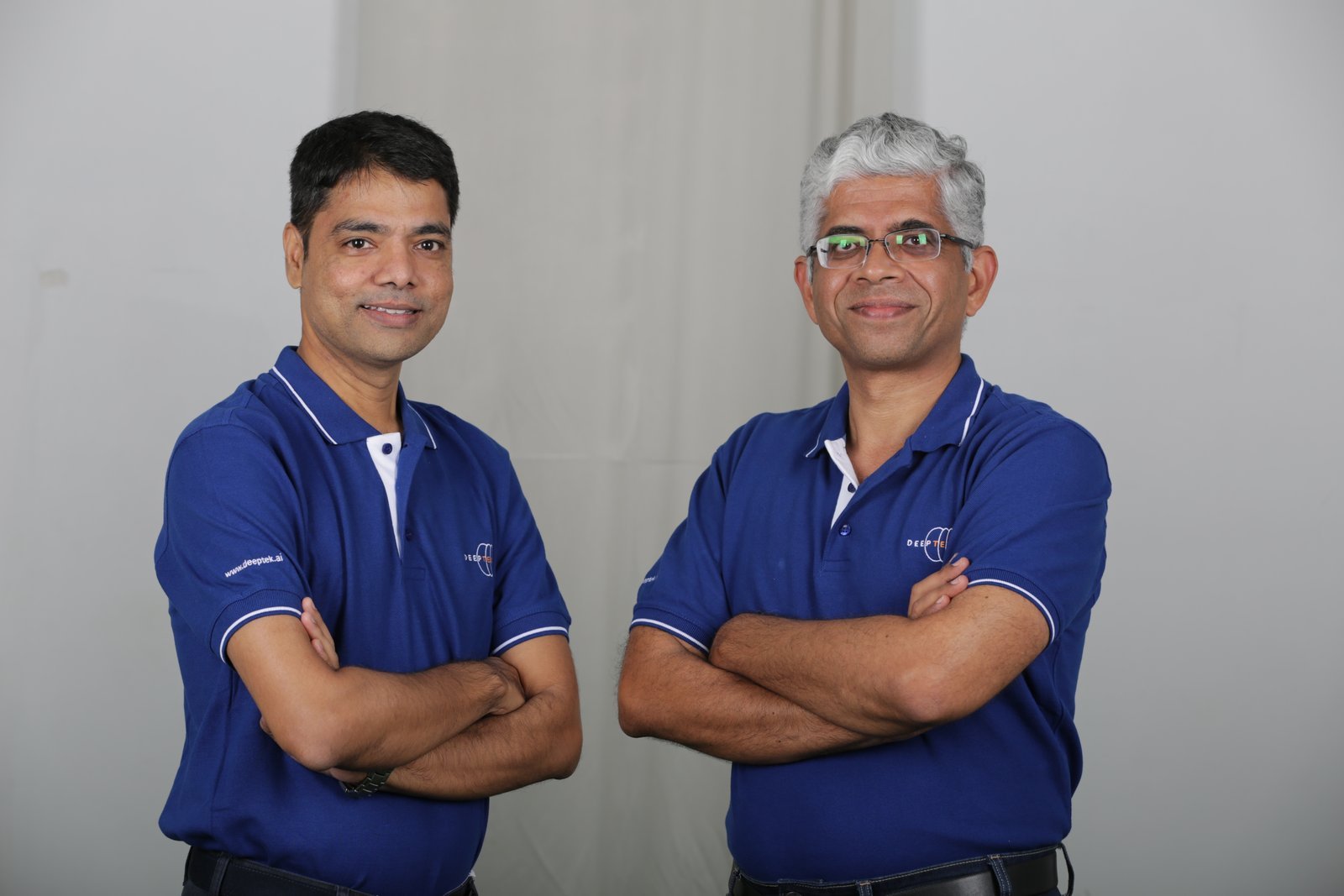
DeepTek brought his domain experience into contact with Ajit Patil’s experience in technology entrepreneurship and Aniruddha Pant’s AI expertise. The company was incorporated in the United States in 2017 and built a substantial presence in India. Its early public identity joined people from different disciplines. For Kharat, founding meant working across the border between understanding a problem and organising the technical effort to address it.
The distinction between those abilities is useful. Knowing precisely where work becomes awkward does not automatically tell you how to build software. Knowing how to build software does not automatically tell you which awkwardness deserves attention. A founding team has to put those forms of knowledge into conversation. Kharat’s place in that arrangement was grounded in work he already knew.
The company grows a business vocabulary
NTT DATA became a strategic equity partner in 2018. In an interview that November, Kharat discussed the relationship in terms of access to international markets. That is the founder speaking. A technical idea needs routes to customers, and a partnership can change the number of doors a small company can reasonably knock on.
The next stage included DeepTek’s participation in GE’s Edison[X] accelerator. In 2020, Kharat described those six months as a chance to understand a broader business ecosystem, make connections and access resources. The emphasis was on what the team could learn. Even in the language of a programme graduation, the founder was still talking about an education.
In March 2022, DeepTek announced a $10 million funding round led by Tata Capital Healthcare Fund II, with Pentathlon Ventures and GHV also participating. The stated uses included international expansion and regulatory work. These are company milestones rather than personal wealth figures. Their relevance to Kharat is the change in the job: a founder must turn new capital into an organisation capable of carrying out its promises.
That work has less romance than the phrase “building the future” implies. It involves agreements, hiring, budgets, customer support and decisions about what to do next. Capital can buy time and people. Choosing what those people should spend their time on remains a management problem. The progression from the 2018 partnership to the 2022 round shows how quickly a specialist’s commercial responsibilities can widen.
Funding round led by Tata Capital Healthcare Fund II, with Pentathlon Ventures and GHV participating.
Where the work actually happens
Kharat’s public writing returned to an unglamorous question in 2022 and 2023: how does new software fit into existing work? His 2022 essay examined information moving through a chain of processes. His 2023 essay considered training, integration and the practical use of AI tools. The reader meets a founder interested in what happens between purchasing a technology and using it routinely.
A demonstration gets a clean stage. A workplace brings its existing systems, established habits and a queue of other things to do. The gap between them is where the founder’s argument becomes interesting. A user has to learn something, an administrator has to connect something, and somebody has to keep the result working after the presentation has ended.
In November 2024, DeepTek announced a commercial partnership with Blackford, adding a route to market through another company’s platform. Kharat’s accompanying comments stressed reach and a shared objective. The business logic fits his repeated concern with integration: meeting users inside an established environment can be part of the product’s value.
He also keeps taking these questions into public conversation. His appearances include an IIT Madras and Pfizer symposium in September 2023 and a Blackford webinar in January 2025 alongside Vytautas Naujalis of Oxipit and Stefan Iarca of Rayscape. The founder’s work includes making an explanation clear enough to travel beyond his own team.
“Technology is fascinating and evolving.”
Dr. Amit Kharat
A tender response enters the AI age
At Pentathlon Day 2025, Kharat joined a discussion about how founders used AI inside their companies. One DeepTek example concerned tender responses running to 100-200 pages. AI agents assembled drafts using previous answers and relevant material; people reviewed and edited the result. The scale of the document gives the example its charm. Even an AI company has paperwork.
It is a revealing extension of his interests. A proposal is a mixture of accumulated knowledge, repeated questions and details that must be correct. Giving software a role in assembling it applies the same attention to the company’s own operations that Kharat brings to discussions about customers’ working routines. The founder has to look inward as well as outward.
There is also a useful limit in the description: people still review the draft. The example treats AI as part of an accountable process. A document can be produced more quickly and still require someone willing to put their name to it. For a founder concerned with adoption, that final responsibility is part of the design problem.
The tender response, with help
An editorial diagram of the process described at Pentathlon Day 2025.
An award, with more learning to do
In December 2025, BioSpectrum named Kharat and Patil its Entrepreneurs of the Year for 2024. The award was presented at an event recognising achievements across two financial years. Shared recognition suits a business assembled from different kinds of expertise. It also provides a neat public milestone in a career whose quieter markers include papers, courses and conversations.
Another detail offers a smaller view of Kharat’s thinking about leadership. In a published letter, he praised Dr. Patkar’s willingness to explore unfamiliar ideas and described learning from him over more than two decades of interactions. He admired the connection between leadership and the common good. A founder’s chosen example can be as telling as an award received.
The 2019 executive course remains a good place to return. A company was already demanding his attention, and he was still making space to learn its subject from another angle. Across his writing and business decisions, expertise appears as something to extend, test and connect with other people’s knowledge. Kharat’s career gives that habit a practical setting: there is always another system to understand, another colleague to ask, another piece of work to make easier.
Keep the conversation going
Explore Kharat’s writing, public conversations and company.
- DeepTek · Official website
- Dr. Amit Kharat · LinkedIn
- Research record · ORCID
- His essay · Information and the working process
- His essay · Putting AI to work
- Watch · Blackford’s January 2025 panel on YouTube
- Watch · A 2019 panel conversation on Vimeo
- Read · Inside the company at Pentathlon Day
- News · BioSpectrum’s entrepreneurship recognition
- More on DeepTek · Company profile