Amit Gupta’s business began with something most of us have trained ourselves to stop reading: the material underneath an email. In 2013, a friend at Microsoft sent him a message with a job opening promoted in the signature. It was a small addition to an ordinary exchange. Gupta saw a question worth pursuing. If that space could help recruit someone, what else could a company do with it?
The territory was hardly glamorous. Below the sign-off lived the telephone numbers, the tiny logos, the disclaimer nobody had invited to the conversation. Yet it offered a useful combination: a familiar format, repeated use and a connection between people already corresponding. The hard part would be turning an informal habit into something an organization could operate.
Gupta became co-founder and CEO of SenderGen, the company that later took the name Opensense. Based in San Francisco, he brought a career in infrastructure to an everyday workplace nuisance. There is a certain engineering comedy in the proposition. Before anyone could put a better banner beneath “Best regards,” somebody would have to deal with the machinery carrying the regards.
An infrastructure career finds an everyday problem
Gupta studied computer science at Johns Hopkins University, earning a B.S. with honors. His earlier work took him through Bloomberg in New York and London. At Bloomberg, he helped design and launch Bloomberg Anywhere, a product whose very name suggested the difficulty involved: making a working environment accessible beyond a single place.
He subsequently co-founded Affle, a mobile media company with operations across Asia Pacific. There, his responsibilities included new product initiatives; he also helped bring about Microsoft’s strategic investment. These were businesses in which a service had to connect to other systems and survive the conditions in which people actually used it.
That background gives his later choice of problem some continuity. An email signature appears to be a design object. Operating one across a company pulls in questions of deployment, identity, devices and administration. A logo can be approved in a meeting. Getting the approved version into the next message is another assignment entirely.
His early writing was willing to enter that assignment at a fairly unromantic level. In July 2017, under the SenderGen name, he published instructions for distributing Outlook signatures using PowerShell and Active Directory. The procedure involved a Word template, directory fields and a logon script. A founder selling the usefulness of a signature was also explaining how the IT department might get it onto employees’ machines.
The name on the booth changes
In 2018, SenderGen became Opensense. The new name arrived at the Marketo Marketing Nation Summit, alongside an expanded founding team that included Michael Perone, a founder of Barracuda Networks. Bobby Narang, Gupta’s SenderGen co-founder, remained part of the venture. The launch put email security experience and marketing ambitions in the same conversation.
Gupta described years of talking with companies and a desire to extend the business beyond signature marketing. The launch proposition included central control, targeted content and analytics, with connections to systems such as Salesforce, HubSpot and Marketo. A signature could be a consistent piece of branding and a place to distribute a campaign, while remaining something an administrator could govern.
That range matters to the founder’s story. A company buying a signature tool might arrive through marketing and immediately encounter IT. Sales might want different messages for different accounts. Legal might care about the disclaimer. Gupta’s product had to make sense to people who could agree on the same rectangle while having quite different reasons for caring about it.
The engineer meets the interface
Gupta’s product updates offer a more revealing portrait than a polished description of the company. In February 2019, announcing a revised interface, he acknowledged that the user experience had fallen behind the technology underneath. Anyone who thought the old version looked as though an engineer had designed it had, he conceded, identified the culprit.
“I am an engineer by training”
Amit Gupta, February 2019
The explanation was specific: he had concentrated on the platform’s capabilities. The next job was to improve layouts, visual design and basic functionality. Internally, the team called the revision version 1.25, with a more substantial 2.0 still ahead. It was a modest number for a useful admission. Usability had acquired its own place on the workbench.
There is a familiar tension here for anyone who has watched a capable system bewilder a perfectly capable user. Engineers know what the system can do. Customers encounter the arrangement of buttons. Gupta’s update treated that gap as product work, with further changes planned for workflows and embedded help. Technical breadth had created another obligation: making the breadth manageable.
That March, his Salesforce update addressed a more particular set of demands: clearer workflows, different branding for Service Cloud customers operating multiple brands, and signatures personalized using information associated with a lead, contact, account or case. The examples brought the general promise down to an administrator’s screen. “Consistent” still had to allow for legitimate differences.
The banner has to arrive
Other posts show how quickly a marketing proposition leads Gupta back to infrastructure. In April 2019, he argued for running Opensense at the email-server level rather than relying on browser or email-client plugins. His objections concerned mobile behavior, maintenance, client performance and the ability to distinguish recipients. These were his company’s design arguments, aimed at buyers comparing approaches.
The practical question underneath them was straightforward. If a company chooses a message, can it deliver the intended version reliably? A creative team can spend time on a banner without controlling the path between the sender’s application and the recipient’s inbox. Gupta’s interest lay in that path, where a visual promise could become a technical support conversation.
In a separate piece about banner visibility, he suggested a wonderfully ordinary diagnostic: send a message to someone using the relevant email application and ask for a screenshot. The experiment required no grand presentation. Look at what arrived. The advice gave marketers a way to inspect the experience rather than assume the design on their own screen had made the journey intact.
His February 2019 explanation of Sender Policy Framework followed a similar instinct. He walked nontechnical readers through checking an email’s authentication result in Gmail. The emphasis was on helping the person responsible for a campaign recognize a possible delivery problem and bring it to IT. A founder trained in systems was translating part of the system for the people depending on it.
Check your inbox
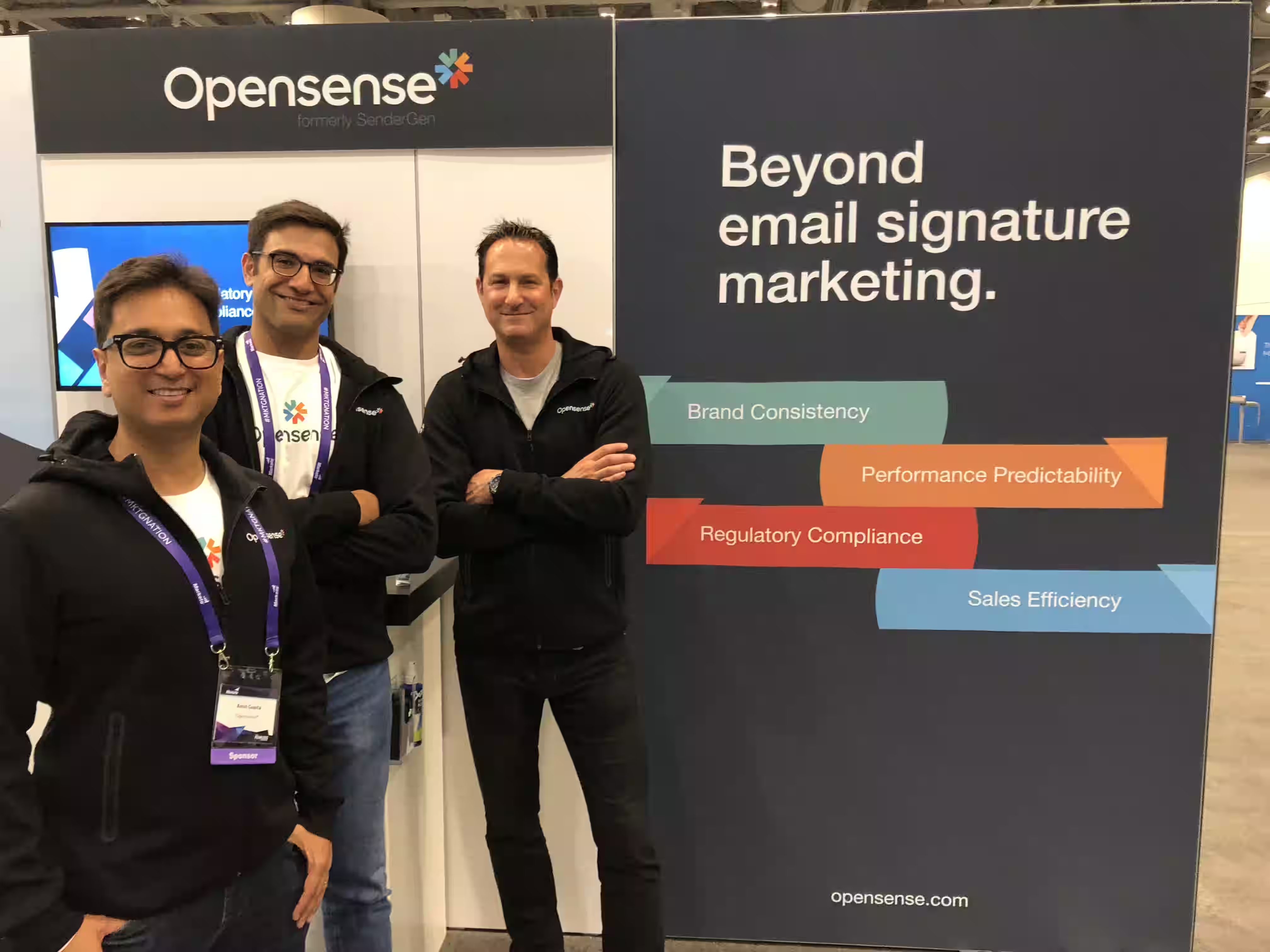
At an Inbound conference booth, Gupta made the product’s explanation unusually literal. When a visitor reached the demonstration, he sent an email. The visitor could then see the message, while Gupta showed the data and explained what the software did. The demo traveled through the same channel the business was trying to improve.
His advice for conference conversations was equally direct: “Ask questions and be educational about the product.” It is a serviceable instruction for selling software that occupies an overlooked part of a familiar tool. The prospective customer already understands email. Gupta’s task was to make the extra layer visible without requiring an introductory course in the inbox.
The scene supplies a useful counterweight to the technical writing. At the booth, the engineer also had to be the explainer. A few clicks and swipes connected the customer’s experience to the information behind it. The product’s small canvas made a compact demonstration possible; the work was showing why anyone should care about that canvas in the first place.
A smaller signature, a longer job
Gupta’s writing also makes room for restraint. In a November 2018 design article, he advised readers to reduce clutter, choose social links carefully and keep images proportionate. It is an agreeable position for someone whose company sells the usefulness of the space: the signature should still respect the reader’s attention. There are limits to how much autobiography belongs underneath a meeting confirmation.
His recommendations included keeping social icons uniform, limiting the contact information on display and adapting details to a person’s availability. Each suggestion asks the sender to make a choice about what the recipient needs. That gives the product an interesting constraint. A company can treat the signature as a communication channel while still deciding to put less into any individual message. Much of the work lies in choosing what belongs there, then making the chosen version straightforward to maintain.
He has described a small beginning: three people in a San Francisco office, accompanied by his corgi, Lola. In an August 2019 update, he reported more than 150,000 users. The domestic detail and the business figure belong together. One recalls the scale at which the work started; the other records how many people were eventually using it at that point.
The work continued beyond that milestone. A 2023 article addressed email and privacy regulation. In September 2025, Gupta was listed in the Digital Mortgage conference’s Demo Challenge program. Opensense now describes its remit in terms of brand governance, spanning email and digital business cards. The problem has acquired more surfaces while retaining the administrative questions at its center.
Read across Gupta’s career and a particular kind of founder comes into view through the work itself: someone moving between the system, the screen and the explanation. A signature offers very little room. Making that room useful has required architecture, revisions and conversations with customers. The original Microsoft message supplied the opening. Gupta kept finding things to do after the sign-off.