Imagine buying something from a stranger you will never meet. The seller wants payment before sending the parcel. You want the parcel before sending payment. Both positions are reasonable. Together, they make a lousy shop. In the early days of Taobao, Alibaba’s online marketplace, this small standoff was a large business problem. Alipay’s answer was to put the money in the middle.
- Hold the payment until the buyer confirms delivery.
- Make the wallet useful for the next everyday errand.
- Give merchants a reason to keep the customer coming back.
The money had to wait
Taobao introduced its guaranteed-transaction service in 2003; Alipay was formally established the following year. The buyer paid into escrow. The seller shipped. The money was released after confirmation. A transaction that had depended on faith now had a sequence. For Alibaba founder Jack Ma and the team behind the service, the consequential invention was a pause.
This is an unusually practical origin for a technology company. The obstacle was the fear of losing money to somebody far away. Alipay changed the terms on which strangers could cooperate. There is a useful lesson here for anyone building a business: before asking customers to move faster, find out why they are standing still.
A checkout becomes an address
The mobile app arrived in 2009. Over time, Alipay moved into bills, transport and a growing collection of partner services. The app became somewhere people returned to because another small job needed doing. A payment habit gave other services a convenient place to live.
Today, someone can use Alipay to pay a merchant, settle a utility bill, hail a ride or reach a medical appointment service. Businesses can connect through payment integrations and mini-programs. Eligible users also access financial products supplied through the wider ecosystem, including Yu’e Bao money-market investments. Those investments carry their own risks and rules.
Ant Group, Alipay’s operator, described the platform in June 2026 as connecting one billion users with more than 10,000 types of consumer services. Those are company-reported figures, and a user count does not tell us how often each person opens the app. Still, the breadth explains its position: a wallet is also a distribution channel.
The consequential invention was a pause.
WeChat Pay is the obvious domestic rival, with payments embedded in Tencent’s messaging ecosystem. Alipay’s distinctive starting point is commerce: a buyer, a merchant and a transaction that must work. Its expertise spans payment processing, merchant integration and risk controls. Consumers supply repeat visits; merchants and service partners supply more reasons to visit.
One less thing to do
QR codes made accepting a mobile payment possible with something as humble as a printed sign. But scanning still takes effort: open the app, find the scanner, aim. Alipay Tap! reduces that choreography by letting a customer bring an unlocked phone to a merchant terminal or tag.
By April 2025, Alipay reported more than 100 million Tap! users. FamilyMart reported that membership sign-ups at checkout tripled after integration. The interesting detail is the membership. A payment ends a purchase; enrollment gives the retailer another chance to talk to the shopper.
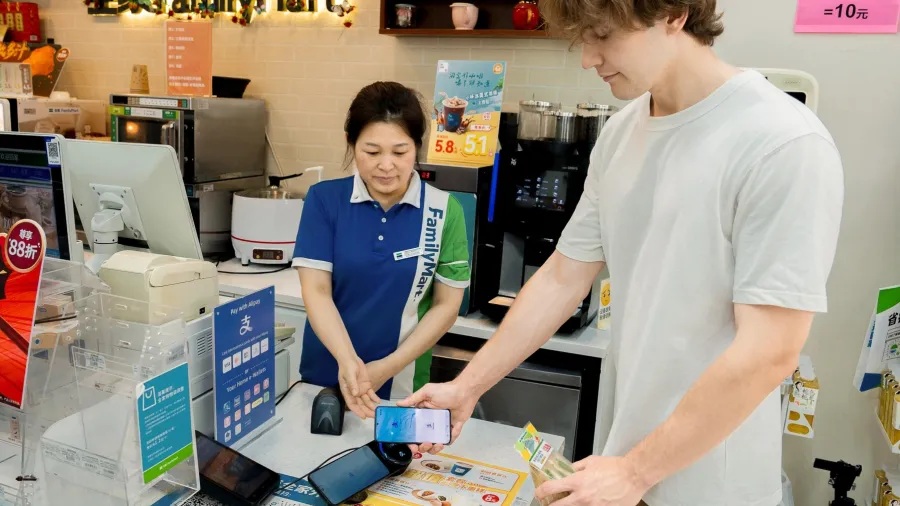
Ant said it had committed RMB 10 billion to growing the Tap! ecosystem. That is a commitment to expansion, rather than an audited price for inventing the feature. The distinction matters. Saving the customer a few seconds can require substantial work across terminals, software, merchants and support.
The tourist at the counter
A visitor to China reveals another complication. A payment system can feel effortless to residents while leaving newcomers puzzled. Alipay lets eligible travelers link supported international cards and pay participating merchants without a mainland bank account. Verification and card compatibility still matter.
Published visitor guidance states that international-card transactions of RMB 200 or less have no additional Alipay service fee; above that threshold, the fee is 3% of the transaction amount. A RMB 300 purchase therefore carries a RMB 9 service fee under that rule. Card-issuer charges may add more, and travelers should check the terms shown in the app.
Purchase + 3% service fee under published international-card guidance. Issuer fees may apply separately.
There is also Alipay+, the separate wallet gateway run by Ant International. It connects participating home wallets with merchants abroad, including Alipay’s acceptance network in China. Its combined account figures describe a network of wallets. They should never be presented as the number of people using the Alipay app.
The bill for growing bigger
The business earns fees for payment processing and escrow services, and offers merchants technology and digital-service capabilities. Alibaba’s filings document paid processing arrangements. The app’s value comes partly from coordinating businesses it does not own: retailers, banks and service providers.
The familiar $4.5 billion funding figure belongs to Ant Financial’s April 2016 Series B. Investors included CIC Capital and CCB Trust. It financed the parent company, which had businesses beyond Alipay. Treating it as the wallet’s startup budget would tell the wrong story.
Scale also brought supervision. Ant’s planned 2020 IPO was suspended, and regulators required restructuring. In July 2023, authorities announced a RMB 7.12 billion fine on Ant Group. The operating conditions had changed. A model involving payments, credit and investments must satisfy financial rules as well as customers.
Now ask for the errand
In June 2026, Alipay introduced its Ah Bao AI agent upgrade. Users could switch to a conversational interface for services such as rides, food orders and appliance repairs. The experiment asks whether an app with thousands of options becomes easier to use when people describe the job they need done.
That is a reasonable next question for a company that began by rearranging the steps in a purchase. The principle readers can copy is modest: remove the obstacle nearest the action. It works when the underlying service is dependable, merchants participate and customers can access the system. An elegant interface cannot compensate for a rejected card, missing acceptance or rules that prevent the transaction. The original escrow idea succeeded because the pause did a real job.
Follow the next transaction
Alipay website ↗ · Newsroom ↗ · Developer projects ↗