Before Alex Rappaport learned to sell industrial membranes, he learned to read a river. For six years before college, he worked as an adventure camp counselor and instructor near the Potomac, teaching children to raft, kayak, climb, race, and stand on paddleboards in whitewater. A river does not care for a polished pitch. It offers conditions, consequences, and a group of people who need to move together. Rappaport later called those summers an early education in leadership - responsibility, logistics, safety, team dynamics, and the delicate business of managing group energy.
Water would become the organizing subject of his professional life, but not by a straight route. At Tufts University, he began in chemical engineering, switched to environmental engineering, and looked for a way to combine technical work with a faster, more creative form of action. He helped build the Tufts Venture Lab, a student entrepreneurship community that gathered aspiring founders for pitch nights, coaching, and the productive ordeal of letting other people inspect an idea.
Then a career disappointment changed the itinerary. Rappaport had worked full-time as a project manager during his senior year, but the company did not offer him a role after graduation. The rejection sent him toward Tufts' one-year M.S. in Innovation and Management program. This was the useful sort of detour, although useful detours are rarely considerate enough to introduce themselves at the time.
A patent in search of a problem
The master's program asked students to build a venture around an idea. Rappaport wanted to work on water or sustainable technology, but he was candid about his limits. He later joked that he was a “pretengineer” who had not invented the core science. Instead, he went to the university's technology-transfer office and studied a list of patents. One came from the laboratory of Ayse Asatekin, a Tufts chemical engineering professor and membrane specialist who had developed a zwitterionic polymer.
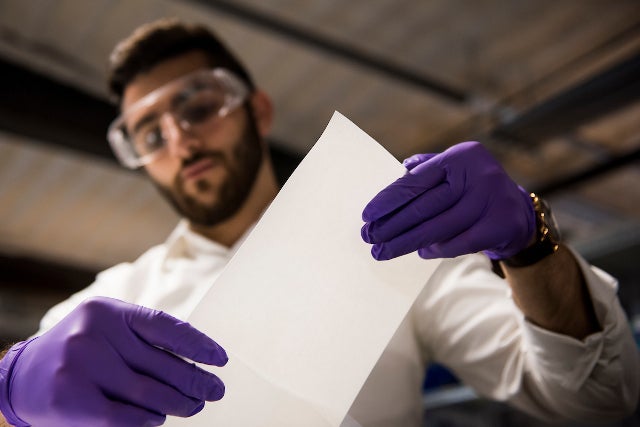
The name needs a moment. A zwitterion carries both positive and negative charges. In the material developed at Tufts, that chemistry makes the membrane intensely fond of water and reluctant to bond with the organic matter passing by. Conventional membranes can be smothered by fats, oils, grease, proteins, and other organics. The accumulation is called fouling, an accurate technical term with the charm of a Victorian insult. Fouling reduces output, prompts chemical cleaning, shortens membrane life, and can stop a process altogether.
The value chain, without the chemistry exam
A clever material, however, is not a market. Rappaport and his collaborator Aditi Deorukhakar were challenged by MSIM director Kevin Oye to contact 100 potential customers. They cold-called across industries. They listened to operators. After ZwitterCo won the Tufts $100k New Ventures Competition in 2018, some of the prize money paid for a trip to a produced-water conference in Texas, where experts could tell them whether the problem was real, expensive, and poorly served.
“Find who you love working with, based on mutual interest and working styles.”Alex Rappaport, on advice for student founders
This is the less cinematic half of technology transfer: the patent has to survive a hundred conversations, a manufacturing method, integration into standard equipment, a procurement process, and the suspicion of people whose plants cannot stop because a startup is learning. Rappaport's role was not to impersonate the scientist. It was to become a translator among the scientist, the operator, the investor, and the customer.
Sell the bill before the dream
ZwitterCo was founded in 2018 around an exclusive license to the Tufts technology. Rappaport joined forces with Christopher Drover, a membrane specialist who became chief technology officer, and Chris Roy, an applications engineer. He has called meeting the two Chrises his luckiest career break, crediting their expertise, connections, skills, and leadership as fundamental to the company. The acknowledgment matters. Deep-tech companies invite the myth of the solitary founder while requiring almost comically collective effort.
The early commercial lesson was blunt. Investors and advisers warned Rappaport not to lead with an environmental, social, and governance story. His first pitch decks barely mentioned saving water. Customers bought relief from an operating problem: less hauling, fewer cleanings, lower chemical use, longer membrane life, more uptime, and a credible route to reuse. The environmental value remained, but the purchase could be defended in the language of a plant budget.
A mission scales faster when the customer can describe its value without borrowing the founder's vocabulary.
Rappaport did not abandon the larger case. He made it concrete. Industrial water often arrives in sustainability speeches as an abstraction, then returns to the factory floor as a disposal fee, a discharge limit, a tanker truck, a cleaning cycle, or an expansion project blocked by scarce supply. ZwitterCo positioned its membranes where ecological and operating logic overlap. A customer can reuse more water because the system also makes financial sense.
The company moved from Greentown Labs into the Imagine H2O accelerator and then into its own operations. A $5.9 million seed round arrived in 2021. A $33 million Series A followed in 2022. In 2023, ZwitterCo prepared a 30,000-square-foot innovation center in Woburn for testing polymer formulations and speeding product development. In July 2024, the company announced an oversubscribed $58.4 million Series B led by Evok Innovations, with investors including DCVC, BHP, Munich Re Ventures, SiteGround, HG Ventures, and Blue Horizon Advisors.
The coalition, not the costume
Rappaport's public advice is revealingly social. He tells young founders to choose people they love working with. He also argues that disagreement is healthy: someone in the room should test assumptions and consider the negative consequences of a decision. Trust, in this version, does not mean a meeting without friction. It means the friction is in service of the work.
His own founder persona is lighter than the hardware. The standard outfit is jeans and a ZwitterCo zip-up, though he once admitted to a conspicuous footwear competition with his vice president of sales. He reads fiction on a Kindle before bed. He is fascinated by watching creative people reveal how they make things, whether they are artists, athletes, engineers, or entrepreneurs. The favorite Boston-area place he named was not a restaurant or riverbank but the research and development space at ZwitterCo's Woburn headquarters, where ideas become prototypes.
There is an appealing consistency here. As a guide, he watched a group negotiate a physical system. At Tufts Venture Lab, he assembled students around the awkward process of making. At ZwitterCo, he built a coalition around researchers, engineers, advisers, investors, commercial partners, and industrial customers. His individual skill appears to be less the lone flash of invention than the creation of conditions in which specialized people can move in the same direction.
That instinct also explains the mentor Rappaport names frequently. Kevin Oye, who founded the MSIM program, urged him to take risks before a clear entrepreneurial path existed and remained a confidant through the early company-building years. Rappaport, in turn, has continued to lecture part-time at Tufts and support emerging student ventures. The pattern is pleasantly circular: a university did more than license a patent. It supplied a network, a vocabulary, a place to practice, and people willing to keep asking difficult questions after the competition prizes had been handed out.
“We founded ZwitterCo to address the global water crisis by making safe and commercially viable industrial water treatment a reality.”Alex Rappaport
The hard water gets harder
By 2025, ZwitterCo had organized its commercial portfolio into three families. Evolution targets sanitary food, dairy, and bioprocessing separations. Elevation addresses reverse osmosis and challenging industrial reuse. Expedition is built for high-strength streams that defeat ordinary membrane approaches. The names are tidy; the liquids are not. They include fermentation waste, landfill leachate, power-plant water, food-processing streams, and the organic load that accumulates wherever industry turns raw material into useful product.
The company reported applications across more than 70 customers in more than 20 countries and four million gallons per day of treatment capacity in a 2026 Tufts profile. Those figures describe commercial reach, but they also reveal the next managerial problem. A technology that works in a controlled test must become repeatable across feed streams, climates, equipment, operators, and local rules. Scale is the long conversion of exceptional performance into ordinary reliability.
Rappaport's stated aspiration is correspondingly practical: unlock unconventional sources of water so industries can keep operating as scarcity grows, while meeting the purity their processes require. It is a large ambition attached to small pores and very specific invoices. The work lives between molecular behavior and a maintenance schedule.
Years ago, Rappaport stood beside the Potomac and learned that water is force, route, risk, and resource at once. ZwitterCo is an industrial expression of the same lesson. The unwanted stream is not merely waste. It is water carrying the evidence of what has happened to it. Read it correctly, build a system that can tolerate the mess, and some of that water can go around again.