Alex Jones had a question for a priest. He had been trying meditation apps, and he wanted to know whether the Catholic Church offered anything similar. The priest was Father Pete McCormick, his former rector at Notre Dame’s Keough Hall. McCormick’s answer came with a laugh and the suggestion that Jones might have missed something in class. Catholic contemplative prayer had been around for centuries. Jones had managed to grow up inside the tradition without noticing the door.
That is an awkward discovery for anyone who has already graduated. Jones had finished a mechanical engineering degree at Notre Dame in 2015 and gone into consulting at McKinsey. He could work through a technical problem. He had a respectable professional direction. Yet a basic question about the religion of his childhood was sending him back to the beginning.
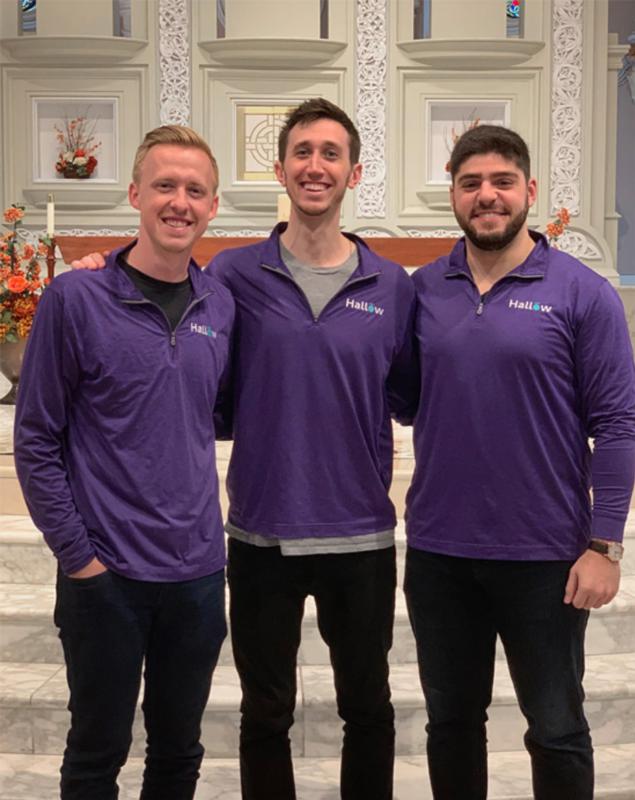
The question eventually produced Hallow, the Catholic prayer app he co-founded with Erich Kerekes and Alessandro DiSanto. It launched in December 2018. A familiar prayer supplied the name; college friendships supplied much of the early company. Before the funding announcements and famous collaborators, there was a young consultant trying to understand what he believed and how to put it into practice.
A second reading of a familiar life
Jones grew up in Columbus, Ohio, in a Catholic family. He went to Mass, learned the prayers and received the sacraments. By high school and college, he was distancing himself from belief. In his own accounts, he has used both agnostic and atheist to describe that period. Attending a Catholic university did not automatically settle the matter. A campus can offer a chapel; it cannot supply conviction on demand.
His reconsideration involved reading and argument. Friends who could explain their faith gave him reasons to look again. He wrote about taking a philosophy of science class and encountering David Hume’s questions about knowledge. Michael J. Himes’s Doing the Truth in Love helped him think about the Christian understanding of God as love. C.S. Lewis’s Mere Christianity pushed him to consider what Jesus’s claims might mean.
These were personal explorations, and Jones presented them that way. His essays acknowledged that he was no trained theologian or philosopher. He was trying to explain which arguments had opened a possibility for him. The writing has the informality of someone thinking aloud, with books passed along and another question waiting at the end.
“I am still very much at the beginning”
Alex Jones, on exploring faith and prayer
Accepting that faith might make sense still left a practical difficulty. He had learned prayers as a child, but the idea of a living relationship with God remained unfamiliar. The guided meditation apps he tried showed him how useful an accessible introduction could be. He wanted to explore that kind of guidance within Christianity.
Then came lectio divina, a practice of reading Scripture slowly and returning to a passage. Jones tried it with the Lord’s Prayer. His attention settled on the words about God’s name being hallowed. To hallow means to make holy. A word he had said many times became something he wanted to spend time with. Eventually, it would also have to fit beneath an icon on a phone.
Friends before co-founders
The people around Jones mattered as much as the reading. At Notre Dame, he and DiSanto lived down the hall from each other in Keough. They became friends in freshman year and later served as co-best men at each other’s weddings. Bryan Enriquez, another Notre Dame friend, was also part of the early Hallow group. This was a company taking shape through relationships that already had a history.
Jones knew Kerekes through McKinsey, where both had worked after Notre Dame. Jones began experimenting with a prototype, then moved to the Bay Area for business school at Stanford. Kerekes was in San Francisco on a consulting rotation serving startups. By July 2018, he faced a choice: return to Chicago with McKinsey or stay and join the developing Hallow project.
Kerekes did what a consultant might reasonably do. He made lists. Chicago offered his girlfriend, his family, his friends, a job he enjoyed and a promotion ahead. It also offered Portillo’s, which earned its own place among the advantages. Joining Hallow had a rather shorter list. On paper, the answer looked settled.
He called Jones while waiting for a flight at Los Angeles International Airport. In Kerekes’s account, Jones offered no salary, equity package or title in that conversation. He suggested taking the decision to prayer. Kerekes tried the discernment exercises Jones had been researching. He chose Hallow.
It is a revealing early example of how Jones approached the work. He was asking a friend to try the practice behind the proposed product while making a decision about joining it. The stakes were personal before they were commercial. DiSanto, whose career had included Goldman Sachs and private equity, joined the founding team too. Their shared graduation year was 2015. Their next shared undertaking was less conventional.
An app with somewhere else to be
Hallow’s early purpose was specific: help people learn Catholic prayer through guided audio. Jones and his friends researched prayer traditions and tested recordings with family and friends. The app gave those experiments a repeatable form. Someone could choose a session, press play and listen.
Audio was an important choice. In 2020, Jones explained that users could close their eyes while a prayer played. The phone provided the guidance without requiring constant attention to a screen. There is a pleasing modesty to a piece of software whose useful moment can begin when its owner stops looking at it.
The audience also widened beyond the young adults the founders had first imagined. Parents and retired people began using it. The practices were Catholic, and the company worked with priests, bishops and theologians on its content. Jones also described an audience that included people from other traditions and people returning to faith after time away.
- 01Choose a prayer
- 02Press play
- 03Take time to listen
Jones remained a learner as well as an executive. That position helps explain the tone of his origin story. He could remember knowing the words while missing the experience. Hallow offered an introduction for someone in that position: a way to begin without first becoming an expert in every prayer tradition available.
When the small experiment got a big audience
The experiment acquired the machinery of a venture-backed business. In May 2023, Jones announced a $50 million Series C led by Goodwater Capital, bringing Hallow’s total funding to $105 million. The same announcement marked ten million downloads and 225 million completed prayers. A project built with friends now had figures that belonged in an investor presentation.
Jones’s accompanying explanation kept returning to the individual using the app. He described helping people develop a daily prayer habit as the purpose of the work. The totals could describe its reach; a person’s relationship with God remained the aspiration. It is a distinction he has continued making as the audience has grown.
Familiar voices brought another route into that audience. Jonathan Roumie, known for playing Jesus in The Chosen, contributed to Hallow. So did Father Mike Schmitz and Bishop Robert Barron. Mark Wahlberg became an investor and collaborator. In February 2024, Wahlberg and Roumie appeared in Hallow’s Super Bowl commercial. The small audio experiment had reached a very loud advertising occasion.
The following year brought that billion-prayer milestone. Jones responded with a brief expression of gratitude: “All glory and thanks to God.” By then, the app’s collection included Scripture, the Rosary, music and guided reflections across eight languages. The scale was larger than the founding group’s first tests, while the action at the center was still someone choosing a prayer and listening.
Back through the school gates
Jones’s connection to education runs through the story. Notre Dame supplied friends and mentors; he completed his Stanford MBA in 2020. In 2026, Holy Cross College selected him to speak at its May commencement. Its announcement described him living in Chicago with his wife and four children. The consultant who had gone back to ask questions was now being invited to address graduates.
Hallow was also moving further into the institutions where habits take shape. In September 2026, it announced more than 2,000 partnerships with parishes, schools, campus ministries and other organizations for the coming academic year. The work included community prayer challenges and resources for teachers. The company described the aim as connecting individual prayer with life in local communities.
That brings the story close to its starting point. Jones had needed another person to show him something inside a tradition he thought he knew. His company now helps institutions introduce those practices to other people. A school day, a parish group or an ordinary evening can provide the setting. The app supplies a voice and a place to start.
“What can we do to help the most people pray?”
Alex Jones
The question is his own. It has room for a business, a large audience and the considerable work of managing both. It also has room for the younger Jones, who knew the prayer by heart and still found something unfamiliar in it. Hallow began when he stayed with one word long enough to ask what it required of him. The company’s daily invitation is to make a little time for that kind of attention.
Follow the conversation
Essays, interviews and the people behind the app.
- Hallow: the founding story ↗
- Alex Jones on reconsidering belief ↗
- Erich Kerekes on choosing Hallow ↗
- Watch: Jones with Chris Stefanick on faith and technology ↗
- Listen: Faith Driven Entrepreneur, episode 359 ↗
- NPR conversation: prayer on the digital continent ↗
- Jones’s 2023 funding announcement ↗
- Hallow’s June 2025 milestone ↗
- School and parish partnerships in 2026 ↗
- Notre Dame: the friendships behind Hallow ↗
- Holy Cross College: the 2026 commencement invitation ↗
- An early conversation with Jones on prayer and audio ↗