Alex Jones had a Silicon Valley problem disguised as a spiritual one. He liked meditation apps. He used them every day after graduating from Notre Dame and starting work at McKinsey in Chicago. The interfaces were calm, the instructions clear, the habit pleasantly portable. Yet when he sat in silence, his attention kept wandering toward a cross. The apps could teach him how to breathe and observe a thought. They could not tell him what to do with that tug.
So Jones began asking priests, pastors and old Notre Dame contacts whether faith and meditation had ever met. To him, this was a discovery question. To the clergy, it was rather like asking whether Italy had considered pasta. One priest told him, with a laugh, that Christians had been doing it for about two thousand years. It was called prayer.
The joke landed because the answer was useful. Jones found Lectio Divina, the daily examen, the Rosary and Ignatian spiritual exercises. Far from quaint objects behind glass, these were instructions for attention, refined across centuries and still available to anyone willing to sit down. While meditating on Jesus teaching the Lord's Prayer, one word caught him: hallow, to make holy. It gave the app its eventual name and Jones a way back into the Catholic faith in which he had been raised.
“The idea isn't to invent new ways to pray, but rather to bring to the world the enormously rich pool of contemplative prayer methods that already exist within the Christian faith today.”Alex Jones
The first user was sitting at the keyboard
Jones had trained as a mechanical engineer, earning his degree from Notre Dame in 2015. He also knew enough code to make a simple prototype. That combination mattered. Engineering gave him permission to treat the problem as something that could be assembled, tested and made less awkward. His own inexperience gave him a sharp sense of where a newcomer got lost.
The early product brief was personal: create the thing he wanted to use. Audio would guide a person through prayer. Sessions would fit into an ordinary day. The phone, already the place people reached for distraction, could hold a small appointment with silence. Its cleverness came from removing the friction around an inheritance rather than claiming an invention.
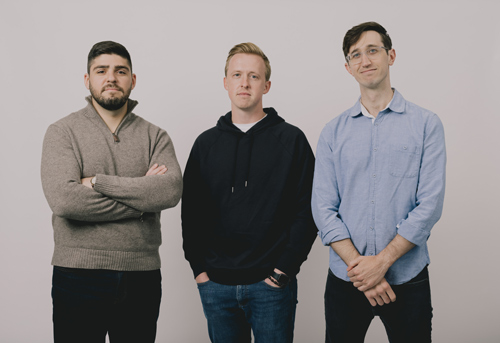
A prototype is lonely until other people decide the problem belongs to them. Jones found those people close by. Alessandro DiSanto had lived down the hall in Notre Dame's Keough Hall; the two became close friends and later co-best men at each other's weddings. Erich Kerekes, another Notre Dame graduate, had also joined McKinsey. He and Jones properly got to know each other during a company retreat, after barely crossing paths at university.
Their résumés suggested comfortable routes through consulting, finance and business school. Their decision was less tidy. Jones left his role as an engagement manager at McKinsey. Kerekes walked away from his own consulting trajectory. DiSanto brought a finance background. Alongside other early teammates from Notre Dame, they began building Hallow and launched the app at the end of 2018.
A category that sounded odd until it didn't
Jones carried the prototype to Stanford, where he completed his MBA in 2020. Faith was not a familiar ingredient in the local language of innovation. He remembers people asking whether anyone still “did religion.” The question was dismissive, but it also exposed the opportunity. Consumer software had become very good at organizing transport, dinner, exercise and dating. Spiritual practice was often left to websites that felt like filing cabinets.
Hallow borrowed the legibility of a modern subscription app without pretending its source material was modern. Users could choose guided sessions, daily scripture, music, challenges and longer collections. A first-time visitor did not need to know the difference between an examen and a novena before pressing play. The interface could teach the vocabulary gently.
Fundraising was a harsher tutorial. Jones has described taking roughly eighty meetings during the first two weeks of Hallow's seed process. At that stage, the company had little numerical proof. Each pitch felt like a referendum on an intimate story and an unfashionable market. Rejections accumulated. Then came a term sheet, followed by others. Hallow would eventually raise substantial venture funding, but the useful part of the tale sits before the money: Jones had chosen a mission sturdy enough to survive a crowded calendar of no.
“You have to find something bigger than yourself. You have to, there's no choice.”Alex Jones on advice to founders
A habit, counted in completed prayers
Selected public milestones. The bars show relative scale, not time elapsed.
Thirty seconds of spectacle, years of return visits
Hallow's public breakout arrived during the 2024 Super Bowl. A thirty-second commercial featuring actors Mark Wahlberg and Jonathan Roumie invited viewers to pause and pray. The app soon reached the top position in Apple's U.S. App Store. It was a dramatic piece of distribution for a product organized around quiet.
Celebrity voices helped make the doorway visible. The catalog expanded to include clergy, actors, musicians and teachers. Yet a prayer app cannot live on premieres alone. Its real competition is the morning alarm, the crowded commute and the infinite scroll. The lasting product question is whether someone returns tomorrow, when no commercial is playing and the only audience is the person holding the phone.
This is where Jones's origin as the first user keeps proving useful. Hallow is designed around repetition: a daily Gospel, a Rosary, a seasonal challenge, a remembered place in a longer series. The metrics tell the same story at larger scale. In September 2022, Hallow announced one hundred million completed prayers. By June 2025, it reported one billion, nearly twenty-four million installs, eight languages and use across more than 150 countries.
Jones graduates from Notre Dame in mechanical engineering and joins McKinsey in Chicago.
Hallow launches after Jones and his co-founders leave established careers to work on it full time.
He completes his MBA at Stanford Graduate School of Business.
Hallow reaches the top of the U.S. App Store after its Super Bowl advertisement.
The company announces its one-billionth completed prayer.
The small word inside the large number
One billion is a number built for a press release. Jones's own public language tends to shrink it back down. He calls Hallow a “little tool.” When the company announced the milestone, his response was gratitude rather than a victory lap. That reflex can sound unusual in software, where founders are trained to narrate inevitability. Jones narrates dependence.
It also reveals the governing tension in Hallow. The company uses venture capital, performance marketing, famous collaborators and familiar subscription mechanics. Its stated purpose cannot be reduced to any of those things. The business needs growth; the mission asks what that growth is for. Jones's answer has remained consistent: help people pray and deepen a relationship with God.
The team has had to make that answer travel. Hallow began with explicitly Catholic contemplative practice and now speaks to a broader Christian audience while retaining that foundation. Its institutional partnerships reach parishes, schools and dioceses. Its content ranges from brief daily reflections to scripture, chant, music and seasonal programs. Expansion makes the shelves longer. The label on the door still matters.
Jones's personal network remains visible in the company's character. Notre Dame supplied friends, mentors, a priest willing to laugh at a useful question and the education that let him build. McKinsey supplied collaborators and a taste for structured problems. Stanford supplied a place to test a contrarian pitch. Chicago became home for the company and for Jones, who lives there with his wife and three children.
There is a neat temptation to read Hallow as a story about making faith contemporary. Jones's more interesting move was to assume the old practices needed no cosmetic surgery, only a patient guide, decent audio and an icon someone could find on a crowded screen. The phone simply shortened the walk to the chapel.
“Had you told me there would be a million prayers prayed, or even a thousand prayers prayed, on Hallow, I never would have believed it.”Alex Jones, June 2025
The name carries the whole project in six letters. Hallow is both verb and instruction: take an ordinary piece of time and set it apart. For Jones, that began with an unsettled meditation session and an almost naive question. For the product, it happens whenever a person ignores the other bright squares for a few minutes and chooses this one. A billion times over, the grand metric resolves into the same modest scene: one person, one phone, a little quiet.