Rian McDonnell’s first food-waste product had a problem familiar to anyone who has ever received an excellent mark: it worked better as an academic achievement than as something a customer would buy. At Trinity College Dublin, he had developed smart trays with cameras to record uneaten food. The project earned high marks. The verdict on selling it was less encouraging. It was too complicated.
A tray is a wonderfully literal place to begin. Dinner goes on it; the evidence stays behind. But McDonnell’s career would take him away from the plate, toward the machinery and decisions that determine how much food reaches it. His company, once called FloWaste and now FloVision Solutions, puts cameras and sensors into processing plants. The questions have become more industrial: how much usable meat remains on a bone? Is a cut meeting its specification? Can someone correct the process before another shift repeats the loss?
The distance between those two products is the story. It includes an Irish engineering education, a move to Indiana, a co-founder who took charge of the technology, and several years of learning where a sustainability idea could earn its keep. The camera stayed. Much of the business around it changed.
An engineer learns to leave the laboratory
McDonnell is originally from Dundalk, Ireland. He completed his studies at Trinity in 2019 with first-class qualifications in mechanical and manufacturing engineering. His education also took him to the University of California, Berkeley, where he worked on vehicle control and dynamics toward an autonomous car and did research in the Laser Thermal Laboratory on two-dimensional materials. Food analytics was hardly the only possible destination for that training.
The food idea developed through Trinity’s student entrepreneurship world, including LaunchBox. It also passed through New Frontiers at TU Dublin. By the time McDonnell arrived at the University of Notre Dame in 2019, he wanted to learn the business skills that would let him take an engineering idea to market. He graduated from the ESTEEM Master of Science programme in 2020.
His route involved accumulating qualifications at a brisk pace. In a 2020 university interview, he counted four degrees over six years: two bachelor’s degrees, in engineering and mathematics, and two master’s degrees, in engineering and ESTEEM. In the same interview, asked about a favourite taco spot, he pleaded his Irish origins and limited taco expertise. Even a substantial education has its gaps.
South Bend became the base from which he built the business. Crossing the Atlantic gave the idea access to another network of entrepreneurs and investors, while its origins remained in the Irish university system. There was no single ceremonial moment at which the student project became a company. It travelled through programmes, conversations and increasingly practical tests.
A co-founder, and a different language
Elise Weimholt entered the story through Notre Dame. A 2019 mechanical engineering graduate, she noticed McDonnell’s work after he reached the semifinals of the McCloskey Business Plan Competition. She became his co-founder and CTO. The partnership allowed him to concentrate on running the business while she led the engineering side.
That division of work required McDonnell to change how he talked. His entrepreneurial training taught him to explain technology to people who would judge its usefulness rather than admire its algorithms. He had experience in user-centred design, but he recognised the temptation for engineers to describe features when a prospective customer needed benefits. A technically elegant answer could still be an unconvincing sales conversation.
There is an endearing candour in that account. He does not describe himself as a born CEO whose education merely confirmed the obvious. He says the programme helped him learn the role. The subsequent business makes the lesson concrete: a processor needs to know what the equipment will reveal, how quickly staff can act and whether the investment will pay back. The algorithm can wait its turn.
The camera moves upstream
FloVision launched in 2020 with a Raspberry Pi and a depth camera. McDonnell has described its beginnings as a prototype above waste bins. Early food-service work sought to identify what kitchens and diners were throwing away, gathering information without demanding that kitchen staff stop their normal work to record it.
By March 2021, the company had announced a $270,000 pre-seed round led by Plug and Play Ventures. Seven pilots were lined up across customers that included food-service operators and an Irish beef processor. Those were planned trials, a useful distinction when following a young company: interest had become an opportunity to test, rather than proof that every installation would work.
During 2021 and into early 2022, the team narrowed its attention to protein processing. McDonnell’s explanation was practical. These products had substantial financial value and a substantial carbon cost. Recovering more of them offered a way to connect the environmental aim with a business case. The move upstream gave the cameras a different job, observing production while there was still a chance to change it.
His background also gave that market a personal connection. McDonnell grew up in rural Ireland, where his family worked in beef processing. Yet familiarity with an industry and a commercial solution for it are different things. The business still had to work through the choice of market, refine its measurements and win customers willing to put equipment on their lines.
Advice worth getting up early for
McDonnell was initially doubtful that FloVision needed an accelerator. Conversations with Rockstart’s agri-food team changed his mind. He liked the frankness of the people he met and the format: six months, with an intensive week each month, leaving time between sessions to work on the company.
Being based in the United States while much of the programme operated in Europe brought early mornings. The more consequential inconvenience was deciding where to concentrate. Food service and protein processing both looked plausible. Mentors with experience across food and agriculture helped the founders examine the alternatives. McDonnell says the final choice was not settled during the cohort itself.
He also credits the programme with helping define useful business metrics and introduce employee feedback practices as the company hired its first engineers. These are quieter milestones than funding announcements, but they describe the work of becoming an operator: deciding what progress means and helping other people make it. An accelerator’s calendar ends. A feedback habit can stay in the company.
“The best way to see a sustainability benefit is to tie it to the financials of business.”Rian McDonnell · 2023
The factory gets a second pair of eyes
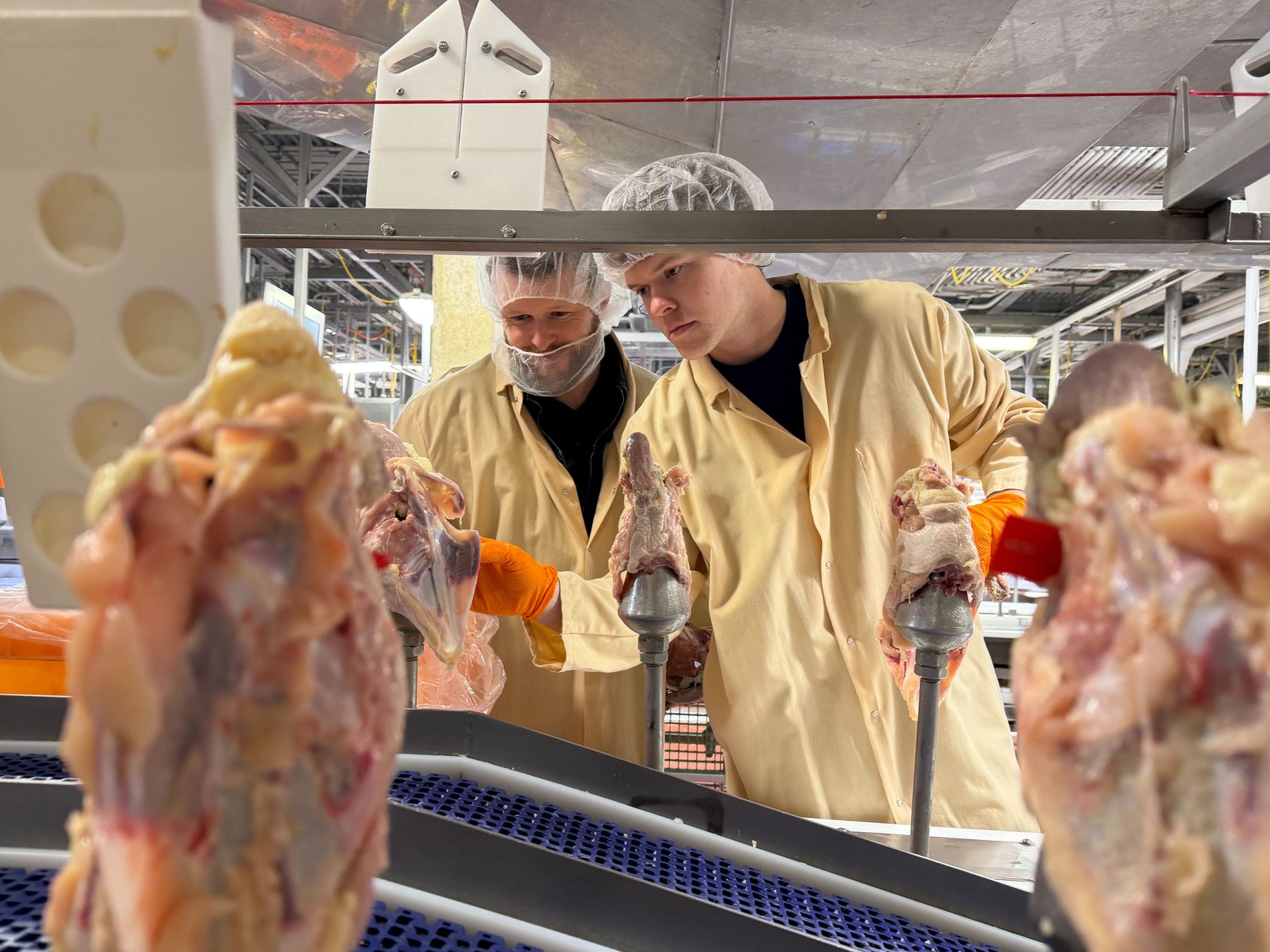
Today the equipment is built around the production floor. Compact sensors mount on existing conveyors and processing stations. The system measures pieces moving through the line and gives operators information about yield, quality and defects. A supervisor can see patterns by shift or product, rather than waiting for a disappointing total to arrive after the useful moment has passed.
The physical setting matters. Steam, cold, water, stainless steel and wash-down routines give industrial cameras a less forgiving home than a demonstration table. FloVision describes its current sensors as IP69K-rated, with installations designed around existing equipment. McDonnell’s original concern about whether a product was too complicated to commercialise has a practical echo here: the customer already has a factory to run.
There is another problem behind the camera. A vision model needs examples, and production images are not conveniently identical. The team uses tools from Roboflow to prepare data, train models and deploy them in the cloud or on local devices. Local deployment matters when a line needs an immediate decision and cannot wait for an image to travel over the internet.
The team also uses Voxel51’s FiftyOne to inspect and organise large volumes of images. Its work includes estimating yield and checking box labels. Finding unusual cases once meant manually searching data for days, sometimes a week. The case study reports faster diagnosis after the team adopted the tooling. Helping a camera see reliably involves people looking carefully at what it has missed.
A percentage point can have weight
By July 2025, FloVision reported that its systems had analysed more than 51 million pounds of food. Its first corporate customer had been in Ireland; deployments had expanded across North America, Europe and Australia. Customers reported yield gains of up to 1.5% and returns as high as 15 times the investment. These are reported results, with “up to” doing essential work.
On July 30 that year, FloVision announced an $8.7 million Series A led by Insight Partners, with Serra Ventures, SOSV and Rockstart participating. The funding was directed toward international expansion and hiring across engineering, AI and sales. For McDonnell, the announcement meant more capacity to address customer problems and deliver features processors had requested.
The numbers grew again. In its August 2026 announcement of the AgTech Breakthrough FoodTech Equipment of the Year award, FloVision said it had measured more than 220 million pounds since its first production installations in 2022. The figure measures food observed by the system. It is not a claim that 220 million pounds were rescued. Keeping that distinction makes the scale useful.
McDonnell’s larger ambition is a company mission to help reduce global greenhouse gas emissions by 1%. It remains a goal. His way of approaching it is to make better use of what processors already handle, connecting a recovered piece of product to a financial result a business can recognise. Large ambitions need smaller units in which to do their work.
An appetite for practical answers
There is a pleasing complication in the biography of someone who studies leftovers. Recalling childhood, McDonnell described himself as “a vacuum for food.” The boy who finished his dinner grew into a founder studying what other people could not use. The work took him from trays to bins to production lines, each move changing where he could intervene.
His public conversations now range from model deployment to the experience of working with traditional processors. He has discussed the business on Rooted & Reaching and Agbioscience, bringing the factory questions back into the entrepreneurial community around South Bend. The CEO’s job involves translating between worlds: the engineering team, the people running a shift and the investors financing the next stage.
The early tray project still offers a useful way to read everything that followed. A good mark could not make a cumbersome product convenient. An environmental intention could not choose the customer. Those decisions demanded further work. McDonnell kept the original interest in waste and changed the means of addressing it. Somewhere along that route, the leftovers became the starting point for a business that watches the food before anyone gets a plate.