The Company That Turned a Kitchen Trash Can Into a Spreadsheet
For 20 years, Leanpath has bet that you cannot fix what you refuse to weigh. The payoff: kitchens that cut food waste in half, one logged banana peel at a time.
Walk into most commercial kitchens and you will find precise controls for almost everything. Ovens hold temperature to the degree. Inventory is counted, labeled, dated. Recipes are scaled to the gram. And then there is the trash can, a black hole into which perfectly good food disappears with no receipt, no record, and no questions asked. Leanpath, a foodservice technology company based in Beaverton, Oregon, built a 20-year business on a single, slightly uncomfortable premise: nobody manages the one thing they never measure.
Since 2004, Leanpath has sold kitchens the ability to see their own garbage. Its products - connected scales, AI cameras, a cloud analytics platform and a team of actual chefs - weigh and photograph food as it is discarded, then turn that stream of tossed carrots and over-produced rice into charts, alerts and coaching. The company says its customers have collectively prevented more than 200 million pounds of food from being wasted. Its client list runs from Google and IKEA to the contract-catering giants Sodexo and Aramark.
Measure first, moralize never
The founding insight is almost aggressively simple. Most food a kitchen wastes never reaches a diner's plate. It is lost upstream - in prep trimmings, in over-production, in things that spoil in the walk-in before anyone touches them. This is "pre-consumer" waste, and because it happens out of sight, it rarely gets counted. Leanpath's answer was to put a scale, a screen and later a camera at the point of disposal, so every scrap gets logged the moment it is thrown out.
Co-founder and chief executive Andrew Shakman is an unlikely person to have spent two decades thinking about garbage. He studied at Stanford and earned a film degree from USC before turning his attention to kitchens. In 2008 he co-invented US Patent 7,415,375, "Systems and Methods for Food Waste Monitoring" - one of the first patented systems for automatically metering food waste, and a document that essentially named a category that did not yet exist.
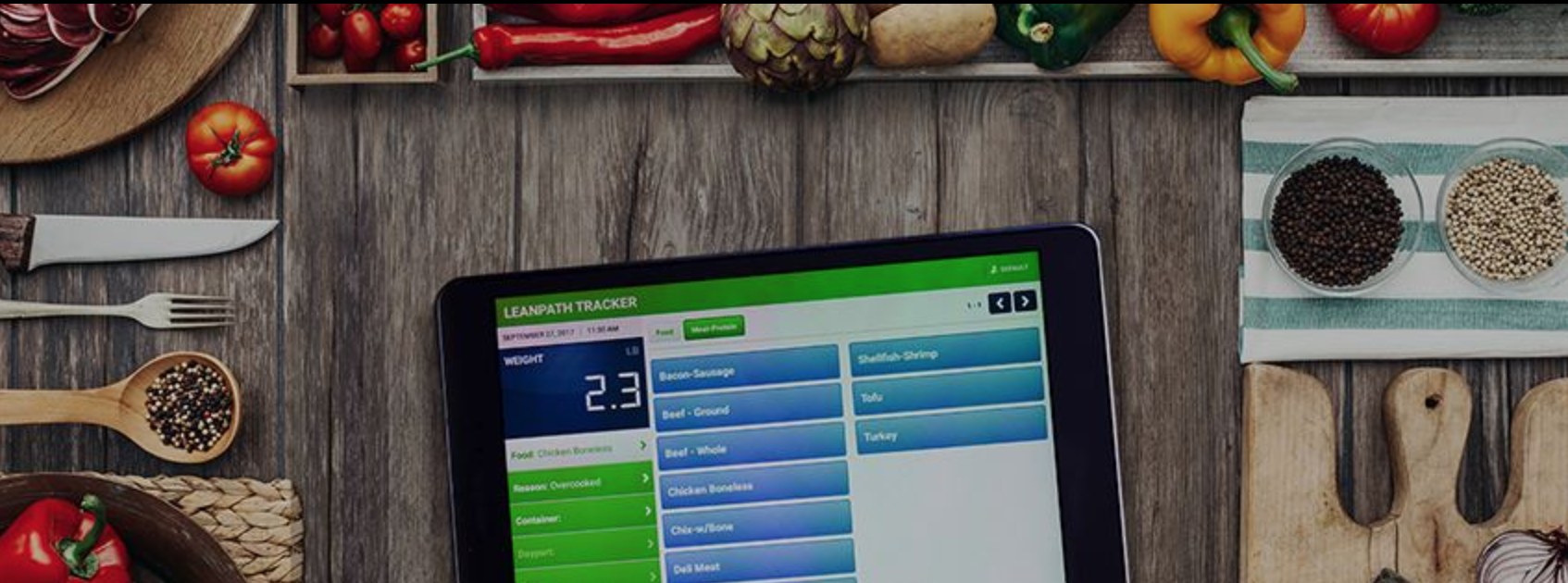
What makes the approach work is that Leanpath refuses to lead with guilt. The pitch to a line cook is not "you are wasting food." It is "here is what got thrown out today, and here is the one change that would help most tomorrow." The data does the persuading. In interviews Shakman has framed the whole effort around a phrase that sounds modest until you try it at scale: "We are working towards behaviour change."
A scale, a camera, and a habit
The mechanics have grown more automated over the years, but the loop is unchanged: capture the waste, understand it, act on it, repeat. Early stations required staff to weigh food and tap a touchscreen to classify it. The newest hardware, including the Floor Scale AI launched in 2025, uses embedded machine vision to identify the food and the container on its own - no tapping required, which removes both friction and training.
Capture
Food hits a connected scale; a camera photographs it and logs the weight.
Classify
AI identifies the item, or staff tap the food type and the reason it was tossed.
Analyze
Leanpath Online turns the stream into dashboards, trends and cost figures.
Coach
Goals and an AI coach surface the biggest opportunity and a plan to fix it.
On top of the hardware sits Leanpath Online and a mobile app, delivering real-time reporting to a single kitchen or across thousands of sites. In 2023 the company added AI-powered coaching in beta, and in 2024 it wove generative AI through the platform to write plain-language daily summaries - the digital equivalent of a manager who reads every waste log overnight and hands you a one-paragraph brief at the start of your shift.
When Google weighed its lunch
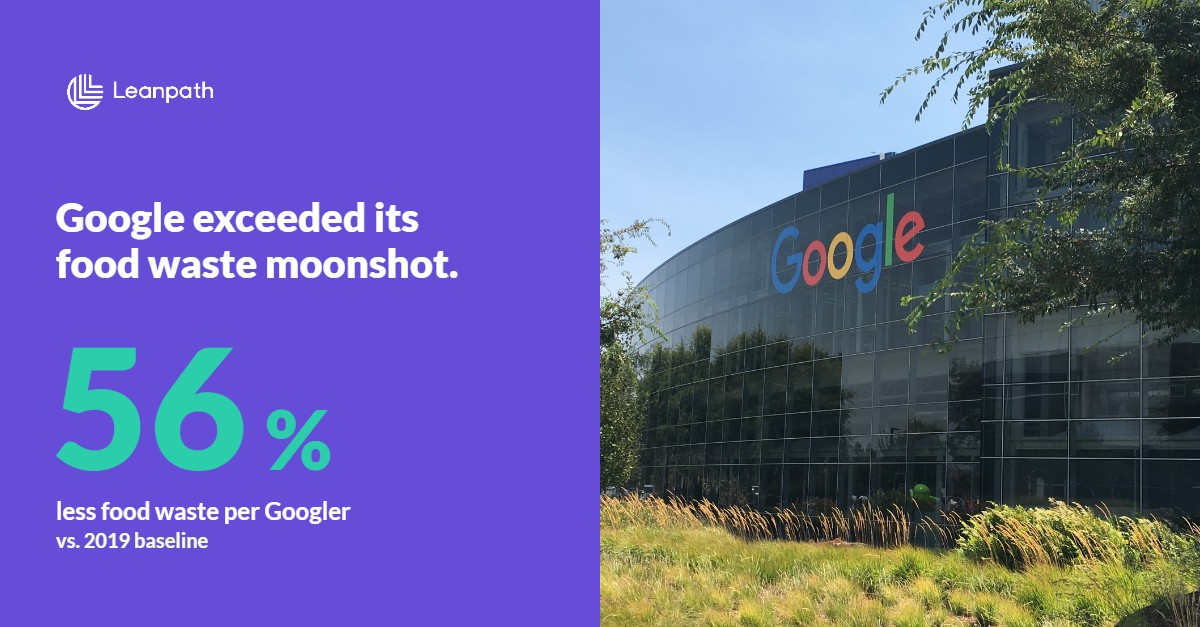
The clearest evidence that measurement changes behavior comes from Leanpath's largest showcase customers. Google deployed the system across its cafes and, by its own accounting, exceeded its internal food-waste "moonshot," reporting 56% less food waste per employee against a 2019 baseline. That is not a rounding error. It is the difference between a sustainability slide and an operational one.
Reported food-waste reduction, selected results
Sodexo, the global contract caterer, went a step further than most customers: instead of building its own tool or shopping around, it white-labeled Leanpath as "WasteWatch powered by Leanpath" and has been rolling it out toward 3,000 sites worldwide. When a multibillion-dollar operator adopts your product as its own house standard rather than treating you as a vendor, it is a quiet signal about who owns the category.
Boring problem, sharp tools
Leanpath sells to enterprise and non-commercial foodservice - universities, hospitals, hotels, corporate dining and contract caterers - on a subscription that bundles hardware, the software platform and human coaching. It is a registered B Corporation, and it grew in an unfashionable way for a company routinely called a "food-tech leader": mostly on debt financing rather than venture equity, including a $7 million debt round in 2019. Public estimates put annual recurring revenue near $10 million and headcount around 74.
- HeadquartersBeaverton, Oregon
- Founded2004
- ModelB2B hardware + SaaS + coaching
- StructureRegistered B Corporation
- Team size~74 employees
- Revenue~$10M ARR (est.)
- Reach~1,000 customers, 50+ countries
The detail that separates Leanpath from a pure software play is that it keeps chefs on the payroll. Not engineers gesturing at kitchens from a distance, but culinary people who coach managers on trim, over-production and rotation. The technology measures; the humans change minds. That combination is expensive and hard to copy, which is exactly why it is a moat.
One idea, many form factors
Over two decades the product line has spread out to fit every kind of kitchen. The historical flagship, branded Leanpath 360, put a bench scale and touchscreen at the center of a busy prep line. Its successors, the Bench Scale AI and Floor Scale AI, add cameras that recognize food automatically, so tracking survives even the busiest shift when no one has time to tap a screen. Smaller operations get lighter tools: Tracker Scout for a fast return on investment, Tracker Lite for a tablet-only satellite kitchen, and Snap AI, a mobile tracker for off-site catering and events where there is no fixed station at all.
Two products aim past the prep line at the diner. Spark tracks plate waste - the food guests take and then scrape into the bin - and turns it into signage and engagement that nudges the people doing the wasting. Goals, meanwhile, is the analytical brain: it scans a kitchen's data, ranks its biggest waste opportunities by cost and frequency, builds an action plan and then tracks whether the plan is working. Layered on top since 2024 is generative AI that writes the daily debrief in plain English and drafts the questions a manager should ask the team. The hardware collects the evidence; the software decides what to do about it.
Twenty years of watching kitchens fail the same way
Leanpath's real asset may be pattern recognition at scale. Having logged waste across thousands of kitchens in more than 50 countries, it knows the recurring villains - over-production for a buffet that never fills, trim loss from knife work, spoilage from bad rotation, the pan of pasta cooked "just in case." That accumulated view is what lets its coaches walk into a new site and predict, before the first week of data is in, where the money is being thrown away. Shakman has carried that expertise into rooms far from the kitchen, speaking on food waste at venues tied to the World Bank, the UN and the Culinary Institute of America, and the company aligns its mission with the UN target of halving food waste by 2030.
Where it sits in a crowded kitchen
Leanpath is no longer alone. A generation of rivals - Winnow, Orbisk, Kitro, Phood, Lumitics - now sell their own blends of AI cameras, smart scales and analytics, and the category has rebranded itself from "waste tracking" to "kitchen intelligence." What Leanpath leans on is time and scale: it named the space, it has the enterprise and contract-catering relationships, and it pairs its hardware with a coaching layer most competitors do not staff.
The larger backdrop is a global reckoning with food waste, tied to the United Nations' goal of halving it by 2030. That framing is good for Leanpath's mission and its sales pitch alike, because it turns a line-item cost problem into a climate one. Whether a kitchen cares about the landfill, the water, the greenhouse gas or simply the money, the first step is the same: put the food on the scale.
That, in the end, is the whole idea - unglamorous, patient, and surprisingly hard to argue with. Leanpath did not invent a smaller trash can. It invented the receipt.