The most honest employee in a commercial kitchen may be the bin. It never flatters the chef. It accepts the overcooked potatoes, the unpopular sausage, the pan prepared for guests who never arrived. Then it keeps quiet. Andrew Shakman built a company to conduct the exit interview.
Leanpath began with a blunt idea: before a kitchen can prevent waste, it needs to know what is being thrown away. The answer had to fit the speed and physicality of foodservice, where hands are wet, the clock is rude and nobody wants another spreadsheet. So the first system paired a shipping scale with a microprocessor, a membrane keypad and a small liquid-crystal display. A worker placed a pan on the scale, identified the food and tapped a reason for its demise.
It was less an invention of dazzling novelty than one of useful choreography. Weigh. Name. Explain. Learn. Repeat. The little ritual turned refuse into evidence. And evidence, Shakman believed, could alter the next purchase order, prep list or menu.
Before the bin, there was a story
Shakman's preparation for the garbage station was delightfully indirect. At Stanford he studied theater, reading plays, directing and pulling apart character, motivation and structure. At the University of Southern California he earned an MFA in motion-picture producing, a discipline that joins creative judgment to the unsentimental work of financing, markets and assembling a team.
He expected Hollywood. Instead, in the mid-1990s, he became fascinated by the early internet and the possibility that storytelling was migrating to a new screen. His work moved into first-generation digital marketing, often for food brands. One assignment forced a question no management textbook had anticipated: if Cap'n Crunch appeared in a video game and somebody punched him, how should the captain react?
The anecdote is funny because the work was serious. A character needed rules. A brand needed a voice. An audience needed a reason to care. Years later, the same sensibility would make a weight reading more than a number. A pan of wasted food needed context: what was it, why was it prepared, what did it cost, and what pattern did it join?
My purpose is to solve consequential puzzles.Andrew Shakman
After the dot-com bubble burst, Shakman wanted technology to touch something more tangible than a website. In January 2004, he and engineers Stephen Rogers and William Leppo formed LRS Solutions without a settled product, only an interest in embedded systems. A salesman named Carl Nelson brought them a practical problem from a foodservice customer: could they simplify the awkward process of weighing discarded food and making sense of the result?
Within months, the founders had a prototype. It spent six months in an Intel cafeteria. The trial supplied the kind of feedback entrepreneurs cherish later and endure in real time. The plastic device looked frail beside heavy stainless-steel equipment. Its fixed keypad could not keep up with seasonal menus. The team replaced it with a touchscreen, tested again, and released the first commercial product in February 2005.
A factory with knives, fire and feelings
The intellectual move behind Leanpath was to treat the kitchen as a kind of factory. Manufacturing had Lean, Six Sigma, statistical process control and decades of practice making defects visible. Commercial kitchens transformed raw ingredients into repeatable outputs, yet much of their loss vanished without a record. Shakman wondered what might happen if management science came through the swinging door.
But a kitchen is not a silent assembly line. It is a social system staffed by people who care about food and work under pressure. If measurement feels punitive, employees can avoid it or hide the problem. Shakman's recurring instruction is therefore deceptively humane: make food waste a safe topic.
He rejects the convenient villain. Cooks generally do not arrive intending to waste. Waste often acts as a buffer against other anxieties: running out, disappointing a guest, misjudging demand or taking a risk with quality. Once the system is blamed less and examined more, the frontline worker changes roles. The person closest to the bin becomes the person closest to the answer.
When you measure things, they change.Andrew Shakman
That behavioral layer may be the company's least photographable product and its most durable one. A dashboard can expose chicken wasted every Thursday. It still takes a team to discover whether the cause is purchasing, prep, portioning or a menu item guests quietly dislike. The data does not issue a verdict. It opens a case.
The elephants on the wall
Story returned in an unexpectedly pachydermal form. Leanpath began translating cumulative waste into the equivalent weight of elephants. Chefs picked up the metaphor. In some kitchens, Shakman later recalled, teams posted elephant pictures on the wall like a thermometer. A thermometer made of elephants is a mixed metaphor with terrible manners. It is also hard to forget.
That is the old producer at work. Pounds are precise but emotionally slippery. An elephant supplies scale, absurdity and a shared image. The measurement becomes a story the chef can retell at lineup. Progress becomes visible enough to celebrate.
The technology, meanwhile, kept growing up. Early units passed data by USB. Networked versions moved reporting to the cloud. Cameras arrived in 2013, initially because a picture told a richer story than a row in a report. The company also knew machine vision was coming. Those labeled images created a long runway for computer vision when the economics and accuracy became practical.
Shakman describes that sequence as choosing the right technology at the right time. Leanpath could have chased machine vision earlier. Instead, it spent years on scaled programs, affordable deployment and behavior change, then returned to AI as costs fell and the tools matured. Patience, in this account, is not waiting. It is sequencing.
AI enters by the service door
In his 2025 writing, Shakman positioned AI as an assistant to culinary expertise, not its replacement. Recognition can reduce the friction of logging a waste event. Analytics can surface a pattern across hundreds of sites. Recommendations can help a manager decide where to look first. Yet somebody still changes the batch size, questions the garnish or notices that diners keep abandoning the same side dish.
This is a useful restraint in a market fond of magical nouns. A camera does not prevent waste merely by recognizing rice. Prevention happens when information changes the next act of production. Shakman's work keeps returning to that modest causal chain, and to the people holding the ladles.
Leanpath now says its platform is used in thousands of kitchens across more than 45 countries and has helped prevent more than 100 million pounds of food waste. The company became a Certified B Corporation in 2020. Shakman's industry recognition includes the NACUFS Daryl Van Hook Award, a Waste2Zero Special Achievement Award and a place on the 2023 Meaningful Business 100. He has carried the argument for prevention to the World Bank, the UN Food and Agriculture Organization, Harvard and the Culinary Institute of America.
Awards provide punctuation, but his preferred sentence is unfinished. In 2025 he described food-waste prevention as entering a second act. Awareness has grown. Measurement is increasingly accepted. The remaining question is whether businesses can turn insight into action fast enough and at sufficient scale to meet the global goal of halving food waste by 2030.
Tomorrow's prep list
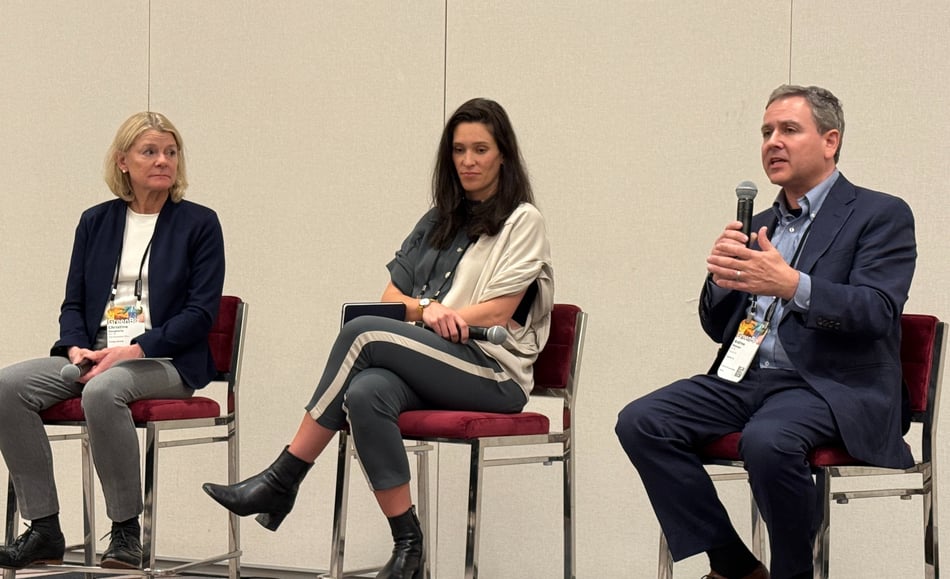
At GreenBiz 26, Shakman spoke about technology adoption in terms that would have made sense beside the original Intel cafeteria prototype: respect the workflow, show immediate value, recruit multiple champions and let people see their own data. The software is more sophisticated now. The social bargain is much the same.
This may be the transferable lesson hiding at the bottom of the bin. Measurement works best when it is neither surveillance nor ceremony. It should arrive close to the decision, return something useful to the person doing the work and make improvement easy to see. Otherwise, the dashboard becomes an expensive still life.
Shakman started as a student of character and story. He ended up giving character to a data point and a plot to a pile of scraps. What was prepared? Why was it lost? What will the kitchen do differently tomorrow? A good story changes its audience. A good measurement system, it turns out, does too.