At an airport in Los Angeles, with a boarding call somewhere in the background, Erich Kerekes phoned a friend about a choice that looked suspiciously easy. He could return to Chicago, where his parents and many old friends lived. McKinsey would pay for the move. His salary had recently doubled. A promotion was weeks away. Chicago also had Portillo’s, which Kerekes considered pertinent enough to include on his list.
The other option was less polished. Stay in San Francisco. Leave the job he loved. Help build a Catholic prayer app that had made him no promise of a salary, equity, title, or even a sensible explanation for relatives. Alex Jones, the friend on the phone and Hallow’s founder at the time, did not sell him. He suggested that Kerekes pray about it.
This was awkward advice for an analyst. Kerekes had been trained in computer science and consulting, professions that reward a clean model and punish an unexamined premise. His own prayer life, by his account, was not especially sophisticated. Still, he tried a series of discernment exercises: imagine choosing one path, sit with the response, then imagine the other. The more he prayed, the less comfortable the safe answer became.
So in July 2018 he left McKinsey and stayed. The decision would eventually make him Hallow’s co-founder and chief technology officer. It would also produce a delightful corporate paradox: an engineer building an attention-based product whose purpose is to redirect attention somewhere else.
First, a beach. Then all the detours.
Kerekes grew up in Barrington, Illinois, outside Chicago, and arrived at the University of Notre Dame in 2011. He studied computer science, added a minor in Corporate Engineering Practice, and graduated summa cum laude. The résumé has the crisp efficiency of a person who knows how to finish things: president of the campus Habitat for Humanity chapter, four years of club ultimate Frisbee, webmaster for the team, membership in the computer-science honor society, and the department’s award for its outstanding senior.
There was range beneath the neatness. A scholarship program sent him to Washington to work on nonprofit partnerships, then to Ghana with an anti-trafficking organization. Another summer involved translating scientific protocol language from C++ into Python. In 2014 he interned in McKinsey’s Chicago technology office. After graduation he joined the firm full time.
He barely knew Jones at Notre Dame. They properly met after college because both had joined McKinsey’s Chicago office and happened to land on the same beach during a company retreat. A late-night conversation wandered toward God, faith, and the difficulty of sustaining either inside a hectic, largely secular workplace. They never worked together and later lived in different cities, but the conversation kept going for three years.
The route that did not look like a route
The route from that beach to Hallow included several refusals. Kerekes missed out on a Gates Foundation rotation and instead spent his third McKinsey year in the Bay Area advising fast-growing technology companies. Stanford’s business school interviewed him but did not admit him. Two Chicago landlords rejected applications he made with old roommates. Each result disappointed him. Together they left him in San Francisco, unusually prepared to help a startup grow and unusually free to take the risk.
Kerekes later wrote about this chain of events without pretending he had received a guarantee. Perhaps Hallow would work; perhaps it would fail after teaching him a few lessons. His conclusion was narrower and more useful: it was the right thing to do at that moment. Silicon Valley prefers a founder who claims to have seen the future. Kerekes offered a man who had finally made peace with not seeing it.
A North Star that refuses to blink
The founding team was also its own first customer. They were young professionals from Christian backgrounds, doing demanding work and looking for quiet. Kerekes described his prayer at the time as repetitive and one-sided. He spoke; he rarely listened. Jones had tried a secular mindfulness app. Kerekes found silence in hiking. Both saw value in those practices, but felt something absent from them.
Their research took them to priests, religious communities, professors, family, friends, and books. Christianity, it turned out, did not lack contemplative techniques. It lacked a contemporary doorway that looked at home on a phone. Hallow became that doorway: audio-led prayer and meditation, designed with the fluency of a consumer app.
The first version took roughly four months. Another four passed before the public launch on both major app stores. The founders and friends cobbled together code, design, voices, and recordings. A Kickstarter raised $25,000 against a $20,000 goal. In its first month, the app recorded more than 4,000 downloads and a 4.8 rating. These figures were promising. They were not the figure Kerekes cared about most.
Hallow’s early North Star metric was Weekly Prayers Completed. The phrase is almost comic in its collision of management dialect and devotional life, but it gave the team a serious instrument. A reminder feature might increase the number of prayers people completed. A more convenient payment flow might not. The metric helped decide which one came first.
Good metrics expose a company’s values long before the mission statement does. A streaming platform can reward minutes watched; a social network can prize daily active users. Hallow counted the completion of the practice it existed to support. It did not measure faith, which would be presumptuous. It measured whether the tool helped a person do what they came to do.
The screen is not the sanctuary
By 2024, Hallow had passed 20 million downloads. Notre Dame named Kerekes to its Domer Dozen, an alumni recognition, and credited him with leading product, technology, design, and analytics. When he returned to campus for IDEA Week in April 2025, the app stood at 23 million downloads and more than 900 million completed prayers. The little doorway had become a very busy entrance.
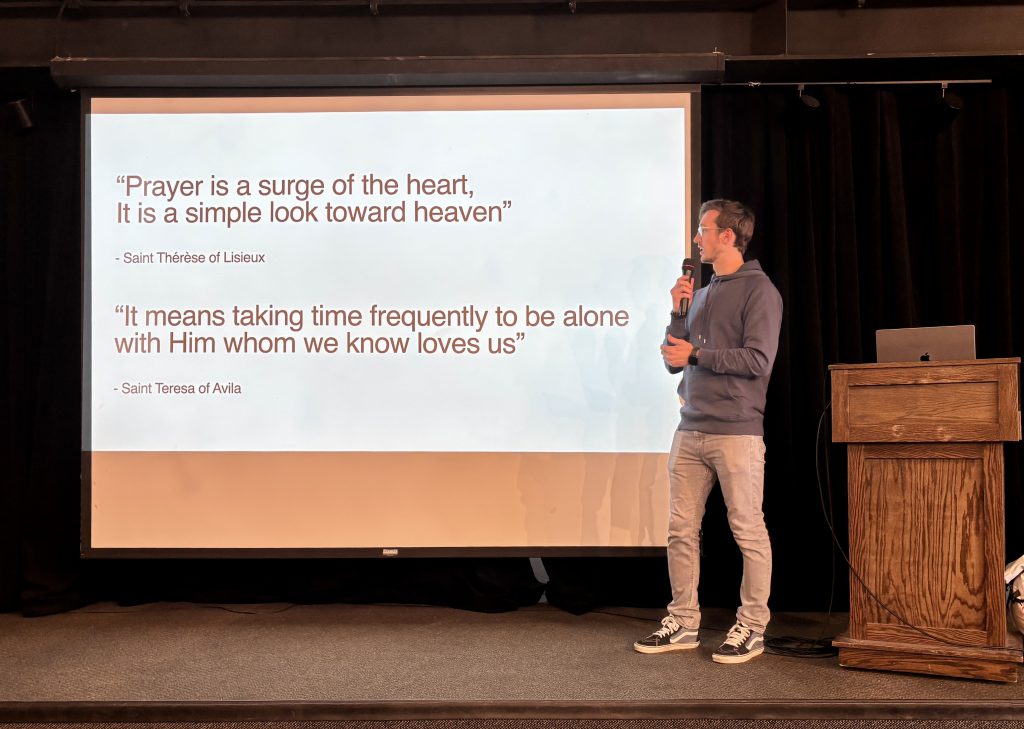
Growth made an old question harder to avoid: where should the technology stop? Kerekes has warned against treating Hallow as passive religious audio or as the center of a person’s faith. At its best, the app supports attention, habit, and community. It does not perform the act on the user’s behalf. In a 2026 conversation filmed inside Chicago’s Holy Name Cathedral, he put the boundary plainly: technology is a tool and should not become the end of the practice.
His thinking about artificial intelligence follows the same line. Kerekes does not treat AI as inherently corrupt, nor does he offer it a blank cheque. Used well, he argues, it can free people for deeply human work. Used to outsource creativity, moral judgment, or human connection, it crosses a line. This is less a policy platform than a product test: does the tool enlarge human agency, or quietly collect it?
There is a pleasant consistency here. As a student, Kerekes moved between code, service, and organizations. At McKinsey, he learned growth strategy. At Hallow, he joined those skills to an interior problem he understood firsthand. The company’s scale is remarkable, but his part of the story is more interesting when kept at human size: a restless prayer life, a phone call, a metric on a whiteboard, a willingness to let an app be useful without asking it to be ultimate.
The engineer leaves room for mystery
In his own writing, Kerekes is analytical without performing certainty. He follows an argument, tests its weak joints, supplies caveats, and occasionally lets the joke survive the edit. His account of faith is full of books, debates, conversations, and unresolved questions. It is not the testimony of someone who stopped thinking. It is the story of someone who decided thinking ought to change how he lived.
That temperament may explain the unusual balance in his work. The computer scientist likes systems. The believer distrusts systems that confuse themselves with the purpose. The operator wants scale. The person who stayed in San Francisco without a salary remembers that the original promise was smaller: if the work brought peace and love to even one person, he wrote then, the world would be slightly better.
Millions of downloads later, the proposition has become grander in reach but not in mechanism. Someone opens the app. A voice begins. The screen, for once, is asked not to be fascinating. And the engineer’s best work is completed when attention passes through his product and lands somewhere he cannot measure.