A signature is a wonderfully misleading ending. The negotiations stop. The document acquires a date. Someone can finally close the file. Yet the agreement has only just begun its working life. A supplier must deliver, a customer must pay, and somebody must remember the detail everyone spent so long agreeing. Ajay Agrawal built his second company around the distance between that satisfying signature and the much less photogenic business of keeping a promise.
The question came into focus during his years at UnitedLex, the legal services company he co-founded in 2006 with Daniel Reed. A client described a problem of “contract education”: the promises written into an organization's agreements were drifting away from what it actually received. That phrase carries a small embarrassment. An enterprise could negotiate a sophisticated contract and then struggle to teach itself what it had bought.
Agrawal already knew the world that produced those documents. He had worked as a securities lawyer before becoming an entrepreneur. His career would take him from structuring transactions to asking how their terms could survive ordinary business life. The change is worth dwelling on. Writing an obligation and making it visible to the people responsible for it are separate accomplishments. Sirion, founded in 2012, became his attempt to connect them.
There is an appealing lack of ceremony to the task. Nobody holds a signing dinner for an accurately checked invoice. Yet the invoice is where a carefully negotiated term can acquire a practical consequence. The work Agrawal chose to pursue asks a company to sustain its attention long after the occasion for celebration has passed.
Brown, Cambridge, Wall Street - then a different bargain
His education makes an unusual preface to enterprise software. Agrawal studied semiotics at Brown University, earned a law degree at Trinity College, Cambridge, and completed an LL.M. at Columbia. Semiotics concerns signs and meaning; securities law concerns language with expensive consequences. The sequence offers an appealing lens on his later work, though a degree alone cannot explain a company.
His legal career included Simpson Thacher & Bartlett and Debevoise & Plimpton. By his own account, the experience of practicing on Wall Street during the 1990s helped draw him toward contracts. He then watched large businesses seek ways to automate legal work and reduce their dependence on costly onshore resources. UnitedLex put him inside that transition, where services, software and legal expertise met in the same commercial problem.
The next question was whether automation could become a product in its own right. A service business can solve a customer's problem with expertise and effort. A software product has to make more of that expertise repeatable. For Agrawal, the attraction was the possibility of taking what he had learned from individual engagements and building something other organizations could use. He was changing the mechanism through which his experience reached the customer.
A repository was only the opening request
Agrawal did not make that transition alone. Sirion's founding group included Claude Marais, Kanti Prabha and Aditya Gupta. Prabha had worked with him at UnitedLex before he invited her to join the new venture. Their connection matters because this was a business assembled across disciplines: legal understanding, commercial operations and the engineering required to make messy agreements behave inside software.
Prabha remembers HP as the first customer. Following a large acquisition, it needed thousands of contracts stored centrally. The team built a platform to answer that request, then saw how much remained beyond the repository. Finding the document was useful. Businesses also needed to create agreements, negotiate them and manage the outcomes recorded inside them. The first customer helped reveal the size of the next question.
By 2016, Sirion's proposition explicitly connected what a contract promised, what a supplier delivered and what the customer paid. Its software brought together contracts, performance, finance, risk and relationship management. That combination sounds administrative until an invoice lands. Then the ability to compare the bill with the bargain becomes rather interesting to the person paying it.
Consider an illustrative service agreement: a report is due monthly, prices can change under a specified formula, and a missed service level triggers a credit. Each provision needs a responsible person and a way to check performance. The document contains the instructions, but it will not attend the monthly review. Agrawal's chosen problem lives in that gap.
The paperwork around the paperwork
The same logic helps explain Sirion's acquisition of Eigen Technologies in 2024. Agrawal and Eigen co-founder Lewis Liu were joining capabilities that addressed adjacent pieces of a customer's business. Sirion worked with contracts. Eigen extracted information from documents. The useful evidence often sat across both.
Customers were asking about performance information in orders, invoices and service-level reports. Some of it appeared in tables or numerical sections that could be difficult for language systems to handle. To assess whether an agreement had delivered value, the software needed to understand those surrounding records as well. An elegant reading of the contract could still leave the decisive number sitting in another file.
Agrawal described the expansion as a move from contract intelligence into document intelligence. The acquisition followed the question outward: if the promise is recorded here and the evidence is recorded there, the system has to reach both. It is a pleasingly practical reason to buy another technology company. The contract had brought its attachments, and the attachments had brought more attachments.

Ask a question. Then make the answer useful.
By October 2025, Sirion was presenting a conversational contracting experience built around AskSirion and specialized AI agents. Search, creation, extraction, issue detection, redlining and playbook work appeared as distinct capabilities. For Agrawal, the interface was becoming another part of the original problem: how easily could someone reach the knowledge inside an agreement?
In a public post introducing AskSirion, he argued that enterprise software would become conversational. His examples were everyday contracting tasks: checking renewal dates, comparing service-level agreements and redlining a clause. These are recognizable requests from a colleague. Asking them in ordinary language makes the proposed relationship with software easier to picture than another menu of enterprise features.
The ambition also raises a practical standard. An answer must remain connected to the agreement it describes, and an action must respect the organization's rules. Sirion says its agents use contract-specific context and operate within guardrails. Those are product claims, and the important test is what happens when a real team uses the system on its own agreements.
Agrawal's writing in July 2026 returned to the longer life of a contract: performance, renewals and obligations over years. The interface had changed, but his preferred unit of value remained the business outcome. A contract retrieved in seconds is convenient. A contractual obligation handled in time is the point of the exercise.
“The future of all enterprise software is conversational”
Ajay Agrawal, introducing AskSirion on LinkedIn
A quieter morning, a complicated evening
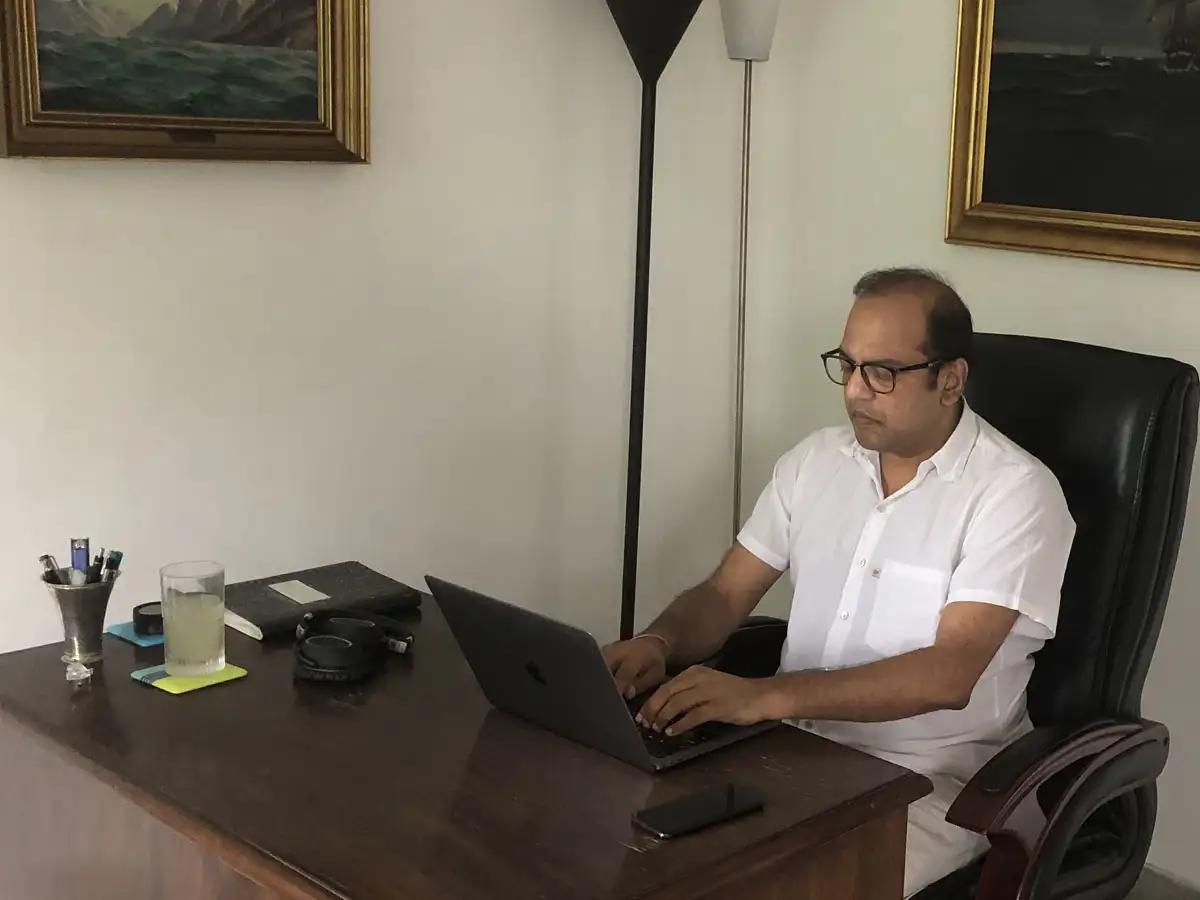
There is a more domestic picture of Agrawal in his 2020 account of working from home. He set aside a separate workspace and dressed in business attire. The commute had disappeared; he kept the distinction between home and office. Even a software founder sometimes needs a physical cue that the working day has started.
He tried to keep the first half of his day clear of calls and meetings so he could concentrate on analytical work. Later came conversations with colleagues, clients and partners in Europe and the United States. The schedule gives a concrete shape to the international business: protected thinking time followed by other people's time zones.
For an evening change of pace, he named Indian classical music, The Wire and Breaking Bad. It is an entertaining selection for someone whose professional interests include obligations, institutional behavior and the consequences of an agreement. The connection belongs to the viewer's imagination. What he actually described was a need to switch off after a day of calls.
These details make the founder easier to picture without pretending to explain him completely. A clear morning, a deliberate workspace, a meeting expected to produce an outcome: his own account places considerable value on attention. The person advocating more usable enterprise software also described arranging his day to leave room for thought.
Fourteen years in, another negotiation
On February 23, 2026, Sirion announced the completion of a majority investment from Haveli Investments. The transaction had been announced in January. Financial terms were undisclosed. The company said the partnership would support product development and a wider global commercial presence.
Agrawal described a second purpose: simplifying the board after years of investment from different backers. He said Sirion was already profitable and still held more than half the proceeds of its previous round. He framed the change as a way to make decisions with a more aligned group of owners as AI changed quickly.
The announcement put Sirion's platform at more than seven million contracts across over 100 languages. Those figures describe the company, rather than Agrawal's personal fortune, but they show the scale of the problem he has chosen to pursue. Every additional language and agreement brings another set of terms that must retain their meaning when somebody needs to act.
“Contracts are becoming executable knowledge,” he said when the investment closed. The phrase is ambitious. His career supplies a concrete way to read it: start with the language of a bargain, connect it to evidence, and help somebody carry out the next obligation. Fourteen years after Sirion's founding, Agrawal is still following the promise beyond the signature. There is plenty of work waiting there.
Sirion’s figures in its February 2026 investment announcement.
Follow the conversation
Sirion · Ajay on LinkedIn · Ajay on X
Listen: Agrawal’s 2020 LawNext conversation
Read: Agrawal and Liu on the Eigen deal
Read: Agrawal on the Haveli investment
Read: Agrawal on AI-native contract management
Watch: Sirion’s agentic CLM platform
Watch: Sirion’s AI agents in action
The two videos are company product demonstrations.