The corporate contract has a strange life. Before signature, it is treated like a live grenade. Lawyers debate commas. Procurement challenges rates. Sales chases approvals. Then everybody signs, exhales, and files the thing somewhere sensible. Months later, an invoice arrives, a service level slips, or a renewal date quietly passes. The grenade has become a paperweight.
Sirion built a substantial software company around that anticlimax. Founded in 2012, the enterprise contract lifecycle management company sells a system for storing, creating, negotiating, and - most distinctively - operating contracts. The platform extracts clauses and obligations, watches milestones, compares invoices with agreed terms, flags risk, and gives legal, procurement, sales, and finance teams one shared account of the bargain.
The company says more than 200 customers use Sirion across 70-plus countries, with more than 7 million contracts worth nearly $800 billion under management. Named users include BNY Mellon, IBM, Vodafone, Qantas, Schneider Electric, Raiffeisen Bank International, and Greater Toronto Airports Authority. This is software for organizations where “the contract” is not one PDF. It is a small civilization of master agreements, work orders, rate cards, invoices, amendments, and people arguing about which version is current.
The 10 percent where the money lives
Founder and CEO Ajay Agrawal has described the founding insight with a lawyer's dark humor: much of a contract anticipates unlikely disasters, while the everyday machinery of value - deliverables, milestones, obligations, price books, and adjustment mechanisms - is pushed into schedules and annexures. Sirion concentrated on that machinery. Its early wedge was not prettier drafting. It was performance governance after the ink dried.
That choice explains what Sirion does differently from a basic repository. A repository can tell you where an agreement is. Sirion tries to tell you what it requires today. If a supplier owes a monthly report, if an index changes a price, if a service credit is due after downtime, or if a notice window is approaching, the platform converts those terms into structured data, owners, alerts, and workflows. Connections to systems such as SAP, Salesforce, Microsoft 365, and Oracle pull the contract into ordinary business operations.
“Contracts are becoming executable knowledge, not static documents.”Ajay Agrawal, founder and CEO
The strongest evidence is also company-produced, so it deserves the usual case-study caution. Sirion reports that a Fortune 500 oil-and-gas customer put $4.1 billion of contract value under active governance and found $235 million in hard savings by validating invoices and new work orders against contractual terms. The same project reportedly cut supplier disputes by 70 percent and manual governance effort by 60 percent. The point is not that every deployment produces a nine-figure treasure chest. It is that the product earns its keep only when contract data changes an operational decision.
Then the market caught up to Sirion
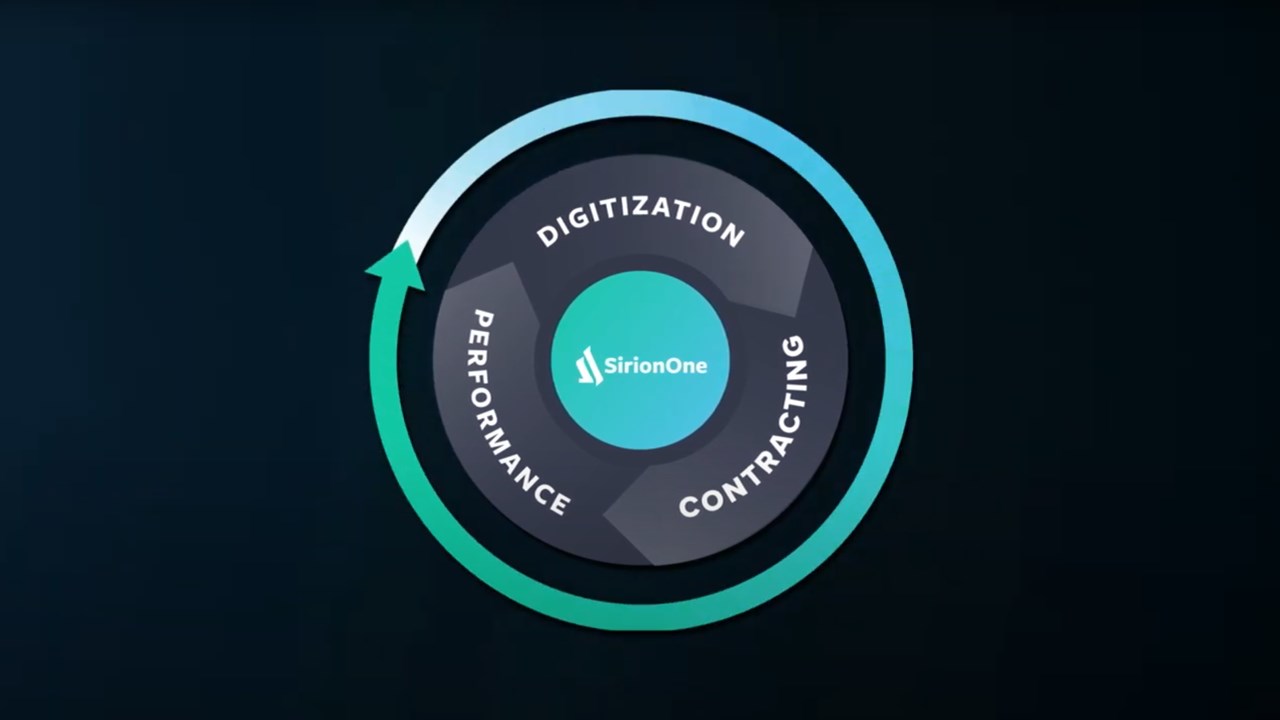
Contract software expanded toward the whole lifecycle. Icertis, Ironclad, Agiloft, DocuSign CLM, Conga, ContractPodAi, SAP, and others compete for overlapping budgets. At the same time, generative AI made drafting and search easier to demonstrate. Sirion followed the market toward end-to-end CLM without abandoning its old thesis. Its current platform covers the three large verbs - store, create, manage - but still puts unusual weight on obligations, performance, governance, and invoice reconciliation.
The new front door is AskSirion, a conversational interface. A user can ask about risk across a portfolio, request a first draft based on company templates, investigate an agreement, or check upcoming obligations. Underneath, Sirion's agentOS routes work to specialized agents for search, drafting, issue detection, redlining, playbooks, extraction, obligations, and invoices. The company says the system can select among more than 10 large language models and more than 1,200 proprietary smaller models. Recommendations are designed to link back to source material so a human can inspect the reasoning instead of admiring a confident paragraph.
That architecture is Sirion's answer to a difficult enterprise question: why trust a general chatbot with a clause that can move millions of dollars? The company is betting on narrower agents, contract-specific data, explainability, and customer policies. Its competitive pitch is not simply that AI can write. It is that AI can understand the organization's preferred language, spot deviations, follow the obligation into business systems, and leave an audit trail.
The acquisition customers asked for
One of Sirion's more revealing moves came in 2024, when it acquired London document-intelligence company Eigen Technologies. The terms were not disclosed. Agrawal explained that customers wanted performance data found outside contracts - in orders, invoices, and service-level reports - because those documents show whether the agreement delivered value. In other words, Sirion's own product boundary had become the next bottleneck.
That is the “what failed first” lesson hiding in the company's evolution. The contract alone was not enough. A perfect extraction of the agreement still could not prove delivery without reading the surrounding evidence. The Eigen purchase broadened Sirion's labeled data and document AI, following an earlier 2022 acquisition of contract-automation company Zendoc. Customer demand changed the unit of analysis from the contract to the commercial relationship.
Capital financed the widening scope. Sirion raised about $4.7 million in 2014, $12.25 million in 2016, $44 million in 2020, $85 million in 2022, and a reported $25 million extension in 2023. TechCrunch reported a valuation around $1 billion during the Eigen deal. In February 2026, technology investor Haveli Investments completed a majority investment, with financial terms undisclosed. Sirion said the backing would accelerate product work and global expansion.
The company behind that expansion is distributed across North America, India, Singapore, Britain, continental Europe, and Australia. LinkedIn showed roughly 1,174 employees in September 2026, close to the 1,200 figure in commercial company data. Sirion names diversity, agility, and ownership as its cultural values. More revealing is the product habit visible in its history: implementation feedback travels back into the roadmap. Early customers shaped the first platform; later customers asking for insight from invoices and service reports helped pull Sirion toward Eigen. In enterprise software, “customer-led” can be brochure paste. Here, at least one acquisition-sized decision followed the request.
Industrial software has an industrial price
Sirion does not publish a simple pricing table. One public AWS Marketplace offer lists a 12-month Sirion entitlement for 100 users at $150,000, with possible infrastructure costs on top. Implementation, support, modules, integrations, migration, and configuration can raise the first-year bill. That number usefully clarifies the buyer: a multinational trying to govern thousands of consequential contracts, not a five-person legal team that needs to redline three NDAs by Friday.
Complexity is the first trade-off. Enterprise CLM requires a contract taxonomy, clean ownership, integrations, playbooks, permissions, and people willing to change how work moves. Public user reviews praise breadth, obligation tracking, AI extraction, and collaboration, while also noting configuration complexity and a learning curve. A company with weak processes can digitize its confusion with impressive precision.
Where it fits
Large, regulated, global organizations with high contract volume, meaningful supplier or customer obligations, multiple business systems, and a named transformation owner.
Where it strains
Small legal teams, low contract volume, narrow review needs, thin implementation capacity, or businesses unable to define the outcome they expect the platform to improve.
The business model is conventional enterprise SaaS - negotiated subscriptions based on users, modules, volume, and deployment scope, plus services around implementation and support. The expertise is less conventional. Sirion sits at the intersection of legal operations, procurement, supplier governance, document AI, and financial control. It competes in CLM, but its most convincing use cases look like commercial operations: catching an overcharge, enforcing a service credit, or preventing a renewal from becoming a surprise.
The part anyone can copy
You do not need a seven-figure transformation program to borrow the underlying playbook. Start with one expensive promise. It could be a volume discount, uptime commitment, renewal notice, rebate, price adjustment, or delivery milestone. Write down the evidence that proves performance, the system where that evidence appears, the owner who must act, and the date after which recovery becomes harder. Then automate that loop. Sirion's insight is that contract management becomes useful when a sentence triggers behavior.
A four-line promise audit
- Choose one obligation with a measurable financial or compliance consequence.
- Name the exact data - invoice, ticket, delivery record, or report - that proves it happened.
- Assign one accountable owner and one escalation path.
- Alert before the notice window, credit deadline, or renewal date closes.
It will not work when the organization cannot agree on its templates, owners, or source systems; when the contract volume is too small to justify configuration; when users refuse the workflow; or when extracted data is accepted without review in high-stakes decisions. It also will not rescue a bad commercial bargain. Software can remind you that a weak clause exists with admirable punctuality.
Sirion's trajectory - from post-signature governance to end-to-end, conversational CLM - looks like expansion, but the center has held. The company keeps returning to an unflashy question: did the business receive what the document promised? In a market full of AI that can produce more words, Sirion is building AI that keeps score.