Lars Ropeid Selsås came close to finishing his master’s degree. Then came a condition he would not accept: publishing the code he had developed during his studies. He left the University of Stavanger without the qualification. The software went with him. For a future founder, it was an unusually literal exercise in deciding what to keep.
In 2013, he headed for Silicon Valley. Three years later, he returned to Norway and co-founded boost.ai with his brother Hadle Ropeid Selsås and university friend Henry Vaage Iversen. The route looks tidy when reduced to dates. What filled the interval was less convenient to put on a business card: engineering work, a growing interest in machine learning, and hours spent writing the foundations himself.
A qualification left behind, an education continued
California offered a place to learn by making things. Selsås lived in Mountain View, worked in software, and developed his interest in artificial intelligence. His career before boost.ai included a senior software engineering role at Gamut. He also built a machine-learning library in his spare time, taking on the underlying algorithms rather than treating the available tools as sealed boxes.
That choice helps explain the company he eventually built. A library is infrastructure: code other software can call on to perform useful tasks. Writing one demands patience with the parts an eventual customer never sees. Selsås later credited that grounding with giving boost.ai the ability to develop its own approaches. The attractive thing about understanding the machinery is that you can change it.
He has been fairly consistent about his preference for practical knowledge over credentials. American employers, he recalled, were interested in what he could produce. The missing degree did not prevent him from working. Nor did California become a permanent destination. In 2016, the next experiment took him back across the Atlantic.
The first customer was close to the first desk
Iversen had arranged an office in SR-Bank’s startup hub in Stavanger. Selsås returned to a ready-made place to work and a bank with a problem: it wanted a virtual assistant. A founder can spend months searching for a market. Here, the prospective market had helped arrange the furniture.
The local circumstances mattered too. Rogaland was dealing with an oil-industry downturn. Selsås later described lower costs and easier access to skilled people as advantages for a new technology business. SR-Bank offered free office space in Stavanger’s Romsøegården, part of its effort to help new companies develop during the region’s transition.
The bank became boost.ai’s first customer. Within a few months, the team had built an assistant; the SR-Bank deployment went live in early 2017. The assignment gave the founders something more demanding than a demonstration. They had to make a system useful to people arriving with real questions, in the language those people happened to use.
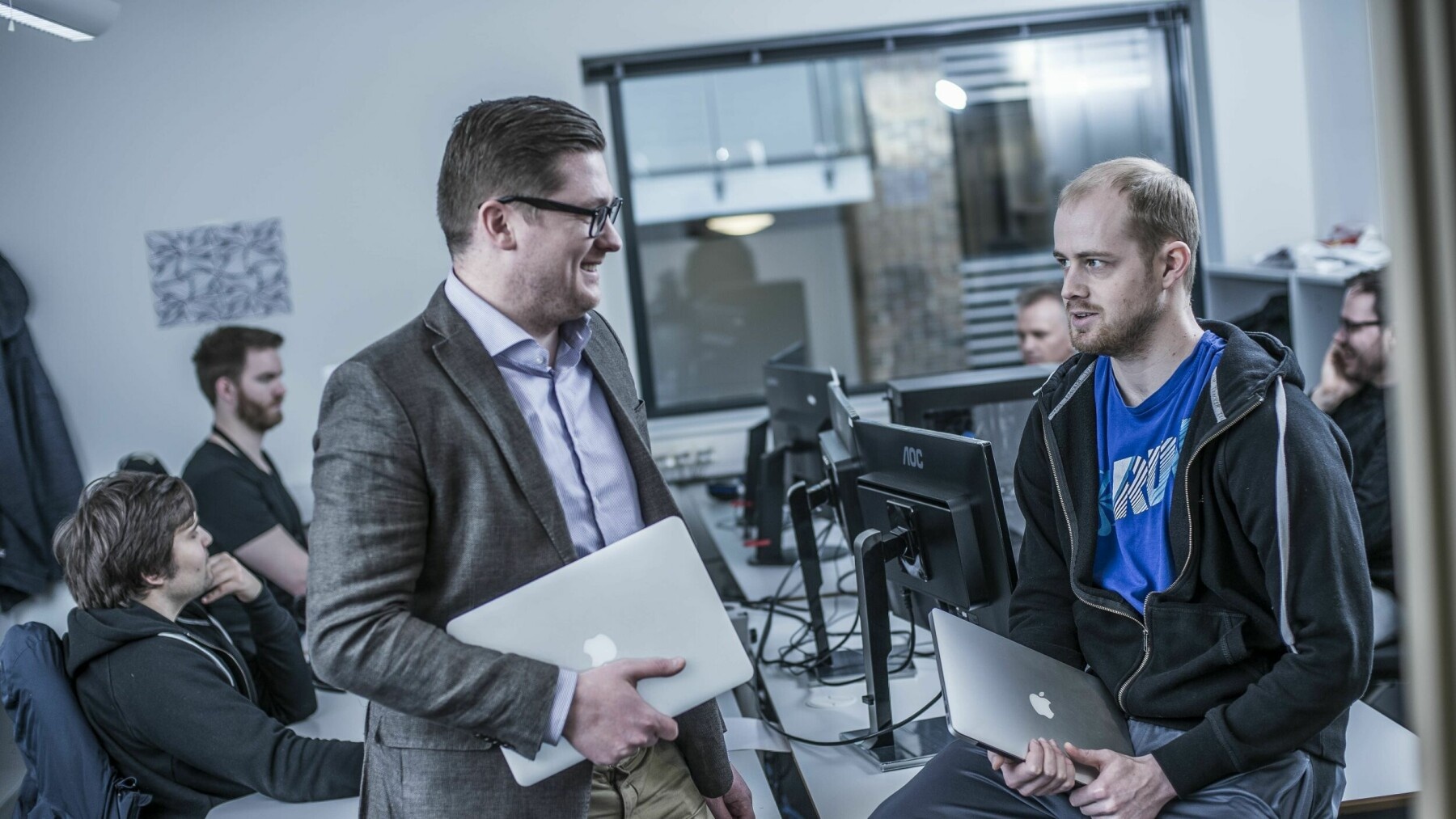
By the time Selsås appeared at FinovateFall in 2019 with AI solutions specialist Sam Danby, the company listed more than 100 live virtual agents and close to 100 employees. Its customers included DNB, Nordea, Telenor and Santander Consumer Bank. Partnerships with consulting firms including Accenture and Capgemini offered ways to take the product to businesses beyond the founders’ immediate reach.
The percentage was only part of the answer
Early on, the founders concentrated on how much customer contact they could automate. Selsås later said they learned to give priority to the entire customer experience. That sounds like a small correction until you imagine being the person stuck in an automated conversation. An impressive percentage is poor company when your own question remains unanswered.
His 2019 explanation of the product allowed an explicit place for human support. A virtual agent could handle routine interactions and bring in a person when necessary. He described one banking customer automating half its incoming chat traffic within six months. The point was a workable division of labour, with the customer’s progress determining whether the system had done its job.
He also wanted assistants to go beyond answering frequently asked questions. Authentication could allow them to help with transactions, such as reporting a lost card or changing a phone package. Those examples reveal his practical interests. A conversational interface earns its place when something useful happens after the customer starts typing.
In a conversation with Silvija Seres, he pushed back against the cinematic version of AI. He stressed the work of human trainers and the continuing need for customer support. Pouring data into a computer and expecting magic was a poor description of the job. People would still have to teach, supervise and work alongside the system.
Ambition, with somebody else keeping the diary
Selsås once wanted to become a professional beach-volleyball player. Before studying IT, he had pursued that ambition seriously. His competitive language survived the change of occupation. In 2019, he was openly talking about making boost.ai a Norwegian unicorn and expanding through the Nordics, the United States and Europe.
His self-assessment was less polished than the usual founder biography. He described himself as ambitious and technically capable, while conceding that organisation was a weakness. Colleagues, he said, supplied that strength. His advice to other founders included putting together a dedicated team and getting a good shareholder agreement. Even ambitious programmers eventually encounter paperwork.
For all the growth plans, his accounts of management stayed stubbornly practical. In 2017, he expressed little enthusiasm for hierarchy and committees. By 2021, he was still describing a workplace with open communication and short decision paths. He wanted people to get the work done, a managerial philosophy with the advantage of requiring very few slides.
“Jeg er fokusert på oppgaver.”
Lars Ropeid Selsås, 2017
“I am focused on tasks.” Translation from Norwegian.
The ambition had acquired measurable weight. At the end of 2020, boost.ai reported approximately NOK 100 million in annual recurring revenue. When Nordic Capital announced its partnership in March 2021, the company had more than 100 employees from 18 countries and offices beyond Norway, including Stockholm and Santa Monica. The founders and existing investors remained invested alongside the new partner.
Who should get the upside?
In December 2021, Selsås’s view of ownership became public. He intended employees to receive half the value of his own holding through an arrangement linked to a sale or stock-market listing. The plan concerned roughly 130 employees. It was a proposal about his personal stake, rather than half of the company itself.
His reasoning was straightforward: employees had built the business and produced the results, so they should participate in the rewards. He had wanted to arrange it for some time and said the difficulty had been finding a workable format. The practical detail matters. Generosity in a founder interview is easy; creating an arrangement that can survive the company’s ownership structure takes more effort.
The proposal also supplies a useful counterweight to his competitive talk. Building a large business and sharing its value could sit comfortably in the same ambition. The people writing code, managing customers and carrying out the work belonged in the financial story as well as the company photograph.
Giving up the title, staying with the problem
In late 2022, Selsås made another choice about what to keep. Boost.ai announced Jerry Haywood as his successor as CEO, with the appointment effective December 1. Selsås wanted more time for product development and innovation. He took part in the selection alongside Iversen and chief operating officer Camilla Gjetvik.
His comments about Haywood were revealing. Commercial experience mattered, but Selsås also singled out approachability, humility and an energetic, people-oriented style. There was room in his assessment for making the work enjoyable. The founder who disliked elaborate hierarchies was helping appoint somebody else to run a larger organisation.
He remained identified as Founder. By May 2023, he was speaking publicly about boost.ai’s use of large language models. The company’s Version 12 release included tools for suggesting and rewriting content and generating training data. His work had moved into a new phase of the technology while keeping the familiar concern with usefulness inside businesses.
question↓Relevant company
knowledge + AI↓A controlled answer
or action
A conceptual illustration of the approach in Selsås’s writing: connect language models to business information, then manage what happens next.
A fluent answer still needs somewhere to stand
In his writing on connecting language models to company data, Selsås focused on a practical obstacle: producing and maintaining the material an assistant needs. He described content suggestions tied to identifiable information and a proposed synchronisation feature to keep answers current as the underlying material changed. He also highlighted the challenge of verifying generated answers before using them directly with customers.
His April 2024 account of a generative-first platform went further. It described an orchestration layer routing questions between specialist topics, with documents, instructions and controlled processes attached to them. His example involved a bank assistant helping a parent order a child’s card. The appeal lay in joining a conversation to the records and actions needed to complete a request.
On October 7, 2026, Automation Anywhere announced an agreement to acquire boost.ai from Nordic Capital. The proposed combination would connect customer conversations with work carried out in middle- and back-office systems. Closing was expected in the fourth quarter, subject to approvals and other conditions. The announcement marked a new stage for the business Selsås had helped start ten years earlier.
Across that decade, the questions grew larger: how to understand a message, how to serve a bank, how to reward a team, how to connect a conversation to completed work. Selsås’s place in the story has changed from founding CEO to Founder. The recurring interest is recognisable. He still wants to know what the software can actually do.