A startup can have a working idea and still be stuck on the next question: who will help turn it into a business? At AIC RNTU Foundation, that question has an address on a university campus near Bhopal. It also has a timetable. Depending on the program, founders might spend ten weeks developing an idea, thirteen preparing an early venture for the market, or twelve working on growth.
The specificity is refreshing. Entrepreneurship support can sound like an endless invitation to network. This nonprofit incubator has built something more usable: different entry points for different stages, with mentoring, infrastructure and funding access attached. The interesting part is how those pieces fit together, especially for entrepreneurs building beyond India’s metropolitan startup centres.
Its homepage reports 197 startups incubated and 51 funded. Those are the foundation’s cumulative counts, observed in September 2026. They describe activity, not a survival rate or an investment return. The more revealing question is what happens between walking through the door and appearing in that second number.
Foundation-reported cumulative totals · September 2026 snapshot
A campus with a second job
Established in 2018, AIC RNTU is hosted at Rabindranath Tagore University and supported by Atal Innovation Mission, NITI Aayog. Its campus address is in Mendua, Raisen district, on the Bhopal-Chiklod Road. Bhopal is the familiar reference point; Raisen is the district on the contact page. For an institution whose work concerns geography and access, the distinction is useful.
The university’s prospectus describes an incubator and accelerator offering funds, management help, mentoring, coworking space and technical assistance. In practice, that places AIC RNTU between education and enterprise development. Founders come to learn, but their assignment is a functioning business. Workshops sit alongside laboratories and office space because a product can need all three.
CEO Ronald Fernandez leads a team whose published roles include incubation management, administration, accounting, software development and video production. That mix hints at the daily work behind the public events: helping ventures get organised, communicating what they do and keeping programs running. It is a service operation with an educational home.
Choose the door that fits the business
AIC RNTU’s offer starts with Ideate, a ten-week pre-incubation format intended to help turn an idea into a minimum viable product. Discover moves further along: a thirteen-week hybrid program for early-stage ventures. Growth is a twelve-week accelerator. Investment Bridge convenes sector-specific pitch days for revenue-generating companies seeking initial rounds of funding.
These distinctions matter more than the program names. A founder still deciding which problem to solve has different needs from someone negotiating a first investment. Investor introductions become useful when there is something credible to introduce. Equally, a business already selling a product may need focused commercial help rather than another introductory class.
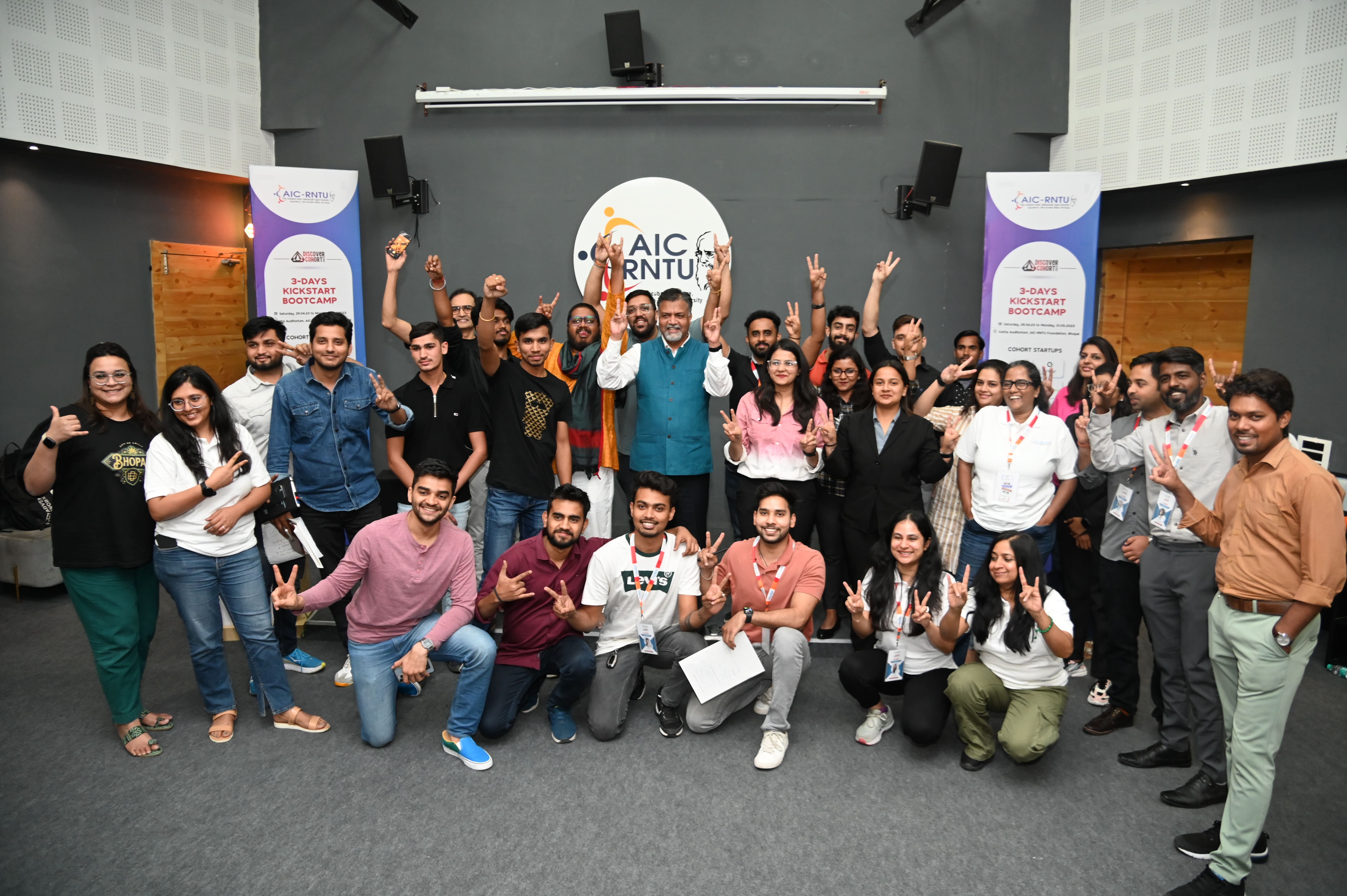
The archived Discover 2023 cohort makes the workload tangible. It combines a three-day physical component with virtual workshops, specialist one-to-one mentoring and a week devoted to financial preparation, including deal documents and financial models. A demo day concludes the process. Eligibility called for a registered company, completed MVP and early traction. Even before selection, those requirements tell a founder what homework comes first.
10 weeks
13 weeks
12 weeks
Recurring
Choose by stage. These are separate offers, not an automatic progression.
The useful work happens before the cheque
Founder testimonials offer a glimpse of the problem this structure addresses. Antar founder Himaksh Kashyap, describing his Discover 2023 experience on the foundation’s website, says, “I was blank about a lot of stuff”. He credits the team with helping through the process and reports subsequently receiving Startup India funding.
It is a modest admission with more explanatory power than a victory slogan. A first-time entrepreneur can understand the product and still struggle with the sequence: incorporation, applications, financial assumptions, introductions. The incubator supplies people who have seen those steps before. These are testimonials selected by the organisation, but they make the service easier to picture.
The portfolio also stretches across quite different businesses. The foundation features Wrixte Infosec, Ingnious AI, Medyseva and ALANNA among its founder accounts. The common need is business-building support. A sector-agnostic front door can accommodate that variety, while specialist mentors and narrower funding programs deal with the technical differences.

Follow the rupees, carefully
Money enters this story through several doors. There is support awarded to startups, the maximum available under a scheme, and what a participant pays for a particular service. Mixing them produces impressive-looking nonsense. AIC RNTU’s nonprofit incubation model brings together university infrastructure, government programs and institutional partners; its funded-startups page also identifies HDFC Bank Parivartan SmartUp Grant beneficiaries.
The university’s innovation disclosure provides concrete examples of startup support: ₹35 lakh for Wrixte Infosec in 2023-24, ₹30 lakh for Zygnos Technologies in 2024-25 and ₹25 lakh for Garudalytics in 2024-25, each naming AIC-RNTU as the funding organisation. These are reported awards to ventures. They should not be read as revenue earned or capital raised by the foundation.
Participant costs are program-specific. SHEvolution’s 2026 page says applicable legal, intellectual-property and company-registration costs are charged at actuals. IGNITE, its school entrepreneurship course, lists ₹5,999 plus GST for an individual, with an advertised ₹3,999 plus GST early-bird offer for the first hundred enrolments. A program’s published terms are the place to start a budget.
A prototype needs somewhere to prove itself
GENESIS shows how targeted the support can become. The entrepreneur-in-residence component offers eligible innovators assistance up to ₹10 lakh, with milestone-based funding in two tranches. Its focus includes electronics, deeptech products and information and communications technology. Applicants must meet conditions around stage, previous support and physical incubation; the scheme specifically addresses ventures from or operating in Tier-II and Tier-III cities.
The Pilot component tackles a later problem: demonstrating a market-ready solution with a customer. Its page advertises support up to ₹40 lakh and requires an eligible corporate, public-sector undertaking or unicorn work order or purchase order. A working prototype, full-time founder and qualifying company structure also form part of the criteria.
That customer document is the telling detail. It makes the proposed deployment testable. Screening includes validating the order, followed by central review and approvals, with a tripartite agreement involving startup, incubator and corporate. For founders, the lesson is to work backwards from what a program actually funds. A pitch deck alone will not satisfy a requirement for a committed pilot partner.
Starting before the company exists
SHEvolution widens the entrance. Its 2026 cohort accepts women entrepreneurs, students, researchers and other early-stage founders without requiring a registered company. The ten-week schedule begins with the problem and customer, then moves through validation, market research, technology, finance, compliance and pitching. The timetable lists August 10 for orientation and kickoff; applications are marked closed.
One participant account captures the value of being able to revise an idea in company. “The sessions helped us improvise and course correct,” says Arshita Setia of Earthy Promise Consumer Brands in a testimonial on the program page. The curriculum offers a plausible mechanism for that correction: customer discovery before polishing the pitch. Founders get occasions to question assumptions while the business is still taking shape.
“The sessions helped us improvise and course correct.”Arshita Setia · Earthy Promise Consumer Brands
SHEvolution participant testimonial
IGNITE begins earlier still, with students in grades 8 to 12. Its six-week online course uses twelve live sessions and weekly outputs that accumulate into a pitch deck. Students work through problem discovery, customer research, branding, business models and finance. The 2026 schedule places teaching from August 7 to September 12, followed by final-document submission on September 20. The humble customer interview gets a place alongside the competition.
The next useful step
AIC RNTU operates in a market that includes local alternatives such as B-Nest and university incubators, alongside national entrepreneurship institutions. Its distinctive combination is a campus base near Bhopal, multiple entry stages and access to public funding routes. A founder choosing among incubators should compare the relevant mentor, facility or scheme with the work immediately ahead.
Events add another layer. Navonmesh, presented by Scope Global Skills University and powered by AIC-RNTU, gathers entrepreneurship and innovation activity in a festival setting. A documented 2022 KHOJ-Bharat Startup Yatra event with Venture Catalysts illustrates the same outward-facing function: bringing startups, investors and local ecosystem participants together. Introductions are part of the service, not the whole product.
The practical lesson is easy to borrow. Name the next obstacle, find the program designed for it, and leave with a deliverable: customer evidence, an MVP plan, a financial model or a pilot agreement. Eligibility will rule out some routes; a mentor introduction cannot substitute for demand. For a founder who can use its particular mix of facilities, instruction and funding access, AIC RNTU offers a place to make that next piece of work happen.