A paper mill is an unexpectedly good place to begin a startup story. It has raw materials, demanding processes and streams of leftovers. For a founder working on sustainable materials, that is a useful brief. AIC-JKLU, the incubator at JK Lakshmipat University outside Jaipur, has made that connection explicit through an accelerator with JK Paper. The invitation is to tackle industrial problems with products that could have a reason to exist before anyone polishes the pitch.
The partnership is the most revealing part of a broader operation. AIC-JKLU helps entrepreneurs develop prototypes, sharpen business plans, find mentors and approach funding networks. Its programs stretch from rural energy to eldercare. But the paper-industry connection gives those familiar incubator promises a physical setting: a manufacturing process, an available material, a potential user. A good question for any startup is what it can do with the resources already around it.
A factory writes the brief
The sustainable biomaterials accelerator sets out two challenges. One seeks valuable products made from lignocellulosic biomass that could replace fossil-derived materials, using raw materials available in India. The other asks what useful products could come from the inputs, side streams and waste streams of existing hardwood and Kraft-pulping operations. Healthcare, textiles, packaging and energy appear among the possible applications. The specificity matters. “Sustainability” alone is a very large assignment; a defined industrial stream is something a technical team can investigate.
Announced publicly in July 2023, the JK Paper partnership offered national and international startups a route to work on the paper industry’s product and process problems. Reporting on the launch described potential investment or acquisition opportunities within JK Organisation. That makes the corporate partner more than a name on an event backdrop. The structure brings a company with operating problems into the same conversation as people proposing solutions, although an introduction is only the beginning of a commercial relationship.
An editorial map of the accelerator’s two problem statements. These are development routes, not reported commercial outcomes.
Fermentech Labs supplies a participant’s view. In a public announcement, it said it had joined a cohort of seven startups from five countries, selected from more than 250 applications worldwide. The company linked the program’s biomass and bio-based-product focus to its own work with bioreactors and biocatalysts. Those numbers describe that reported cohort, not every AIC-JKLU intake. They also show how a campus incubator in Rajasthan can recruit around a specific technical problem beyond its immediate geography.
A university, with the doors open to founders
AIC-JKLU Foundation was incorporated on September 20, 2018. The university dates the centre’s establishment to 2019, with support from Atal Innovation Mission, NITI Aayog and JKLU. Its origins are institutional: a university host and a public entrepreneurship initiative. AIM describes a remit extending beyond Rajasthan through virtual incubation, while identifying energy and eldercare as focus sectors. A founder does not have to read the campus address as an instruction to enroll for a degree.
JKLU reports more than 200 startups supported over six years and over ₹6 crore raised by incubated startups. Its facilities include access to more than 33 design, engineering and computing labs, alongside a reported network of more than 45 mentors and 35 partners. Those are measures of access and cumulative activity. Their practical value depends on whether a particular founder can use the right equipment, reach the right expert and complete a useful experiment.
The institutional economics are substantial. JKLU’s self-study report records a five-year establishment grant totaling ₹9,95,47,000 from NITI Aayog. The founding agreement also assigns the host responsibility for providing at least 10,000 square feet of built space. A laboratory-equipped incubator needs rooms, equipment and people before its first founder arrives. The replicable idea is to share that infrastructure; copying the institution itself requires resources on a different scale from renting a few desks.
Nine months, and a weekly nudge
The sector-agnostic incubation program describes a nine-month cycle for entrepreneurs at the prototype or scaling stage. Its services include business-plan development, technical help, product development, mentor matching, networking and legal or accounting support. Selection proceeds through application review, a discussion with shortlisted applicants, approval and an agreement. This is a program with admission decisions and a working relationship attached, rather than an open invitation to occupy a spare chair.
The website’s phrase “Aggressive weekly follow-ups” is unusually candid. Incubation can sound airy until somebody asks what happened since last Tuesday. Weekly check-ins make sense when they connect a founder to a concrete task: changing a prototype, testing a price or resolving a registration problem. The useful thing to copy is the short interval between advice and another look at the work. A meeting becomes valuable when the next version of the product is different.
“Aggressive weekly follow-ups”AIC-JKLU’s description of its support model
The current offer also leaves room for founders who are earlier in the process. A September 2026 LinkedIn announcement promotes pre-incubation for students, researchers and aspiring entrepreneurs, without requiring an already registered company. It includes idea validation, prototyping, intellectual-property guidance and registration support. That gives an unincorporated team a different entry point from a startup seeking help to scale an existing product.
The money comes with different labels
The funding menu deserves a slow read. JKLU lists Startup India Seed Fund support of up to ₹20 lakh as a prototype-stage grant and up to ₹50 lakh through OCD or CCD instruments for growth-stage startups. These are optionally or compulsorily convertible debentures. It also describes AIM equity co-investment matching another investor up to ₹12.5 lakh. The amounts are program limits, with different conditions and structures; admission to incubation does not turn them into an automatic payment.
Published scheme limits, not awards to every startup. Bar lengths compare rupee amounts; instruments and eligibility differ.
There are concrete grant records alongside those advertised pathways. A university newsletter records a ₹25 lakh HDFC SmartUp Parivartan grant sanction on December 23, 2021, to support startups. Separately, a 2022 report identifies incubated renewable-energy manufacturer Maini Renewables as selected for a ₹21.25 lakh Parivartan SmartUp grant. The distinction between funding the support institution and funding a venture matters. Neither amount is evidence of the incubator’s sales or of a founder’s eventual commercial success.
The business model combines a nonprofit foundation, institutional facilities, public support, corporate programs and service charges. LEAP’s published terms mention a nominal monthly charge for the first nine months and a utilization charge of ₹3,000 plus tax per person after that period. The same page describes six-month incubation. A founder comparing costs should get the applicable duration and charges into the agreement, along with the facilities included. Time in a lab and time in a coworking seat can have very different value.
Energy in the village, independence at home
RISE, short for Rural India Solution for Energy, organizes incubation around rural energy needs. Its offer includes renewable-energy mentoring, prototyping facilities and connections with NGOs, village panchayats and rural distributors. The program names solar, wind and bio-energy among its interests. The underlying commercial question extends beyond whether a device works: who will install it, distribute it and keep it useful in the place it is meant to serve?
AgriVijay’s 2024 product catalogue lists its Rajasthan branch at AIC-JKLU, providing one tangible example of the centre appearing in a venture’s operating footprint. It is a modest but telling detail. An incubator’s role can include a working address and local presence as well as workshops. For an energy business trying to reach customers across regions, those practical arrangements belong in the same conversation as technology development.
LEAP approaches another set of users: older people. The current Longevity Economy Accelerator Program targets registered ventures with at least a minimum viable product and an eldercare or agetech application. It offers customer-development and proof-of-concept support, research access and professional services. JKLU’s late-2022 newsletter records Ripple Healthcare and Dingole joining an earlier nine-month LEAP cohort. A named participant and a dated intake tell a more useful story than treating every program description as timeless.
At Aarohan, the audience can buy
The campus’s public face comes into view at Aarohan. The university’s account of its 2025 summit describes student ventures displaying prototypes, selling products and collecting customer feedback. CrowdVenture added live pitches, while the event brought in more than 300 students from outside JKLU. Former Tata Sons director R Gopalakrishnan delivered the opening keynote. The format mixed a conventional conference with opportunities for entrepreneurs to discover how strangers responded to what they had made.
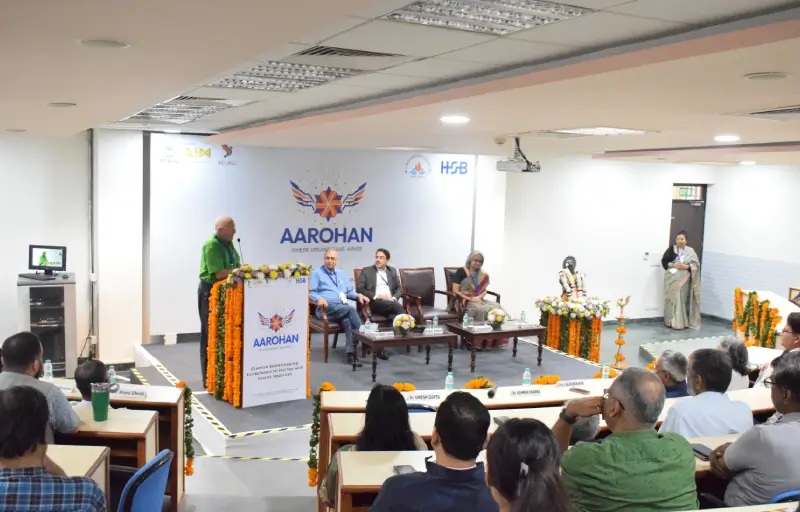
That encounter is where a useful change of mind can begin. An incubator can schedule mentoring; a customer decides whether to care. A founder copying the event’s practical component could arrange a small selling session, record objections and return with a changed offer. The point is to create a test with consequences for the product. A polite round of applause is pleasant, but it supplies very little direction for Monday morning.
Bring a problem that fits the place
AIC-JKLU sits between university infrastructure, public startup support and corporate innovation. Founders can compare it with other academic incubators, independent accelerators or ordinary coworking space by asking which resource their next milestone actually needs. A materials venture may value an industrial problem and technical facilities. An eldercare team may need access to users and validation. A company with an established product and no need for those resources could find a structured incubation cycle an awkward fit.
The strongest lesson is the sequence visible in the JK Paper collaboration: specify the industrial problem, identify relevant expertise, then invite founders to work on it. That sequence depends on a partner willing to engage and a startup able to test a relevant solution. Without those conditions, the connection loses much of its value. For the right founder, however, a paper mill’s leftovers can be a better starting point than a blank slide.