A founder can spend years trying to get into the right room. Ahmed “Eddie” Qureshi has been learning what to do once he gets there. The Rainfall Health founder and CEO has worked in university research, helped start a company, handled corporate partnerships and returned to Arkansas to meet investors. His career makes a useful case for a less glamorous entrepreneurial skill: paying attention to the person on the other side of the table.
There is a temptation to tell this sort of story backward, beginning with the financing announcement and giving every earlier decision the appearance of inevitability. Qureshi’s path resists that treatment. There are changes of discipline, changes of company and a change of name. There is a scientific education that leads into business development. And there is Arkansas, which keeps turning up in a career based in the San Francisco Bay Area.
Nine cities before the founder story
Qureshi immigrated to the United States with his family. In a 2023 Foreign Founders conversation, he discussed a childhood that involved moving with his parents and siblings to nine different cities. That is a considerable collection of introductions before anyone has handed you a business card. His family’s journey and entrepreneurial background were part of the conversation, years before his company’s latest financing.
Arkansas became an enduring connection. He has spoken about settling there with his family, and he continues to have ties to the state. Seattle and the Bay Area belong in the account, too. His ties to all three places would continue into his working life, connecting his education, employers and eventual company.
A scientist with accounting on the timetable
At the University of Washington, Qureshi earned a bachelor’s degree in biochemistry. His interests extended beyond the expected laboratory subjects: his educational profile lists accounting, philosophy and sociology alongside biochemistry and organic chemistry. He also participated in University of Washington Leaders. It is an appealing assortment for someone who would eventually have to understand both a technical proposition and the people expected to buy it.
His research work included the Seelig Lab and the university’s electrical engineering department. The career chronology places him in the lab from 2013 to 2015 and in an electrical engineering research role from 2015 to 2016. The disciplines were already crossing. A biochemistry degree did not keep his work within a single departmental doorway.
His later public conversations show that this scientific background remained part of his professional life. In 2023, he joined Dirt to Dinner to discuss synthetic biology and its applications in food and agriculture. The discussion included how artificial intelligence might help redesign organisms into products. It is a useful glimpse of Qureshi outside a company pitch: explaining a technical field to listeners whose immediate interests might be crops, materials or the contents of a shopping basket.
The subject suits someone moving between research and commerce. Synthetic biology asks what can be made; a business has to ask who needs it, how it will be produced and what it will cost. Those questions sit close together in Qureshi’s early career. They would remain close even as his work moved toward enterprise software.
The part of a startup that does not wear a lab coat
Qureshi co-founded DNAWorks, a University of Washington spinout. His responsibilities included intellectual property strategy, grant applications and developing an advisory board. These are revealing details. They place him among the documents, relationships and resources that turn a research project into an organization. The founding title came with work that rarely makes an exciting photograph.
The chronology puts DNAWorks in 2015 and 2016, followed by business development at Zymergen in 2016 and 2017. At Tierra Biosciences, where he worked from 2017 to 2019, he became head of business development and operations. The sequence matters more than the titles alone: he had experience starting a venture, then worked on growing and running organizations that already had teams and technology.
At Tierra, he managed corporate partnerships, including relationships with Fortune 500 companies, alongside internal operations. The two responsibilities bring different tests. An external partner wants a reason to commit; an internal team needs a workable arrangement once the commitment has been made. A persuasive promise still has to survive its first encounter with the calendar.
During that period, Qureshi discussed the commercial promise of Tierra’s automated discovery work. He described its discovery engine as “10-100 times cheaper and faster than traditional methods.” That was his claim about Tierra’s process at the time, rather than a measurement of his later company. What stands out is the language: cost, speed and a comparison with the existing method. The technical work arrives with a business argument attached.
- 2015Co-founds DNAWorks
- 2016Business development at Zymergen
- 2017Operations and partnerships at Tierra
- 2019Founds the company now called Rainfall
A company, then a different name
In 2019, Qureshi founded the company now known as Rainfall Health. It previously operated as Valorant Health and adopted the Rainfall name in 2024. His personal website still carries the older name, a small reminder that company histories accumulate in public rather than replacing themselves neatly. The internet is an enthusiastic keeper of yesterday’s stationery.
The company took part in Creative Destruction Lab’s Seattle 2021/22 cohort. That connection puts Qureshi back in the city of his university education, this time through a program for building a business. Later came Fuel Accelerator in Northwest Arkansas. His network was developing through structured programs as well as employers and academic connections.
By 2023, he was a Forbes 30 Under 30 honoree in Social Impact. That recognition is one milestone in the chronology, alongside the less easily packaged work of partnerships and operations. A list can introduce a founder to a wider audience. It cannot conduct the next customer meeting for him.
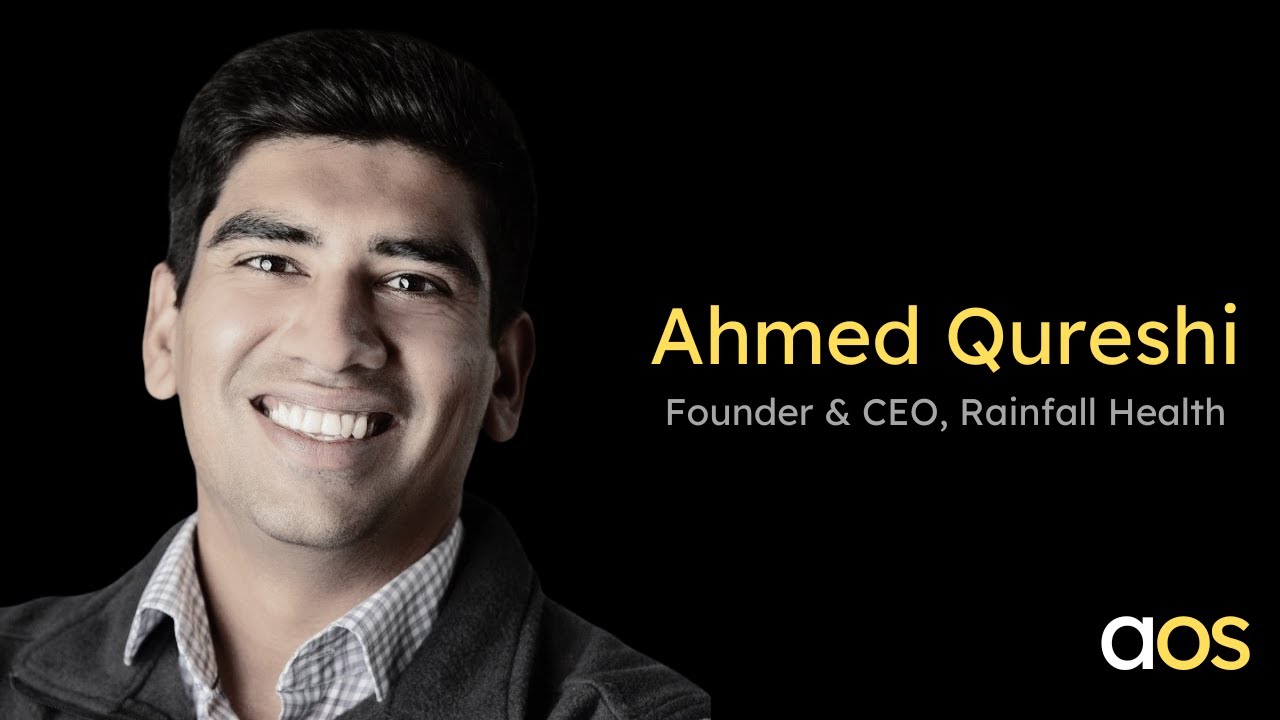
Arkansas gets another meeting
In 2024, Qureshi’s participation in Startup NWA’s VC Immersion Series brought over $600,000 in funding. His involvement with Fuel had also brought mentorship and introductions. For a founder with Bay Area experience, the return to Arkansas added another place to build relationships and seek capital.
His advice from that experience was practical: make the ask clear, understand the investor and remain open to feedback. “Always be prepared to pivot based on feedback,” he said. Read alongside his career, the advice suggests a willingness to revise a proposition after a conversation. It is a modest sentence with an expensive implication: the first version of the plan may need work.
“Always be prepared to pivot based on feedback.”
Eddie Qureshi, 2024
He also brought his experience to a minority entrepreneurship panel at Contra Costa College. The company described him discussing the difficulties and progress of building a business; Qureshi responded that he was honored to be invited. The appearance extends the picture beyond fundraising. Here was a founder explaining the process to a college audience, where the useful material includes the awkward stretches as well as the milestones.
The buyer has a shorter list
By October 2026, Qureshi was making a pointed argument about selling AI. In a conversation with Paul Uhrig on Open Door Salon, he said executives have room for only two or three priorities. A product has to address one of those priorities to earn their attention. Technical sophistication alone does not create a place on the agenda.
He reported that his average sales cycle was running below three weeks, crediting a tightly defined problem and demonstrable return. That is his account of Rainfall’s sales experience, rather than an independently audited result. It nevertheless makes his commercial reasoning clear. Define the need precisely enough that the buyer can connect the purchase to work already demanding attention.
The discussion also included his decision to narrow the company’s focus years before the opportunity fully arrived. “We bet everything on it three years before we knew it was going to see the light of day,” he said. The remark gives the polished sales argument some history. Focus can look sensible once a market is ready. Committing resources earlier requires living with the possibility that the timing will disappoint.
What the next cheque has to pay for
Rainfall announced a $15 million Series A on February 18, 2026, led by Two Bear Capital. The stated uses included expanding its AI and customer support teams. For Qureshi, the announcement marked another transition in the work of running a company: more capital to allocate, more people to bring in and more expectations to meet.
The support-team detail deserves its place beside the AI investment. Software needs people who can help customers use it. That requirement connects the current business to Qureshi’s earlier operations roles, where a partnership had to function after the agreement. Raising money enlarges the capacity to do that work. It also enlarges the obligation.
There is a coherent career here without pretending it was prearranged: research, founding, partnerships, operations, then a company whose chief executive talks about the buyer’s crowded agenda. Qureshi has worked on both the proposition and the organization required to deliver it. His next chapter will be written through the same unceremonious activities that fill the earlier ones: hiring, listening, choosing a direction and making the next meeting useful.