Consider the hamburger patty after the cooking is already done. It arrives frozen, its weight decided, its grill marks in place. To the person eating it, this is lunch. To the person running the kitchen, it is a collection of jobs that somebody else has already finished. AdvancePierre Foods built its business around that second customer.
- Factory preparation moves work out of busy kitchens.
- A 2010 merger joined sandwiches, proteins and retail products.
- Tyson bought the business in 2017 for about $4.2 billion, including debt.
The company’s name rarely needed to be the name above the door. Its food went through distributors, schools, convenience stores and retailers. In 2016, it generated roughly $1.6 billion in sales. When Tyson completed its acquisition the following June, AdvancePierre employed approximately 4,500 people. There was considerable machinery behind an ordinary sandwich.
The kitchen buys the minutes
AdvancePierre manufactured ready-to-eat sandwiches, sandwich components, entrées and snacks. Breakfast biscuits, hamburgers, Philly steaks, stuffed chicken and peanut butter and jelly belonged to the same commercial proposition: give an operator something useful that requires less preparation at the point of service. The business sold food, with convenience built into the product.
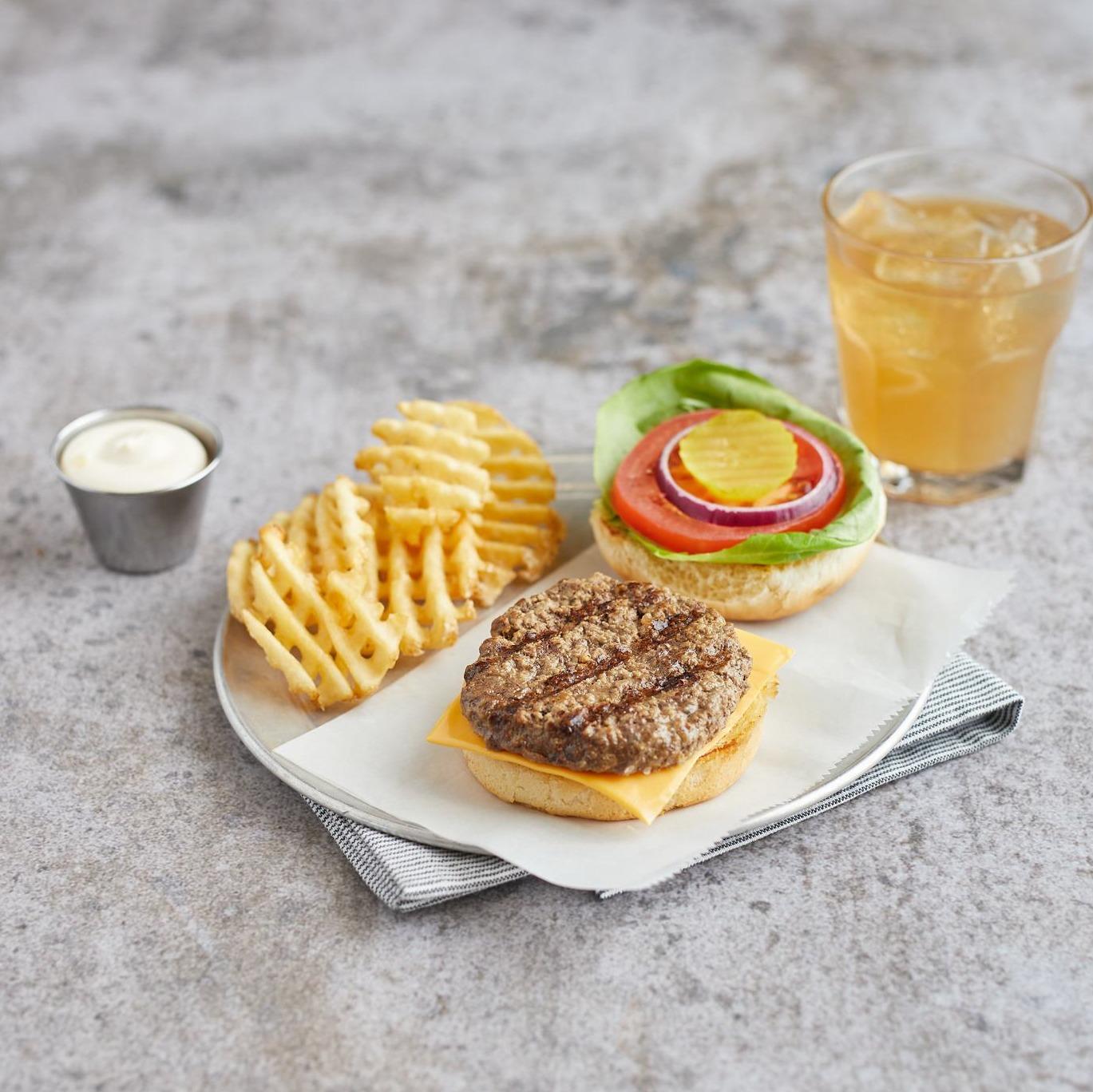
A current Tyson Foodservice listing makes the proposition tangible. AdvancePierre’s three-ounce flame-grilled beef patties are fully cooked, frozen and intended for easy oven preparation. The factory has absorbed part of the kitchen’s workload. Operators still choose the accompaniments, manage service and follow the product’s handling instructions.
The buyer could be several steps away from the eater. Sysco, US Foods and Walmart, including Sam’s Club, accounted for 13.7%, 12.3% and 10.8% of 2016 sales respectively. Those relationships gave AdvancePierre access to many smaller kitchens and shopping baskets. They also created exposure to powerful customers. The company’s annual filing described competition from specialists including CTI Foods, Devault Foods, Lopez Foods and JTM Food Group. Breadth, customization and dependable supply mattered alongside price.
The balance sheet broke first
This system had an untidy prehistory. Pierre Foods, the Cincinnati predecessor founded in 1946, entered bankruptcy in 2008. Bill Toler, who arrived that December, later described it as “a great company with a bad balance sheet.” His diagnosis was specific: a 2007 acquisition had never been fully integrated, then raw-material prices ran upward.
“a great company with a bad balance sheet.”
Bill Toler, on Pierre Foods · 2011
The response involved decisions that sound obvious until someone has to make them. Management dropped businesses and products that did not earn enough, raised prices to reflect commodity costs and pursued factory productivity. In Toler’s account of the turnaround, the first year after bankruptcy produced a record result. Demand alone had not protected the company; the economics of serving that demand needed repair.
In September 2010, Pierre combined with Advance Food Company and Advance Brands. Advance’s roots lay in Enid, Oklahoma, where Paul Allen and David McLaughlin started the business in 1973. Advance Brands had followed in 2001. The resulting company brought different product and channel strengths together. Its history spans decades, although AdvancePierre itself took shape in that merger.
A conceptual view of the capabilities, not a production-flow specification.
A bun is a piece of engineering
One revealing detail is the bread. A sandwich intended for reheating has to work after storage and a trip through a microwave. AdvancePierre’s product developers treated the bun as part of the problem. In a 2013 account, the R&D team used a microwaveable bun developed for other channels in a self-service convenience-store sandwich bar.
The prompt came from competition. Customers were gravitating toward hot-dog roller grills, hurting the handheld foods AdvancePierre supplied. Its response involved a retail collaborator and an equipment manufacturer, with testing and adjustments before launch. The episode shows how product development could extend into equipment and the store’s selling space. A better recipe was only one possible answer.
Packaging carried some of the work, too. In 2015, three Pierre Signatures sandwiches arrived in clear, hand-wrapped packs, allowing customers to inspect what they were buying. The launch specified a 14-day refrigerated shelf life and nine months frozen. Those were specifications for those sandwiches, rather than a promise covering the entire catalog.
Acquisitions added capabilities around the food. Landshire’s wholesale and production operations brought sliced-meat sandwiches, baking and assembly in 2015; Better Bakery added stuffed sandwiches that April. By then, management was also using its APF Way program to rethink pricing, budgeting and procurement. The company reported approximately $155 million in implemented annualized savings from 2013 through October 1, 2016, while eliminating roughly the same amount of lower-margin sales.
The efficiency came with human costs. After acquiring Barber Foods, AdvancePierre shifted fully cooked production to Enid and closed the Portland oven, laying off 232 workers. The same 2013 account reported a planned $10 million investment over two years in renovations and equipment there. Integration meant deciding which plant did which work, with consequences for the people whose jobs had been attached to the old arrangement.
The price of doing less in the kitchen
Tyson paid $40.25 per share. Its announced transaction value included approximately $3.2 billion of equity and $1.1 billion of assumed debt, with the total rounded to $4.2 billion. Tyson projected $200 million in cost synergies within three years through manufacturing, procurement, distribution and overhead changes. A forecast is different from an achieved saving.
$200m projected cost synergies within three years. A target announced by Tyson.
The transferable lesson is practical: identify work the customer repeatedly struggles to finish, then design the product around removing it. That requires knowing the customer’s equipment, storage and service constraints. Prepared food makes less sense when a kitchen’s identity depends on its own preparation, or when frozen inventory and handling requirements outweigh the labor saved. Raw products still require cooking; fully cooked does not remove food-safety responsibilities.
For operators, the details can be more consequential than the corporate story. A 2016 Pierre burger packaging update specified a refrigerated cold case or vending machine, a 14-day refrigerated shelf life and twelve sandwiches per case. That defines a small inventory decision: how many units a location can sell before time runs out. Buying convenience still demands an estimate of demand. The operator supplies the judgment that the factory cannot package. A sandwich saves preparation only if the operator can store, sell and serve it within the intended conditions.
Today, AdvancePierre appears inside Tyson’s portfolio, and its products remain in the foodservice catalog. The public-company chapter ended in 2017. The operating question continues at every lunch service: how much work can happen before the order arrives? AdvancePierre’s answer was tucked inside the bun.