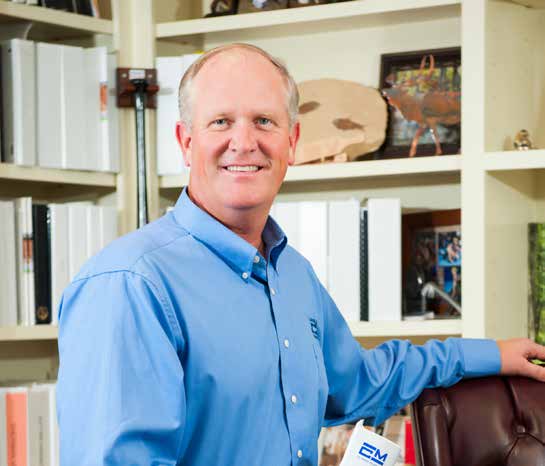
A summer internship is meant to settle a small question: could you imagine doing this for a living? Sherman Miller answered in 1996. Thirty years later, he is still at Cal-Maine Foods, although the job has acquired a few additional responsibilities. The student who went to work in Edwards, Mississippi, is now president and chief executive. Breakfast has kept him occupied.
The interesting part of that journey lies between the two titles. Miller learned the business through processing plants and operating jobs, moving through Mississippi, Utah and Kansas before returning to corporate leadership. His career accumulated geography before it accumulated authority. When Cal-Maine appointed him CEO in September 2022, he had already spent more than a quarter-century inside the company.
Today he is applying that experience to a different question. How does an egg producer build a business whose results depend less heavily on the price of an egg? His answer includes wraps, pancakes, waffles and prepared egg products. For someone who has spent his working life with one employer, Miller is overseeing a considerable change in what that employer makes.
A cattle farm, then a different kind of agriculture
Miller grew up in Ethel, Mississippi, helping raise cattle on his family’s farm. He attended Holmes Community College before Mississippi State University, where he graduated summa cum laude with a poultry-science degree in 1997. Agriculture supplied the setting of his childhood; education helped him choose his particular corner of it.
He has credited a meeting with poultry-science adviser Tim Chamblee as a consequential moment. Chamblee told him the industry had jobs waiting for graduates. It was a practical invitation, with a destination attached. Miller’s subsequent career gives that conversation an unusually long afterlife.
“I personally love the poultry industry.”
Sherman Miller · 2018
The remark is refreshingly direct. He has also encouraged students to try summer internships and discover which part of the industry suits them. His own experience supplied a persuasive example. A few months inside a company gave him enough reason to return, and enough interest to stay through successive changes in responsibility.
Mississippi State later recognized him as a Distinguished Fellow for its Department of Poultry Science. His connections with the field have included service on the department’s advisory board and industry organizations. The university that helped introduce him to the work remained part of his professional world.
Three states before the corner office
His early Cal-Maine assignments included management positions at processing locations in Edwards, Mississippi; Delta, Utah; and Chase, Kansas. He became general manager at Chase and later worked from that office as vice president of operations. These were jobs in the part of the business where plans meet production schedules.
By 2007 he was vice president of operations. In 2011 he became chief operating officer, returning to Mississippi with responsibility for Cal-Maine’s production and processing facilities. A board seat followed in 2012. The sequence describes a steady enlargement of the same assignment: understand how the company works, then take responsibility for more of it.
Edwards, Mississippi
officer
president
officer
When Cal-Maine named him president in March 2018, he added executive duties while retaining oversight of production and processing. He continued reporting to Dolph Baker, the chairman and CEO. The promotion placed someone with experience across the operating network closer to decisions about the whole enterprise.
Four years later, the board chose Miller to succeed Baker as chief executive, effective September 30, 2022. Baker stayed chairman and remained involved in strategy, capital allocation and advising management. The handover preserved a working relationship built over years. Miller described Baker as “a tremendous leader and mentor.”
The company’s current description of Miller’s responsibilities includes long-term growth strategy and stakeholder engagement. Earlier duties covered commodity sourcing, procurement and distribution logistics. That range helps explain the demands of the position. An egg company needs someone to think about tomorrow’s investment while today’s product continues moving.
His earlier remit also included procurement and distribution logistics. These responsibilities connect decisions that can look separate from outside the business: what to buy, where to process it and how to get the finished product to a customer. A shortage or extra cost in one place can change the calculation somewhere else. For Miller, the move into the chief executive’s office followed years of work across those connections. The broader strategy still depends on people making thousands of smaller operating decisions.
There are lighter reminders of the occupation, too. In a 2025 interview, egg statues sat near Miller’s desk, with an American flag above his computer. A career can leave its mark on office decor. His appears to have done so with admirable consistency.
Breakfast grows beyond the carton
The strategy taking shape under Miller extends further into foods made with eggs and other breakfast products. In September 2024, Cal-Maine invested approximately $6.75 million for a 51% interest in a new venture with Crepini. The business brought egg wraps, crepes, pancakes and wrap-ups into a wider product portfolio.
The arrangement had a concrete division of contributions. Cal-Maine supplied cash for equipment, other assets and working capital. Crepini contributed its existing business and assets for the remaining interest. The transaction paired an established product business with money to develop its operations. It also gave Miller another route to customers beyond a shell-egg carton.
Then came Echo Lake Foods. Cal-Maine closed that acquisition on June 2, 2025, adding a manufacturer of ready-to-eat egg products and breakfast foods. Its offerings included scrambled eggs, omelets, egg patties, pancakes and waffles. The purchase broadened both the things Cal-Maine could sell and the customers it could serve.
Miller’s explanation emphasized familiar operating considerations: geography, product mix, proximity to customers and expected financial returns. The attraction included opportunities to use the combined companies’ purchasing and distribution capabilities. Buying a breakfast business still required the practical reasoning of someone accustomed to running plants.
A widening breakfast menu
Wraps & crepes2025Echo Lake
Prepared eggs & breakfast foods2026Van’s
Branded frozen breakfast
Selected investments and acquisitions during Miller’s tenure as CEO.
In May 2026, Cal-Maine acquired certain assets of Van’s Foods from Sara Lee Frozen Bakery. The move expanded its presence in branded frozen breakfast products and consumer-facing retail. Van’s was to retain its brand identity, supported by Cal-Maine’s operating platform and distribution network.
The distinction matters for Miller’s task. A familiar consumer brand carries expectations about what arrives in the package. Owning production capacity is one responsibility; keeping that product available across stores and channels adds another. His agenda now reaches from agricultural inputs through manufacturing to a broader set of purchases at breakfast time.
The machinery behind a promise
Growth in prepared foods also brought appointments. In December 2025, Johnathan Zoeller joined as chief financial officer for prepared foods, while Dave Jordan was promoted to president of Echo Lake Foods. Miller put people at the center of the announcement: “Talent is at the center of every chapter of sustained growth.”
The accompanying projects gave that ambition a physical form. Cal-Maine announced a $15 million Echo Lake network and capacity project, with a plan to centralize scrambled-egg manufacturing and add a production line. It also described a previously announced $14.8 million pancake-line project. There is an industrial answer to the question of where breakfast comes from.
Those changes have a cost before they have a payoff. The company warned that work on its facilities would temporarily reduce production volumes and increase costs. A factory undergoing expansion has to manage the awkward interval between the equipment it has and the output it expects. Miller’s operating background meets a very recognizable operating problem.
By July 2026, Cal-Maine had announced a further $54 million prepared-foods investment. It projected that prepared-foods capacity would grow by more than 60% between fiscal 2026 year-end and the first half of fiscal 2028. That was a forecast for what facilities could produce. Customers, utilization and margins would determine what the extra capacity ultimately earned.
The company also changed the way it presented its operations. In the fourth quarter of fiscal 2026, it introduced three reportable segments: conventional shell eggs, specialty shell eggs and prepared foods. The structure reflected how management reviewed results and allocated resources. For Miller, it made the different parts of the strategy separately visible. Investors could look at the results of the newer prepared-foods segment alongside the egg businesses, rather than read only a combined total. A wider menu now came with a more detailed scorecard.
A difficult quarter keeps the score
The financial test remained visible in September 2026. For the first quarter of fiscal 2027, Cal-Maine reported net sales of $539.6 million and a net loss attributable to the company of $58.6 million. Conventional shell-egg prices were under pressure. A wider portfolio had not insulated the whole company from the market.
The changing sales mix
Specialty shell eggs + prepared foods
Specialty shell eggs and prepared foods together represented 54.1% of sales, up from 37.1% a year earlier. A larger share can coexist with difficult underlying results, especially when another category falls sharply. The figures give Miller evidence of a changing business and a clear reminder that changing the mix is only part of the assignment.
His stated ambition is to build more durable earnings through the cycle. That leaves two timetables to manage: the market for conventional eggs and the contribution from investments in prepared foods. He can direct equipment spending, appointments and integration work. The market will keep its own calendar.
The student who accepted an internship in Edwards could test a career over a summer. The executive who now runs Cal-Maine faces a longer experiment. Its outcome will be measured in factories working as intended, customers returning and earnings that hold up across changing prices. After thirty years with the company, Sherman Miller still has a practical question to answer.